


SEMARANG – As a conservation-oriented university, Universitas Negeri Semarang (UNNES) continues to advance scientific research to support environmental management and greenhouse gas emission reduction. One such initiative is a six-year study of the university’s carbon footprint, which identifies major emission sources and provides a scientific basis for developing strategies toward a Net-Zero Campus.
The study, entitled “Six-Year Dynamics of Campus Carbon Footprint at Universitas Negeri Semarang as a Basis for a Net-Zero Campus Strategy,” was published in IOP Conference Series: Earth and Environmental Science, Volume 1671 (2026). The research was conducted by Dr. Muhammad Abdullah, Prof. Nana Kariada Tri Martuti, Teguh Prihanto, Dr. Ananto Aji, Chusna Adzanin Therawati, and Kanokporn Kaewsong through a collaboration between UNNES and Kasetsart University, Thailand.
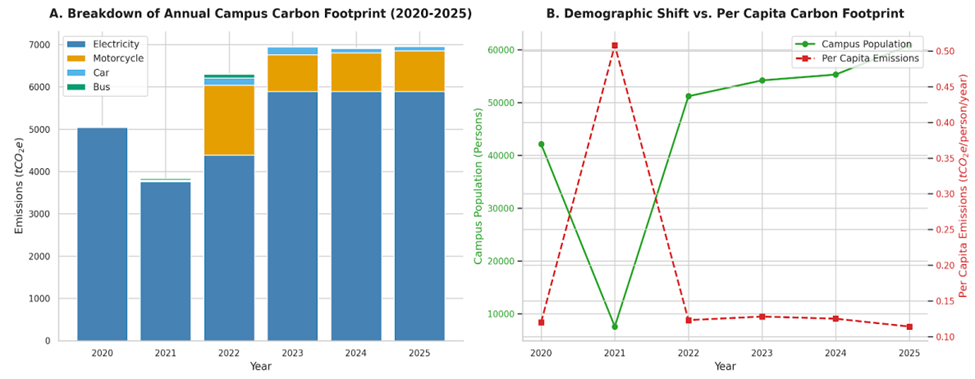
The findings revealed that UNNES’s operational carbon emissions increased by 37.30%, from 5,073.33 tonnes of CO₂ equivalent (CO₂e) in 2020 to 6,965.70 tonnes of CO₂e in 2025. In 2025, electricity consumption accounted for the largest share of emissions at 84.50%, while internal campus transportation contributed 15.50%, primarily from motorcycles. Despite the increase in total emissions, per capita emissions declined from 0.128 tonnes of CO₂e in 2023 to 0.114 tonnes of CO₂e in 2025. The assessment focused on electricity consumption and internal transportation and therefore did not cover all campus emission sources.
The potential for renewable energy development was also examined in a separate study entitled “Eco-Efficiency Analysis of Solar Panel Installation on the West Campus of Universitas Negeri Semarang,” conducted by Prof. Zaenuri and Yogiswara Danurrachman from FMIPA UNNES. Based on data from 2018–2019, the study reported a solar panel investment of USD 158,015.83, with an estimated economic lifespan of 25 years and a reported annual economic efficiency value of USD 694.78. The findings provide preliminary information for evaluating the economic benefits of solar energy utilization on campus.
The positive contributions of both studies include providing a scientific foundation for identifying emission reduction priorities, particularly through electricity efficiency improvements, solar energy development, low-emission transportation, and regular carbon footprint monitoring. These findings can support more measurable and evidence-based university environmental policies. Both studies align with the Sustainable Development Goals (SDGs), particularly SDG 7 (Affordable and Clean Energy) through renewable energy development, SDG 9 (Industry, Innovation and Infrastructure) through more efficient energy infrastructure management, and SDG 13 (Climate Action) through greenhouse gas emission inventories and emission reduction strategies. Through interdisciplinary research and international collaboration, UNNES continues to strengthen its role as a Conservation Campus, advancing evidence-based strategies toward achieving a Net-Zero Campus.