

FMIPA UNNES Develops Ethnomathematics-Based Textbook Inspired by Liyangan Archaeological Site

Universitas Negeri Semarang/Faculty of Mathematics and Natural Sciences/Berita/FMIPA UNNES Develops Ethnomathematics-Based Textbook Inspired by Liyangan Archaeological Site
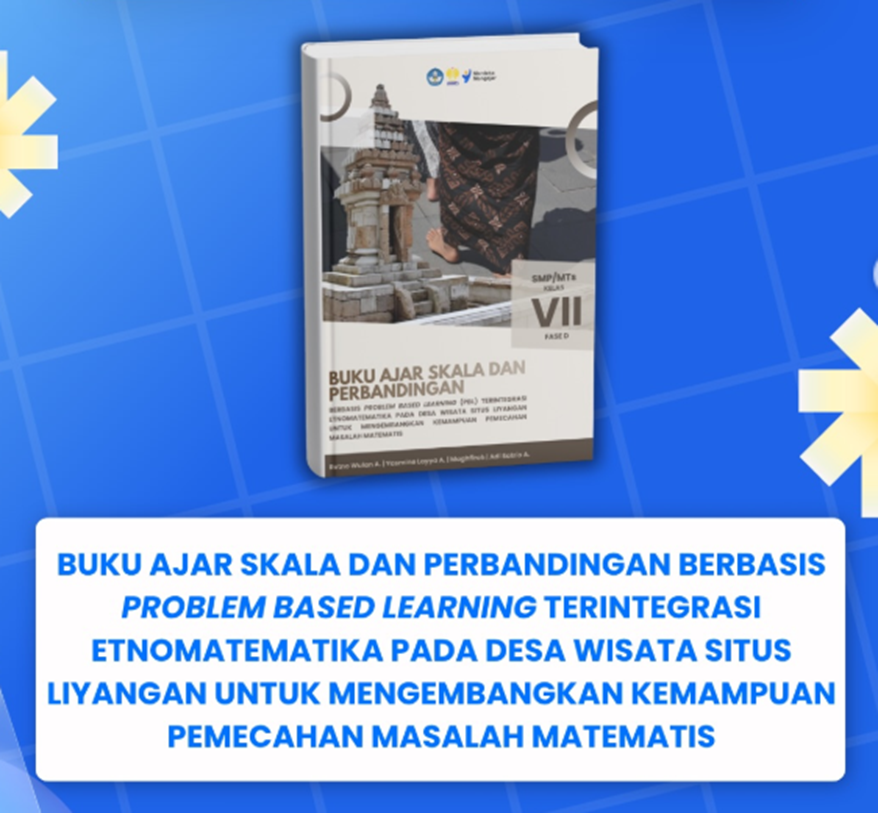
Blue-gradient promotional graphic displaying a 3D mockup of a Grade VII junior high school mathematics textbook featuring a stone shrine from the Liyangan Archaeological Site on its cover, accompanied by a white text box displaying the full book title below.

SEMARANG – The Liyangan Archaeological Site is an ancient archaeological complex dating back to the Mataram Kingdom period, located on the eastern slopes of Mount Sindoro in Liyangan Hamlet, Purbasari Village, Ngadirejo District, Temanggung Regency, Central Java, Indonesia. Discovered in 2008, the site preserves evidence of ancient settlements, ritual activities, and agricultural practices that were buried under volcanic materials from Mount Sindoro. Due to the remarkable preservation of its archaeological remains by volcanic deposits, the site is often referred to as the “Pompeii of Indonesia,” drawing a comparison with the ancient Roman city of Pompeii in Italy, which was buried by the eruption of Mount Vesuvius. This rich historical and cultural heritage has inspired the development of an innovative mathematics learning resource integrating local wisdom.

Building on this potential, students from the Undergraduate Mathematics Education Study Program, Faculty of Mathematics and Natural Sciences, Universitas Negeri Semarang (FMIPA UNNES), have developed a mathematics textbook focusing on scale and proportion through a Problem-Based Learning (PBL) approach integrated with ethnomathematics from the Liyangan Archaeological Tourism Village. This innovation is designed to provide more contextual mathematics learning experiences by incorporating local environmental, historical, and cultural elements.

The textbook was developed by a student team consisting of Retno Wulan Astuti, Yasmine Layya Afifah, Maghfiroh, Habba Arrizal Anas, and Sabrina Riski Astutiningtyas, under the supervision of Adi Satrio Ardiansyah, S.Pd., M.Pd., a lecturer in Mathematics Education at FMIPA UNNES.

During its development, the team explored the historical, environmental, and cultural potential of the Liyangan Archaeological Tourism Village, including local traditions such as Kirab Merti Tirta Amerta Bumi and Sadranan Tuk Tempurung. The findings were subsequently integrated into contextual mathematical problems and learning activities related to scale and proportion.

Through the PBL approach, students are encouraged to understand mathematical concepts by solving problems connected to real-life situations. The integration of ethnomathematics is also expected to help students recognize the relationship between mathematics and local culture while developing critical thinking and mathematical problem-solving skills.

This innovation supports the achievement of the Sustainable Development Goals (SDGs), particularly SDG 4 (Quality Education) through the development of innovative and contextual teaching materials, and SDG 11 (Sustainable Cities and Communities) by promoting awareness and appreciation of historical and cultural heritage through education.

Through the development of an ethnomathematics-based textbook inspired by the Liyangan Archaeological Site, FMIPA UNNES students and their academic supervisor demonstrate their contribution to integrating mathematics education with the preservation of local wisdom. This innovation is expected to serve as an alternative teaching resource that not only supports the development of mathematical problem-solving skills but also fosters students’ appreciation of Indonesia’s rich historical and cultural heritage.
Related Posts

Leave a Reply

* Kode Akses Komentar:

* Tuliskan kode akses komentar diatas:

GDPR

  • Privacy Policy

Privacy Policy

At unnes.ac.id, the privacy of our visitors is of extreme importance to us. This privacy policy document outlines the types of personal information that is received and collected by unnes.ac.id and how it is used.

Log Files

Like many other Web sites, unnes.ac.id makes use of log files. The information inside the log files includes internet protocol (IP) addresses, type of browser, Internet Service Provider (ISP), date/time stamp, referring/exit pages, and number of clicks to analyze trends, administer the site, track user’s movement around the site, and gather demographic information. IP addresses and other such information are not linked to any information that is personally identifiable.

Cookies

unnes.ac.id uses cookies to store information about visitors’ preferences, to record user-specific information on which pages the site visitor accesses or visits, and to personalize or customize our web page content based upon visitors’ browser type or other information that the visitor sends via their browser.

Third-party ad servers or ad networks use technology in their respective advertisements and links that appear on unnes.ac.id and which are sent directly to your browser. They automatically receive your IP address when this occurs. Other technologies (such as cookies, JavaScript, or Web Beacons) may also be used by our site’s third-party ad networks to measure the effectiveness of their advertising campaigns and/or to personalize the advertising content that you see on the site.

unnes.ac.id has no access to or control over these cookies that are used by third-party advertisers.

You should consult the respective privacy policies of these third-party ad servers for more detailed information on their practices as well as for instructions about how to opt-out of certain practices. unnes.ac.id’s privacy policy does not apply to, and we cannot control the activities of, such other advertisers or web sites.

If you wish to disable cookies, you may do so through your individual browser options. More detailed information about cookie management with specific web browsers can be found at the browsers’ respective websites.

Consent

By using our website, you hereby consent to our privacy policy and agree to its terms.

Update

This Privacy Policy was last updated on: 2023-02-14. Should we update, amend or make any changes to our privacy policy, those changes will be posted here.

Contact Us

If you have any questions, comments, or concerns about our Privacy Policy or our practices with regards to your personal information, please feel free to contact us through the contact form on our website or by emailing us at humas[at]mail.unnes.ac.id.

This Privacy Policy is intended as a general guide to our practices in collecting and using information. If there is any inconsistency between this Privacy Policy and the terms of the Service Agreement or any other terms that may apply to specific services you use, then those specific service terms shall apply.

Terms of Use

By using our website, you agree to abide by this Privacy Policy. If you do not agree with this Privacy Policy, please do not use our website. We reserve the right to update this Privacy Policy from time to time without prior notice. Please review our Privacy Policy periodically to check for changes. Your continued use of our website following the posting of changes to this Privacy Policy means that you accept the changes.

Thank you for reading our Privacy Policy. We are committed to protecting the privacy of our website visitors and will continue to update our Privacy Policy to ensure optimal protection.