


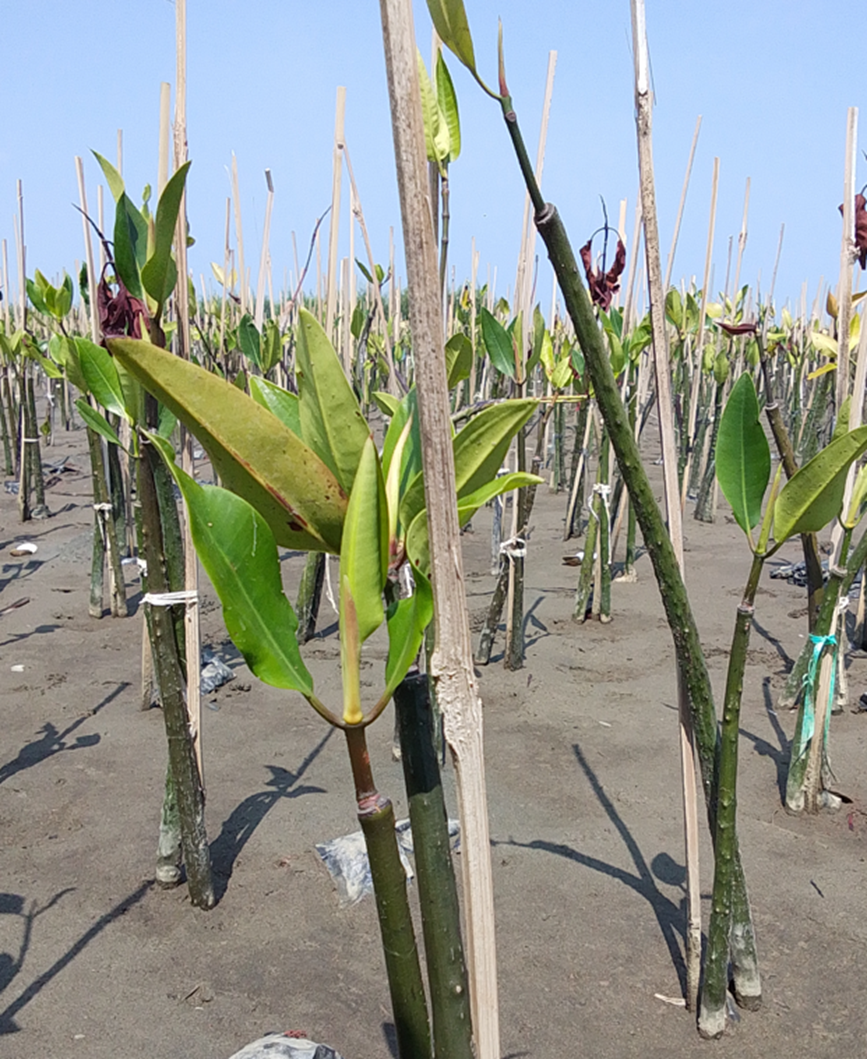
FMIPA UNNES Monitors the Results of Planting 60,000 Mangroves in Coastal Kendal

Universitas Negeri Semarang/Faculty of Mathematics and Natural Sciences/Berita/FMIPA UNNES Monitors the Results of Planting 60,000 Mangroves in Coastal Kendal
Empat anggota tim monitoring FMIPA UNNES berada di lahan berlumpur pesisir di sekitar petak plot bambu berukuran 2 kali 2 meter, dengan satu petugas berrompi kuning membungkuk mengukur bibit mangrove dan tiga mahasiswi berhijab mencatat data pengamatan.

Following the completion of planting 60,000 mangrove seedlings in Pidodokulon Village, Patebon District, Kendal Regency, Central Java, a team from the Faculty of Mathematics and Natural Sciences, Universitas Negeri Semarang (FMIPA UNNES), conducted mangrove monitoring and evaluation on October 31, 2026. This activity was part of the coastal ecosystem rehabilitation monitoring program implemented by PAMA Group and its partners.

The field monitoring was carried out by two FMIPA UNNES lecturers, Abdul Jabbar, M.Ling., and Trida Ridho Fariz, M.Sc., together with students from the Environmental Science Study Program. The activity aimed to evaluate the initial condition of mangroves following the phased planting conducted from August to October 2026. The rehabilitation site is located in the Bodri River Estuary, an estuarine environment characterized by sedimentation dynamics and coastal environmental conditions that influence mangrove growth.

The assessment employed a plot-based sampling method using 2 × 2 meter plots, referring to the FOLU Manual Series: Mangrove Ecosystem Restoration published by the Indonesian Ministry of Environment and Forestry (KLHK) in 2023. Monitoring covered three planting zones, including the identification of surviving and dead individuals and observations of plant conditions during the adaptation phase.

Based on observations of 455 sampled mangrove plants, the initial average survival rate was estimated at 93.41%. If this percentage is extrapolated to the entire population of 60,000 planted mangroves, approximately 56,044 individuals are estimated to have survived, while 3,956 individuals are estimated to have died. However, these figures represent a rough extrapolation, as sampling proportions differed among zones and plant ages varied due to the phased planting schedule.
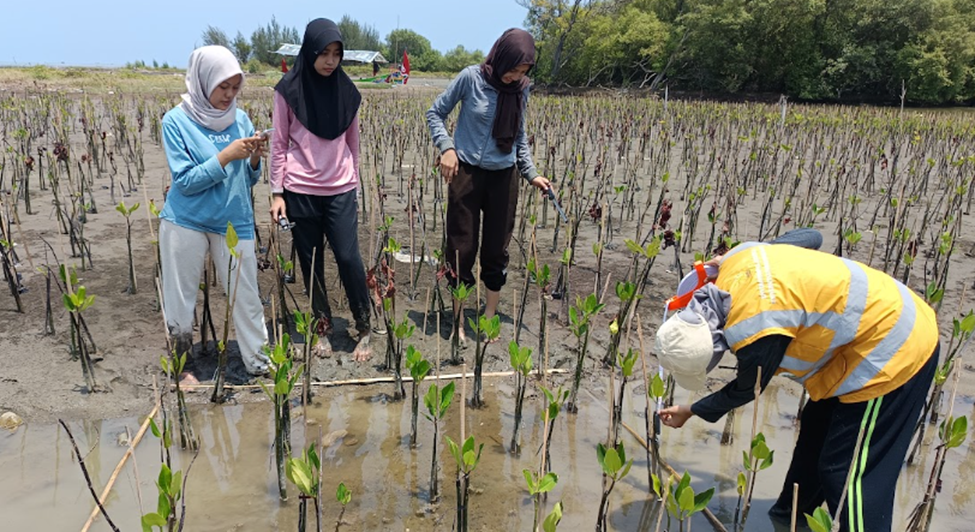
This monitoring activity represents an important step because the success of mangrove rehabilitation depends not only on the number of seedlings planted but also on their ability to survive, grow, and develop into ecologically functional mangrove vegetation. The preliminary findings can serve as a basis for evaluating maintenance needs, replacement planting, and subsequent monitoring activities.

The initiative supports the Sustainable Development Goals (SDGs), particularly SDG 13 (Climate Action) through coastal ecosystem rehabilitation, SDG 14 (Life Below Water) and SDG 15 (Life on Land) through mangrove habitat restoration, and SDG 17 (Partnerships for the Goals) through collaboration among universities, the private sector, and local communities. Through the involvement of FMIPA UNNES lecturers and students in monitoring mangrove rehabilitation in Pidodokulon, the university contributes to providing field-based evaluations that support sustainable coastal ecosystem management. Continued monitoring remains essential to verify mangrove survival rates and assess the long-term success of the rehabilitation program.
Related Posts

Leave a Reply

* Kode Akses Komentar:

* Tuliskan kode akses komentar diatas:

GDPR

  • Privacy Policy

Privacy Policy

At unnes.ac.id, the privacy of our visitors is of extreme importance to us. This privacy policy document outlines the types of personal information that is received and collected by unnes.ac.id and how it is used.

Log Files

Like many other Web sites, unnes.ac.id makes use of log files. The information inside the log files includes internet protocol (IP) addresses, type of browser, Internet Service Provider (ISP), date/time stamp, referring/exit pages, and number of clicks to analyze trends, administer the site, track user’s movement around the site, and gather demographic information. IP addresses and other such information are not linked to any information that is personally identifiable.

Cookies

unnes.ac.id uses cookies to store information about visitors’ preferences, to record user-specific information on which pages the site visitor accesses or visits, and to personalize or customize our web page content based upon visitors’ browser type or other information that the visitor sends via their browser.

Third-party ad servers or ad networks use technology in their respective advertisements and links that appear on unnes.ac.id and which are sent directly to your browser. They automatically receive your IP address when this occurs. Other technologies (such as cookies, JavaScript, or Web Beacons) may also be used by our site’s third-party ad networks to measure the effectiveness of their advertising campaigns and/or to personalize the advertising content that you see on the site.

unnes.ac.id has no access to or control over these cookies that are used by third-party advertisers.

You should consult the respective privacy policies of these third-party ad servers for more detailed information on their practices as well as for instructions about how to opt-out of certain practices. unnes.ac.id’s privacy policy does not apply to, and we cannot control the activities of, such other advertisers or web sites.

If you wish to disable cookies, you may do so through your individual browser options. More detailed information about cookie management with specific web browsers can be found at the browsers’ respective websites.

Consent

By using our website, you hereby consent to our privacy policy and agree to its terms.

Update

This Privacy Policy was last updated on: 2023-02-14. Should we update, amend or make any changes to our privacy policy, those changes will be posted here.

Contact Us

If you have any questions, comments, or concerns about our Privacy Policy or our practices with regards to your personal information, please feel free to contact us through the contact form on our website or by emailing us at humas[at]mail.unnes.ac.id.

This Privacy Policy is intended as a general guide to our practices in collecting and using information. If there is any inconsistency between this Privacy Policy and the terms of the Service Agreement or any other terms that may apply to specific services you use, then those specific service terms shall apply.

Terms of Use

By using our website, you agree to abide by this Privacy Policy. If you do not agree with this Privacy Policy, please do not use our website. We reserve the right to update this Privacy Policy from time to time without prior notice. Please review our Privacy Policy periodically to check for changes. Your continued use of our website following the posting of changes to this Privacy Policy means that you accept the changes.

Thank you for reading our Privacy Policy. We are committed to protecting the privacy of our website visitors and will continue to update our Privacy Policy to ensure optimal protection.