


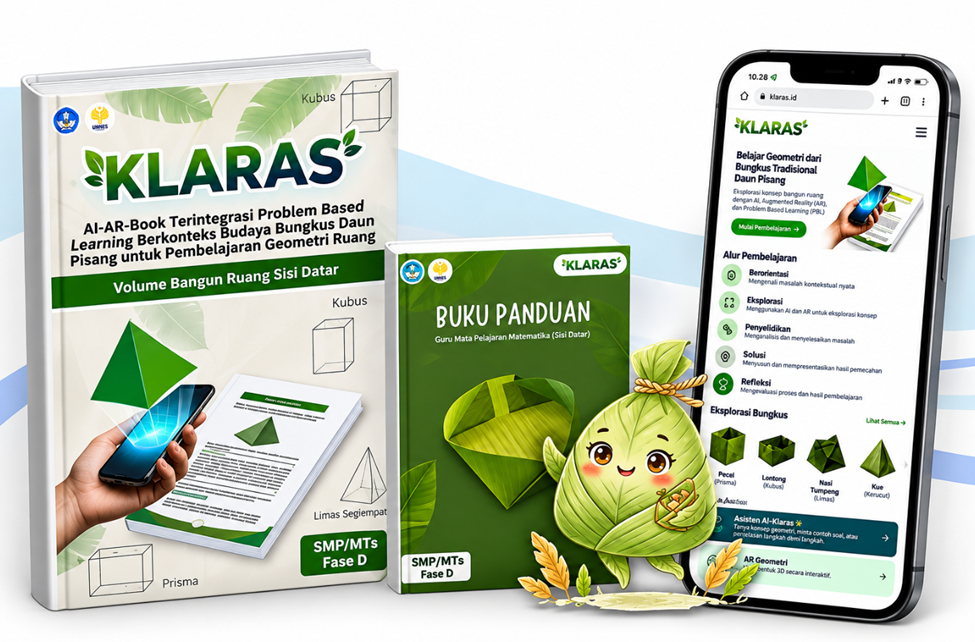
SEMARANG – Students from the Faculty of Mathematics and Natural Sciences, Universitas Negeri Semarang (FMIPA UNNES), in collaboration with Informatics Engineering students, have developed KLARAS (AI-AR-Book), an innovative interactive learning medium that integrates Artificial Intelligence (AI) and Augmented Reality (AR) with a Problem-Based Learning (PBL) approach. This innovation incorporates the traditional practice of wrapping food in banana leaves as a cultural context for learning three-dimensional geometry.
KLARAS was developed by a student team consisting of Septi Anindya Tyasiwi, Fadhilah Aulia, Salsa Bila Titiana, Ihsan Jati Waluyo Budi, and Kinanthi Eka Putri, under the supervision of Adi Satrio Ardiansyah, S.Pd., M.Pd., a lecturer in Mathematics Education at FMIPA UNNES.
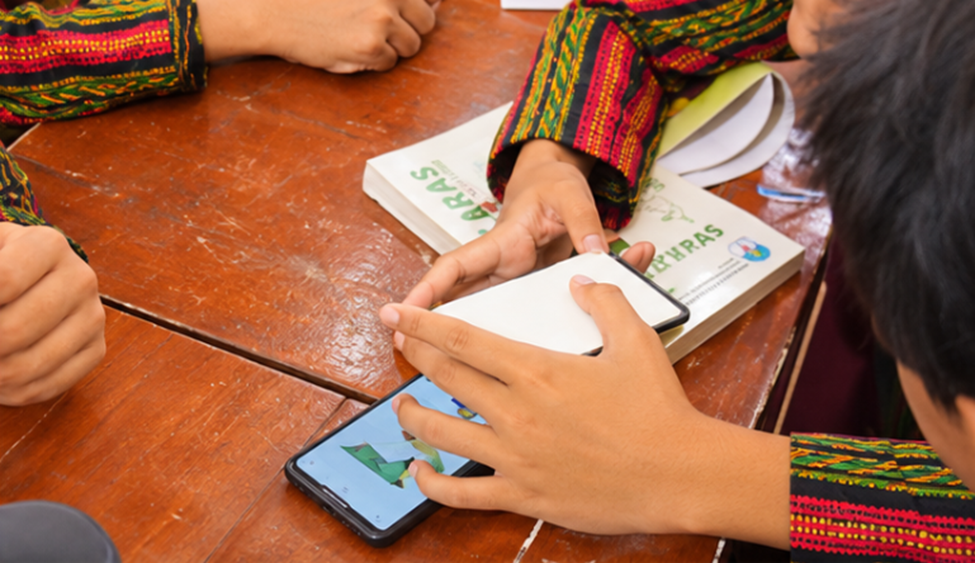
Through KLARAS, three-dimensional geometry concepts are introduced by connecting geometric shapes with the traditional practice of wrapping food in banana leaves. The integration of AI and AR technologies is designed to help students explore geometric objects more interactively, while the PBL approach encourages them to understand mathematical concepts through problem-solving activities related to everyday life.
This innovation is expected to provide several benefits, including improved understanding of three-dimensional geometry, stronger critical thinking and problem-solving skills, and more engaging and contextual learning experiences. Incorporating traditional banana leaf wrapping practices also provides an opportunity to introduce local cultural knowledge to students through technology-enhanced mathematics education.
The development of KLARAS aligns with the Sustainable Development Goals (SDGs), particularly SDG 4 (Quality Education) through the development of innovative and contextual learning media, SDG 9 (Industry, Innovation and Infrastructure) through the application of AI and AR technologies in education, and SDG 11 (Sustainable Cities and Communities) by introducing and preserving local cultural knowledge through educational activities.
Through KLARAS, FMIPA UNNES students and their academic supervisor demonstrate their contribution to developing mathematics education that integrates digital technology, problem-solving, and local cultural wisdom. This innovation is expected to serve as an alternative learning resource that supports educational quality while fostering greater appreciation for Indonesia’s cultural heritage.