


Lecturer from the Federal University of Bahia, Brazil, introduces artificial neural network concepts to hundreds of students at Universitas Negeri Semarang
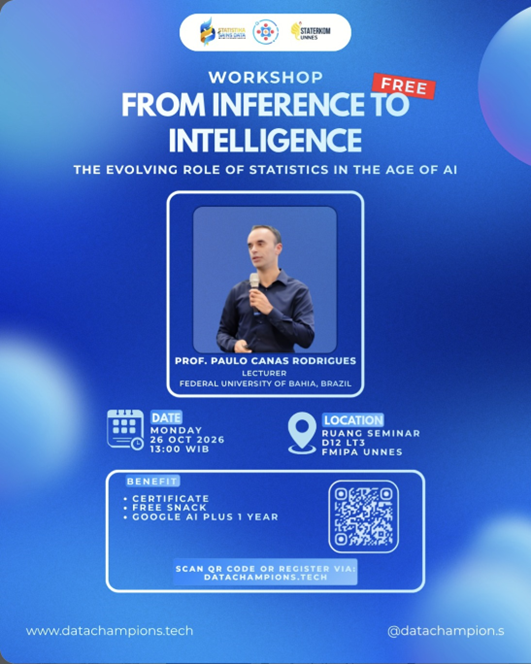
SEMARANG – The rapid advancement of artificial intelligence (AI) demands a stronger statistical foundation for the younger generation. Addressing this need, a workshop entitled “From Inference to Intelligence: The Evolving Role of Statistics in the Age of AI” was held on Monday, October 26, 2026, at 1:00 PM WIB in Seminar Room D12, 3rd Floor, Faculty of Mathematics and Natural Sciences (FMIPA), Universitas Negeri Semarang (UNNES).
This free workshop was organized by the Statistics and Data Science Study Program in collaboration with Datachampions and Staterkom UNNES. Participants who registered via datachampions.tech or scanned the QR code on the event poster received certificates, snacks, and a complimentary one-year Google AI Plus subscription.
Speaker from Brazil The workshop featured Prof. Paulo Canas Rodrigues, a lecturer from the Federal University of Bahia, Brazil, as the keynote speaker. With an engaging and communicative delivery, he invited participants to explore how statistics—long associated with statistical inference and hypothesis testing—serves as the core foundation for modern artificial intelligence technologies.
During his presentation, he explained the concept of artificial neural networks, computational models inspired by the structure of the biological brain. Participants were introduced to their fundamental architecture: the input layer, which receives raw data; one or more hidden layers, which transform and extract patterns; and the output layer, which generates predictions. Each neuron performs a straightforward operation consisting of a weighted sum of inputs plus a bias, followed by an activation function. The model training process aims to find optimal weights and biases so that errors on the training data are minimized.
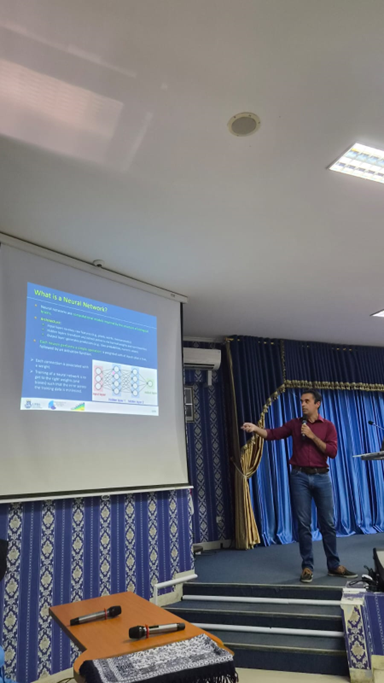
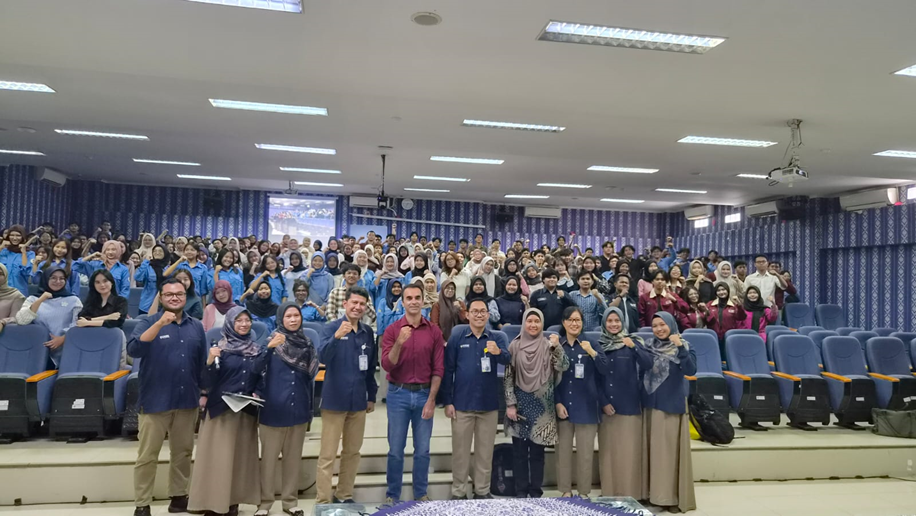
Student Enthusiasm The seminar room was packed with hundreds of students from various study programs, creating a warm and interactive atmosphere. At the end of the session, the speaker, lecturers, and participants posed together for a group photo with clenched-fist salutes symbolizing their enthusiasm for continuous learning and collaboration.
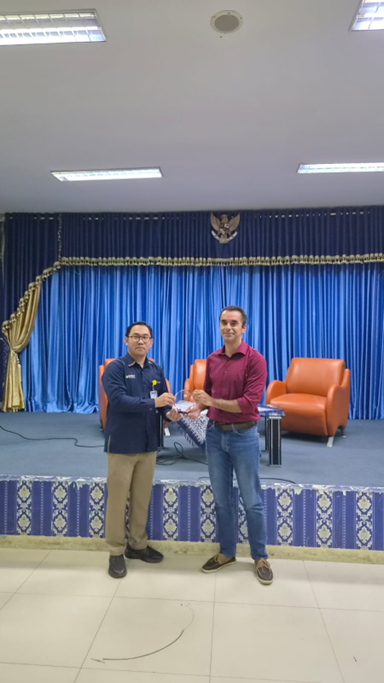
As a token of appreciation, a representative of UNNES lecturers presented a souvenir to Prof. Paulo for sharing his knowledge and experience.
This event is expected to broaden students’ insights into the interconnection between statistics and AI, expand international academic networks, and foster data talents ready to navigate the challenges of the digital era.
Alignment with the Sustainable Development Goals (SDGs) The implementation of this workshop aligns with several United Nations Sustainable Development Goals (SDGs), particularly the following three goals:
- SDG 4: Quality Education. This workshop supports Target 4.4, which aims to substantially increase the number of youth and adults who have relevant skills, including technical and vocational skills, for employment and entrepreneurship. Through this free, certified workshop, students gained foundational knowledge and skills in statistics, data science, and artificial intelligence essential for the digital era.
- SDG 9: Industry, Innovation and Infrastructure. This activity aligns with Target 9.5, which focuses on enhancing scientific research and upgrading technological capabilities. The session on artificial neural networks strengthened the academic community’s capacity to develop data-driven innovations and artificial intelligence technologies.
- SDG 17: Partnerships for the Goals. The participation of an academic from the Federal University of Bahia, Brazil, reflects Target 17.6, which promotes international cooperation and knowledge sharing in science, technology, and innovation. The event also demonstrates strong collaboration among the study program, tech communities, and student organizations in organizing academic initiatives.
Through this workshop, UNNES reaffirms its commitment to supporting quality education, strengthening technological innovation, and fostering global partnerships in the field of data science.