



A two-day exploration combines DNA fingerprinting, the creation of mother-tree duplicates through grafting/top working, and herbarium collection to safeguard the germplasm of Purworejo’s superior durian.
Purworejo, 1–2 August 2026 | Supported by DPA FMIPA UNNES 2026
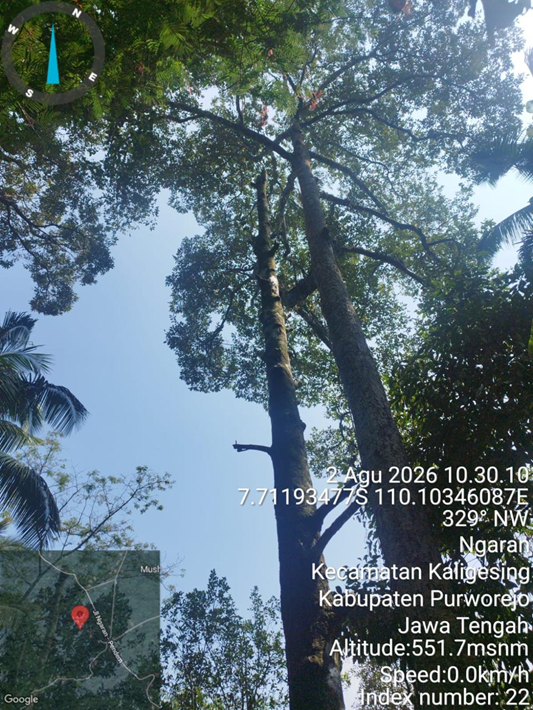
A superior durian mother tree in Ngaran, Kaligesing District. The geotagged photo shows the location at an elevation of approximately 551.7 meters above sea level. Research team documentation, 2 August 2026.
PURWOREJO — The FMIPA Universitas Negeri Semarang (UNNES) research team conducted a two-day exploration of superior durian in Purworejo on 1–2 August 2026 for the research “Fingerprinting of Superior Durian from Purworejo, Central Java”. Funded by DPA FMIPA UNNES, the activity was aimed at revealing the morphological and genetic diversity of superior local durian while building a foundation for mother-tree conservation and the provision of correctly identified scion sources (true to type).
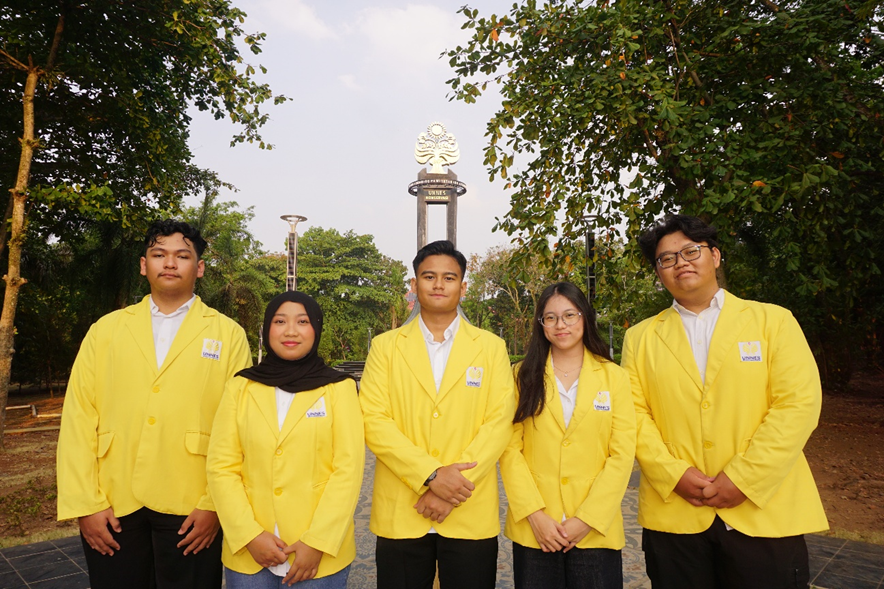
The exploration was led by Prof. Dr. Ir. Amin Retnoningsih, M.Si., together with a team of lecturers consisting of Prof. Dr. Enni Suwarsi Rahayu, M.Si., Dr. Andin Irsadi, S.Pd., M.Si., Dra. Ely Rudyatmi, M.Si., and Amnan Haris, S.Si., M.Ling. Five Biology students directly involved were Agnisa Rahmania Putri, Nada Putri Rahmawati, Anjas Firmansyah Dico Saputra, Norma Lutfiana, and Sabrina Nur Aisyah. In the field, the team was assisted by local durian farmers, local guides, and the owners of each tree, who provided information on the history and distinguishing qualities of the accessions.
Champion trees grow in challenging terrain
Field conditions showed that the single mother trees (PIT) of champion durian do not always grow in easily accessible locations. Some are situated on hills with fairly steep slopes, while others are found in deep valleys with elevation differences of more than 20 meters. The trees are also located far apart; even when they are within the same district, traveling from one tree to the next can take more than 30 minutes.
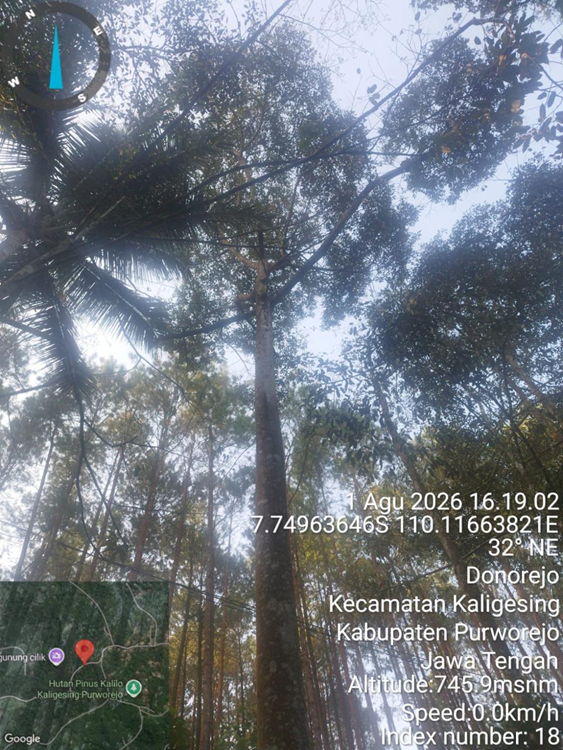
A durian mother tree in Donorejo, Kaligesing District, at an elevation of approximately 745.9 meters above sea level. The topography and high canopy posed major challenges during sample collection. Research team documentation, 1 August 2026.
The champion PITs visited were very large trees. Their trunk circumferences exceeded 1.5 meters, their ages were estimated at more than 75 years, and their heights were approximately 30–40 meters. The canopy and leafy branches were generally concentrated near the uppermost part of the trees. These conditions made collecting branches and leaves for DNA analysis, herbarium specimens, and scion material extremely difficult.
The team received assistance from experienced local climbers to reach productive branches in the upper canopy. However, the availability of climbing safety equipment in the field remained limited. This situation demonstrates that exploration of old durian germplasm requires not only scientific accuracy but also increasingly robust field-safety planning for future activities.
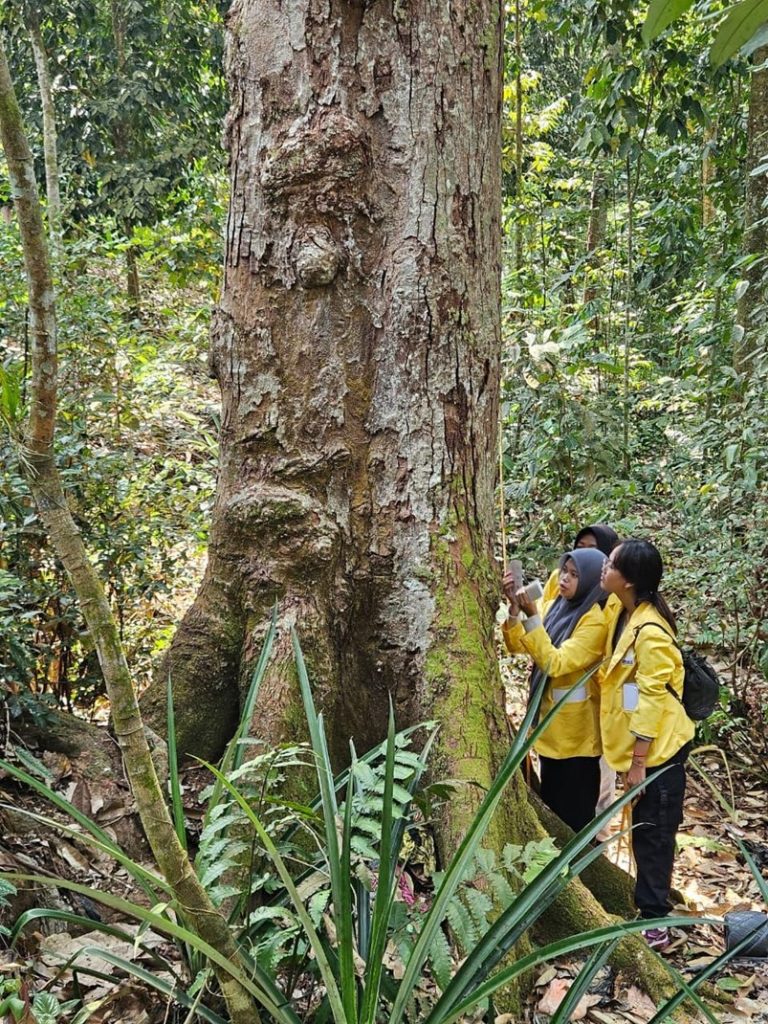
Students document the morphology of one of the durian mother trees with a very large trunk. The champion trees visited were generally old PITs that did not yet have adequate duplicates. Research team documentation, 2026.
One tree, three conservation missions
Each sampling activity was designed so that a single visit to a mother tree would yield three complementary types of material. This approach ensures that the exploration does not stop at collecting leaves for genetic analysis, but is directly linked to living conservation and botanical documentation.
| 1 | DNA | Healthy leaves are selected for DNA extraction and ISSR-based fingerprint analysis to map genetic diversity and detect potentially identical/duplicate accessions. |
| 2 | SCIONS | Healthy branches are collected as scion material for grafting or top working (TW), allowing the genotype of a champion tree to be preserved as a living duplicate before the original PIT is damaged or dies. |
| 3 | HERBARIUM | Leafy branches and flowers, when available, are prepared as herbarium vouchers to expand the Herbarium Semarangense collection at UNNES and strengthen the scientific documentation of each accession. |
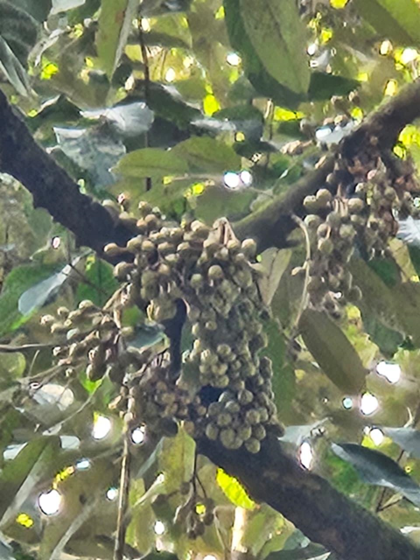
Flowers/flower buds on one of the mother trees explored. When available, reproductive material was also collected as part of the herbarium specimen and morphological characterization. Research team documentation, 2026.
Duplicating mother trees is an urgent necessity
An important field finding was that the champion durian accessions visited did not yet have secure duplicates. This means that the superior characteristics of an accession still depended on a single old tree. This condition places local germplasm at a high risk of loss. Trees may die due to drought, lightning strikes, age-related damage, or, under certain circumstances, be felled because of economic needs and the value of their timber.
If a mother tree dies before its genetic identity is recorded and its vegetative material is propagated, the superior genotype may be permanently lost. Therefore, healthy branches obtained during the exploration were immediately treated as sources of scion material for grafting and/or top working. Through this step, conservation does not exist only as DNA data, but also as duplicate trees that can be maintained as reserves of genetic resources and future sources of scion material.
Meanwhile, leaf samples were selected for DNA extraction and assigned codes linked to passport data, coordinates, photographs, and morphological characteristics. The integration of these data is expected to produce fingerprints capable of distinguishing accessions, revealing patterns of genetic diversity, and helping identify priority mother trees for conservation.
Local durian conservation and contributions to the SDGs
This exploration is aligned with the Sustainable Development Goals (SDGs), particularly SDG 2 (Zero Hunger) through the conservation of crop genetic diversity and the strengthening of superior planting-material sources; SDG 15 (Life on Land) through the protection and sustainable use of plant genetic resources; and SDG 12 (Responsible Consumption and Production) through the preparation of planting material whose identity can be traced and that can be developed responsibly.
For FMIPA UNNES, this research also strengthens the connection between basic research, field-based student education, the management of scientific collections, and germplasm conservation. Students not only learn how to collect samples, but also witness directly that a single old tree can preserve genetic resources that may not be replaceable once lost.
“A champion tree needs to be preserved in three forms: DNA identity, an herbarium voucher, and a living duplicate through vegetative propagation.”
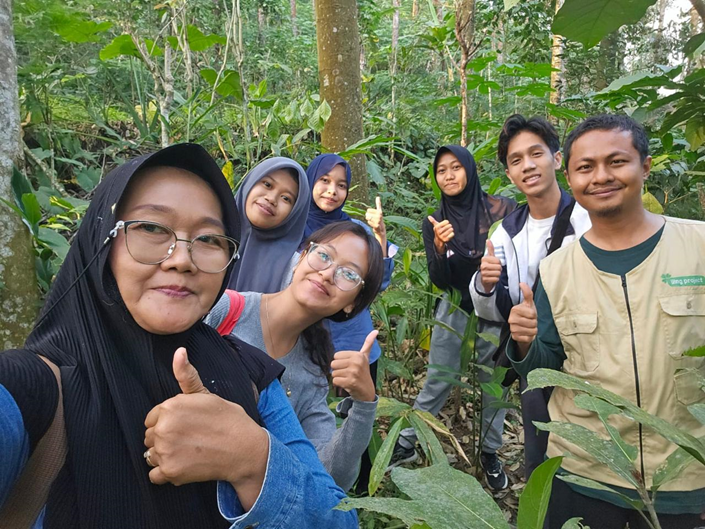
The field team with local guides during the exploration of superior durian in Purworejo. The activity involved lecturers, students, local durian farmers, and tree owners. Research team documentation, 2026.
From old trees to future sources of scion material
Through the research “Fingerprinting of Superior Durian from Purworejo, Central Java”, FMIPA UNNES seeks to ensure that Purworejo’s champion durian does not remain merely a story about a single old tree known in a village. Its identity needs to be recorded, its botanical evidence preserved, and its vegetative material propagated so that it remains available for future generations.
The research results are expected to provide a scientific basis for selecting unique, non-duplicate accessions, determining priority mother trees, strengthening the Herbarium Semarangense collection, and establishing sources of scion material for the development of true-to-type superior durian seedlings. Thus, the two-day exploration across the hills and valleys of Purworejo represents an important initial step in safeguarding the genetic wealth of local durian in Central Java.