SEMARANG – Josue Willian Alwyn, a student in the Environmental Sciences of the Faculty of Mathematics and Natural Sciences (FMIPA) at Universitas Negeri Semarang (UNNES), participated in an international community service initiative in collaboration with the NGO Laudato Si’ Movement Timor-Leste through a reforestation and youth empowerment program. The activity also formed part of his final project in 2026, which examines reforestation success and youth participation in environmental conservation in Dili, Timor-Leste.
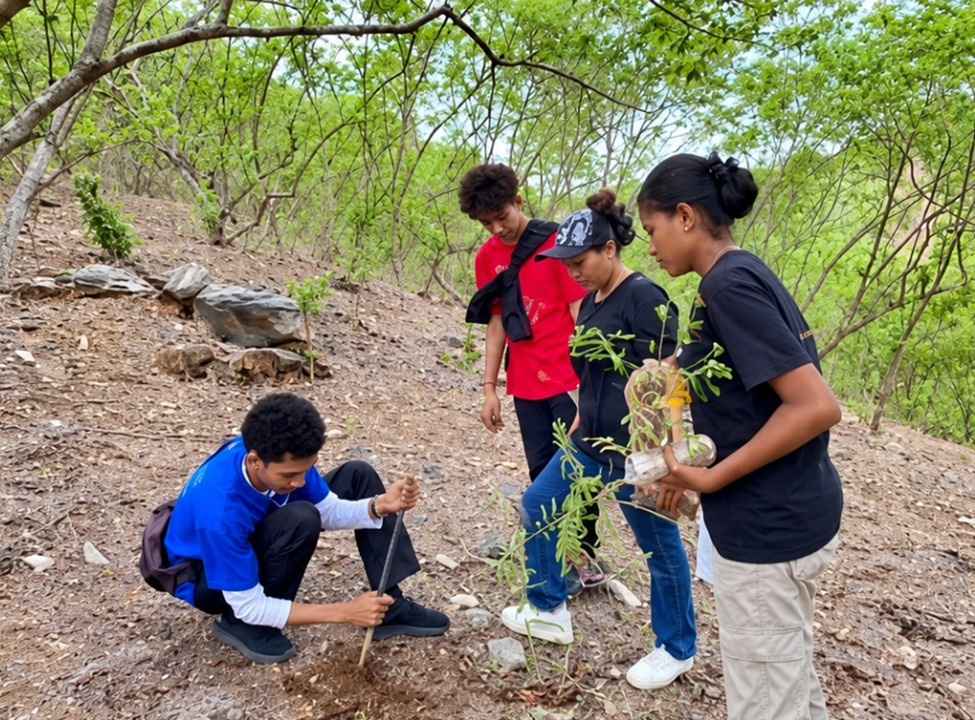
During the implementation of the activity and the preparation of his study, Josue was accompanied by FMIPA UNNES lecturers Abdul Jabbar, S.Si., M.Ling., who serves as his thesis supervisor, and Dr. Andhina Putri Heriyanti, S.T., M.Si. The tree-planting activities examined in the study had been carried out in previous years, while the 2026 study focused on vegetation conditions and the survival and growth of planted trees.
The program, entitled Strengthening Ecological Spirituality and Youth Participation through Reforestation Activities in Timor-Leste, focuses on two locations: Kruz Tolu Golgota Hill in the Tasitolu area and Papa João Paulo II Statue Hill. Both sites are part of vegetation restoration efforts in hilly areas facing environmental challenges, including dry-land conditions. The study of this program was published in 2026 in a scientific article entitled “Integration of Ecological Spirituality and Youth Participation in Reforestation Program: Laudato Si’ Movement Timor Leste” in the journal Ecology, Society and Environment. The publication examines the relationship between ecological spirituality and youth participation in supporting the success of reforestation programs. The full article is available at https://www.journals.ecotas.org/index.php/ems/en/article/view/605/139.
As part of his final project, Josue examined vegetation conditions and the survival rate of trees at both locations. The observations showed survival rates ranging from 50% to 80%. At Kruz Tolu Golgota Hill, neem trees recorded a survival rate of 80%, while pine trees at Papa João Paulo II Statue Hill achieved a survival rate of 75%. These findings highlight that reforestation success depends not only on the number of seedlings planted but also on the suitability of tree species to local environmental conditions and continued maintenance after planting.
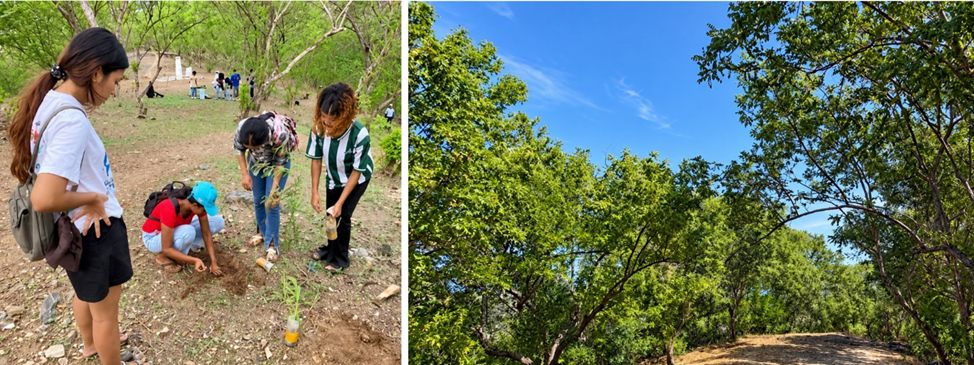
Beyond ecological aspects, the study highlights the role of ecological spirituality, environmental awareness, and youth participation in ensuring the sustainability of the program. The involvement of Laudato Si’ Movement Timor-Leste members, religious leaders, and local communities demonstrates the importance of social collaboration in supporting environmental restoration efforts.
The lecturers’ involvement reflects the integration of education, research, and community service. Through his final project, Josue has developed previously implemented reforestation activities into an academic study to understand vegetation conditions and the factors contributing to successful environmental restoration. Thus, the initiative serves not only as an international community service experience but also as a valuable academic learning opportunity relevant to environmental conservation.
The activity contributes to the achievement of the Sustainable Development Goals (SDGs), particularly SDG 15 (Life on Land) through vegetation restoration, SDG 13 (Climate Action) through environmental action, SDG 4 (Quality Education) through learning and youth capacity building, and SDG 17 (Partnerships for the Goals) through cross-border collaboration.
Through this initiative, FMIPA UNNES encourages students to connect community service with research that benefits society. The collaboration with Laudato Si’ Movement Timor-Leste demonstrates how conservation activities can serve as a platform for learning and evaluation while strengthening the long-term sustainability of reforestation programs.