


SEMARANG – A team of lecturers from the Physics Education Study Program, Faculty of Mathematics and Natural Sciences, Universitas Negeri Semarang (FMIPA UNNES), organized an empowerment program for junior high school science teachers. The program aimed to enhance the quality of learning rooted in local wisdom and digital technology. Entitled “Empowering the Semarang Regency Science Teachers’ Subject Group (MGMP IPA) to Develop Mount Ungaran Local Wisdom-Based STEM-LoCal for Science Literacy”, the initiative reflects UNNES’s commitment to advancing educational quality through its 2026 Community Service Program.
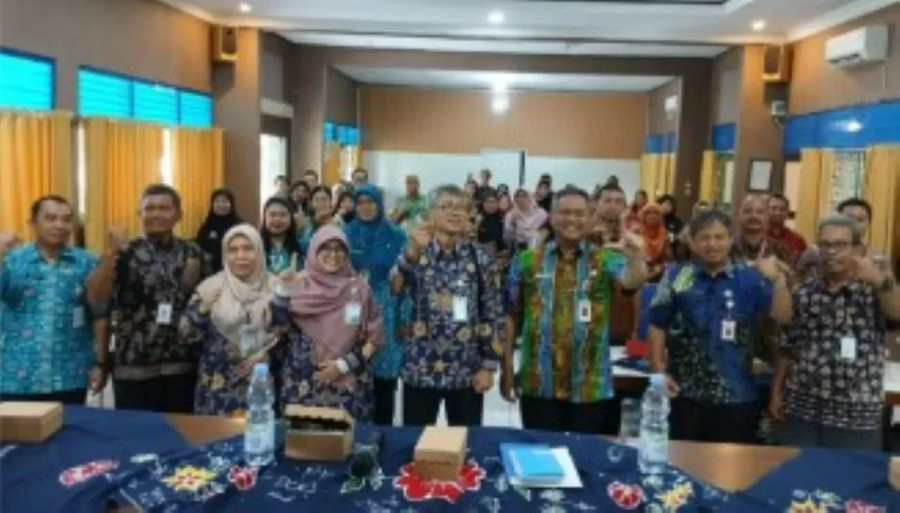
Led by Dr. Ellianawati, M.Si., the team comprised Dr. Bambang Subali, M.Pd., Dr. Pratiwi Dwijananti, M.Si., Dr. Ian Yulianti, M.Eng., and Ridho Adi Negoro, supported by students and alumni of the FMIPA UNNES Physics Education Study Program. A total of 40 junior high school science teachers affiliated with the Semarang Regency MGMP IPA participated in the program. Support also came from the Acting Head of the Semarang Regency Education, Culture, Youth, and Sports Office, M. Taufiqur Rahman, S.Ag., M.Si., as well as the Advisor of the Semarang Regency Junior High School MGMP IPA, Dr. Sugito, M.Pd.
Funded by the 2026 DPA LPPM UNNES budget under the Lecturer Community Service scheme, the program was designed to strengthen teachers’ capacity to implement the STEM-LoCal approach rooted in Mount Ungaran’s local wisdom. Additionally, teachers were equipped with insights into ethnoscience, the utilization of digital learning technologies, and the development of hands-on experiments using locally sourced materials. The digital technologies introduced included PhET Simulations, Augmented Reality (AR), and Tinkercad as integral components of 21st-century science education.
The program was carried out in stages, combining face-to-face workshops with online mentoring. In the initial phase, participants took a pre-test to assess their baseline understanding of ethnoscience, STEM-LoCal, local wisdom-based learning, and educational technology integration. The average pre-test score was 51.27, indicating the need for capacity building across these areas. Subsequently, participants received training from speakers according to their respective areas of expertise, covering ethnoscience, STEM-LoCal, local-material science experiments, and the integration of PhET Simulations, AR, and Tinkercad into science instruction.
Teachers were then mentored in designing instructional materials that merge Mount Ungaran’s local potential with digital technology. Through ongoing mentoring and monitoring, participants produced four teaching modules and four Student Worksheets (LKPD) based on STEM-LoCal. The developed themes covered biotechnology, food additives, gamelan physics, and static electricity—topics closely connected to the daily lives of the local community. Across each theme, teachers integrated local cultural phenomena with digital media such as virtual simulations, AR, and Tinkercad virtual laboratories, making science learning more interactive and contextual.
The head of the community service team, Dr. Ellianawati, explained that the STEM-LoCal approach helps students grasp scientific concepts through phenomena they encounter in everyday life. Students not only learn theoretical concepts, but also understand the connection between science, culture, and local community practices. According to her, this instructional model simultaneously serves as a means of preserving local wisdom through education.
The program’s success was demonstrated by a substantial improvement in participant competency. Teachers’ average post-test score rose to 91.56—categorized as very good—with an N-Gain score of 0.83, falling into the high category. These results reflect a significant increase in teachers’ mastery of STEM-LoCal, ethnoscience, PhET Simulations, AR, and Tinkercad.
Beyond competency enhancement, UNNES supported the Semarang Regency MGMP IPA by facilitating eight Intellectual Property Rights (IPR/HKI) registrations, providing mentoring equivalent to 32 training hours, and distributing four practicum kit boxes. Each box contained eight sets of experiments based on Mount Ungaran’s local wisdom, such as batik making and aromatherapy candle production. At the conclusion of the program, the team handed over all program deliverables—including teaching modules, LKPDs, IPR certificates, practicum kits, and training certificates—to the Semarang Regency MGMP IPA so that STEM-LoCal-based science learning can be sustained across schools.
Through this initiative, UNNES hopes teachers will serve as agents of change who deliver more innovative, contextual, and 21st-century-ready instruction. Ongoing collaboration among higher education institutions, local governments, and teacher communities is expected to further strengthen science literacy while preserving rich local cultural heritage as a high-value learning resource.