


Friday, June 12, 2026 | Rewritten from Suara Merdeka news by Fista Novianti
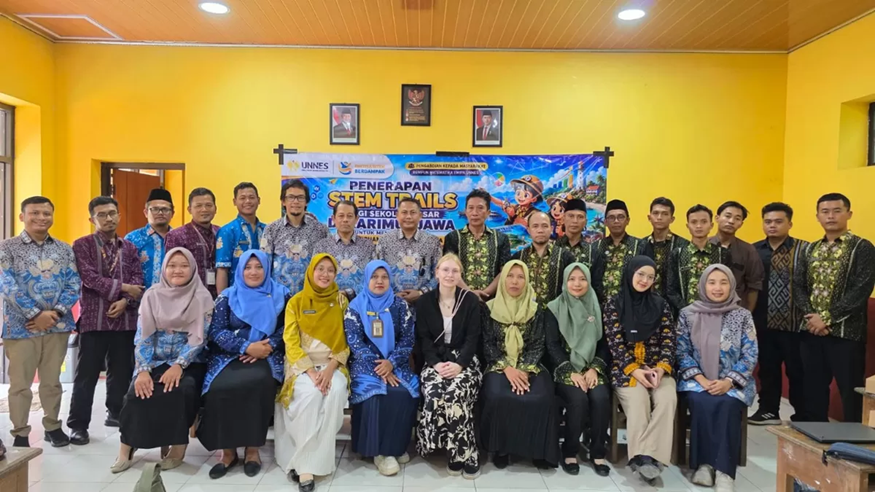
KARIMUNJAWA – A team of lecturers from the Mathematics Department, Faculty of Mathematics and Natural Sciences, Universitas Negeri Semarang (FMIPA UNNES), invited elementary school teachers and students to sharpen their numeracy skills by utilizing the coastal environment of Karimunjawa as an outdoor learning space. This initiative aligns with Sustainable Development Goal (SDG) 4 on Quality Education, particularly in improving the quality of foundational education.
The community service program, entitled “Implementation of STEM Trails for Elementary Schools in Karimunjawa to Improve Students’ Numeracy Skills” (Penerapan STEM Trails bagi Sekolah Dasar di Karimunjawa untuk Meningkatkan Kemampuan Numerasi Siswa), took place from Thursday to Saturday, June 11–13, 2026, in Karimunjawa.
The community service team comprised FMIPA UNNES Mathematics Department lecturers: Dr. Tri Sri Noor Asih, Dr. Arief Agoestanto, Dr. Walid, Dr. rer. nat. Adi Nur Cahyono, Wakhid Fitri Albar, Fashihah, and Virgania Sari.
The program also involved a German student currently completing an internship at UNNES. Her participation is part of the partnership between UNNES and Universität Würzburg, Germany, aimed at strengthening international academic collaboration in mathematics education as well as digital technology- and environment-based learning. This cross-national collaboration reflects the spirit of SDG 17 on Partnerships for the Goals.
Participants included teachers from SDN 1 through SDN 7 Karimunjawa, as well as SDN 1, SDN 3, SDN 4, and SDN 5 Kemujan.
Numeracy as a Way of Thinking The head of the community service team, Dr. Tri Sri Noor Asih, explained that through the STEM Trails approach, teachers and students are encouraged to treat their surrounding environment as a learning resource.
“STEM Trails positions numeracy not merely as the ability to calculate, but as a way of thinking to understand everyday problems. Students can learn through observing, measuring, calculating, estimating, reading data, and discussing solutions to real issues they encounter directly in their surroundings,” she stated on Friday (June 12).
Environmental Issues as Learning Materials According to her, the Karimunjawa context is highly relevant for raising socio-scientific issues, including waste management, coastal ecosystem conservation, clean water availability, the impacts of tourism activities, environmental change, and the balance between community needs and nature conservation. These issues directly intersect with SDG 12 (Responsible Consumption and Production), SDG 6 (Clean Water and Sanitation), SDG 13 (Climate Action), and SDG 14 (Life Below Water).
Such issues provide a learning space that encourages students not only to grasp mathematical concepts, but also to foster environmental awareness and sustainability values.
Teacher Empowerment and Mentoring During the program, teachers received training on the concepts of STEM Trails, environment-based numeracy learning, and designing learning trails that connect mathematical concepts with real-world objects around schools and coastal areas.
Teachers were also mentored in designing learning activities infused with environmental and sustainability themes, such as calculating waste volume, estimating water requirements, measuring specific land areas, reading patterns of human activity, and analyzing the environmental impacts of those activities.
The Principal of SDN 6 Karimunjawa, Mohamad Muklisin, together with the Principal of SDN 1 Karimunjawa, Nita Kurnia Rahman, noted that STEM Trails transforms Karimunjawa from merely a place to study into a living space for understanding mathematics, reading the environment, and cultivating care for a sustainable future.
Alignment with the Sustainable Development Goals (SDGs) Overall, this program contributes to several Sustainable Development Goals (SDGs). Strengthening teacher competencies and contextual numeracy learning supports SDG 4 (Quality Education). Activities involving waste volume calculation relate to SDG 12 (Responsible Consumption and Production), while estimating water needs and discussing clean water availability align with SDG 6 (Clean Water and Sanitation). Analyzing environmental changes and the impacts of human activities corresponds with SDG 13 (Climate Action), whereas preserving the Karimunjawa coastal ecosystem supports SDG 14 (Life Below Water). Meanwhile, the collaboration among UNNES, Universität Würzburg, and partner schools reflects SDG 17 (Partnerships for the Goals).