

Related to SDGs
The Faculty of Mathematics and Natural Sciences (FMIPA) at Universitas Negeri Semarang (UNNES) strengthened its commitment to sustainable campus environmental management through routine water quality monitoring. This assessment encompasses both drinking water facilities and receiving water bodies across the campus grounds. On September 1, 2026, FMIPA UNNES conducted microbiological water testing on drinking taps located at Building D12 (FMIPA Deanery) and Building D9 (Physics Laboratory) to test for Escherichia coli (E. coli) bacteria, using sterile distilled water as a negative control.
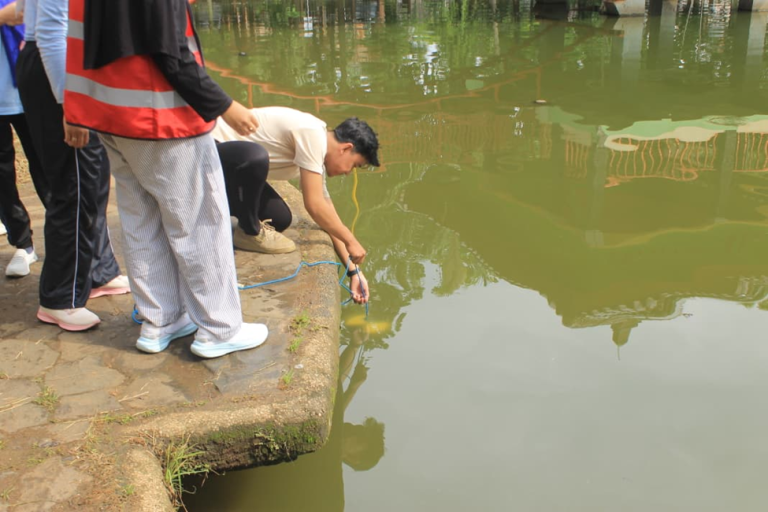
Laboratory results confirmed an E. coli count of 0 CFU/100 mL across all collected samples, verifying that drinking tap water within the faculty is safe and completely free from microbiological contamination. In addition to drinking water safety, Environmental Science students from FMIPA UNNES conducted sampling and physical-chemical measurements at the UNNES Retention Pond (Embung UNNES) on January 11, 2026, as part of direct field learning. Monitoring the pond is essential because faculty drainage and runoff from the FMIPA Water Treatment Unit near Building D8 empty directly into it. Measurements across two sampling points recorded a green water color, temperatures of 28.4°C and 28.6°C, turbidity levels of 36.5 and 41.5, a pH of 8, and Total Dissolved Solids (TDS) of 150 at both locations.
This comprehensive water quality monitoring program directly advances three key Sustainable Development Goals (SDGs). First, it supports Clean Water and Sanitation (SDG 6) by ensuring safe drinking water access and monitoring campus water bodies. Second, the initiative contributes to Good Health and Well-being (SDG 3) by safeguarding the campus community against waterborne biological hazards. Finally, the program promotes Quality Education (SDG 4) by providing Environmental Science students with hands-on field experience in practical environmental assessment.