

Related to SDGs
The Faculty of Mathematics and Natural Sciences (FMIPA) at Universitas Negeri Semarang (UNNES) reinforced its commitment to energy efficiency and carbon emission reduction through a research study titled “Assessing Energy Efficiency Potential and CO2 Emission Reduction Through Energy Use Intensity and Vegetation-Based Carbon Balance in University Campuses”. Authored by Maulana Malik Wicaksono, Sri Ngabekti, and Amman Haris, the study was published in a SINTA 2 national journal in January 2026. Findings revealed that laboratory buildings represent the highest energy consumers, averaging 6,916.94 kWh per month. By implementing energy-saving scenarios based on Energy Use Intensity (EUI), FMIPA UNNES has the potential to cut electricity consumption and carbon emissions by 32.64%.
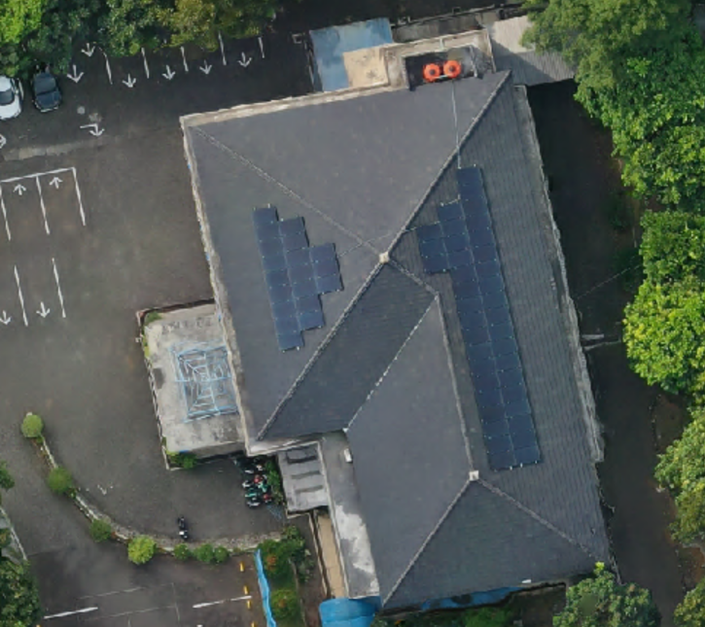
Beyond electricity efficiency, the study highlighted clean energy integration and campus carbon sequestration. FMIPA’s baseline electricity consumption yields a carbon footprint of approximately 526.81 tons of $\text{CO}_2\text{eq}$ per year, which can be reduced to 397.16 tons of $\text{CO}_2\text{eq}$ per year through efficiency measures. This effort is supplemented by $101\text{ m}^2$ of rooftop solar panels generating around 11,612 kWh per year to curb Scope 2 emissions. Furthermore, an assessment of 318 trees across 54 species identified a sequestration capacity of 1,067.41 tons of $\text{CO}_2\text{eq}$ per year. This establishes a negative carbon balance, demonstrating that the green campus canopy absorbs far more emissions than the faculty’s electrical consumption produces.
This carbon assessment and energy study directly advances three key Sustainable Development Goals (SDGs). First, it supports Affordable and Clean Energy (SDG 7) by optimizing rooftop solar power and implementing campus energy-saving scenarios. Second, the project contributes to Climate Action (SDG 13) through strategic carbon reduction and vegetation-based emission absorption. Finally, the initiative promotes Life on Land (SDG 15) by sustaining 318 campus trees as critical local carbon sinks.