

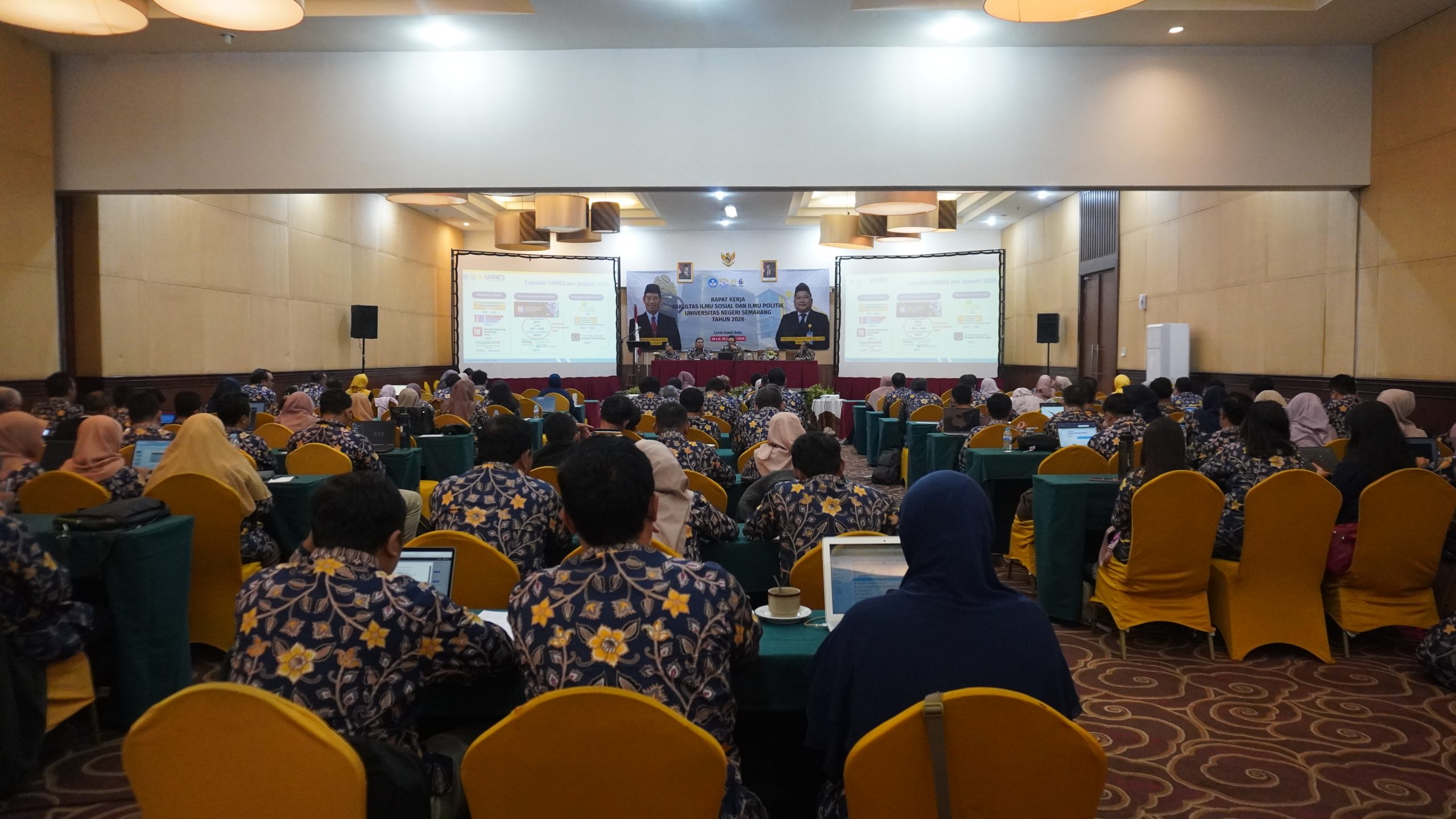
The Faculty of Social and Political Sciences (FISIP) of Universitas Negeri Semarang (UNNES) held its Work Meeting (Rapat Kerja) at Lorin Hotel, Solo, Central Java, from 28 to 30 January 2026. The meeting served as a strategic forum to consolidate faculty policies in responding to UNNES’ performance targets and challenges for the year 2026.
UNNES Secretary, Prof. Sugianto, stated that FISIP’s policy direction for 2026 is fully aligned with national higher education policies and the performance contract signed by the Rector of UNNES with the Ministry of Higher Education, Science, and Technology on 5 January 2026. This performance contract serves as the main foundation for institutional policies, particularly those related to the Key Performance Indicators (Indikator Kinerja Utama / IKU).
FISIP Dean, Prof. Arif Purnomo, added that several IKUs have become top priorities for the faculty. “Out of the eleven IKUs that have been established, FISIP is directly responsible for IKU 1 through IKU 8. These indicators are our collective top priority,” he said.
In the area of research and publication, FISIP faces significant challenges. With a total of 126 lecturers, the faculty has been assigned a publication performance target of 127 outputs. However, publication achievements in the previous year reached only 74 outputs. This gap has reinforced the implementation of the One Lecturer One Scopus (OLOS) policy as a key strategy to enhance research performance.
Prof. Arif emphasized that the publication policy is inclusive. In addition to lecturers, administrative staff (tenaga kependidikan) are also encouraged to write and contribute to reputable publications, including journals indexed by Scopus. The university has also prepared support for article processing charges (APC), particularly for publications in high-impact international journals ranging from Q1 to Q4, including those categorized as top-tier journals.
Significant changes have also occurred in IKU 5 related to partnerships. Previously, collaborations could be counted based solely on Implementation Arrangement (IA) documents. Under the new policy, partnerships must produce tangible outputs. Collaborations are required to result in concrete outcomes such as publications in reputable national journals, national journals, or other research and community engagement outputs.
In the context of community service, community engagement proposals to be opened in February 2026 are required to involve external partners. Partners are no longer positioned merely as activity objects, but are also expected to participate as co-authors in scholarly outputs.
Timely graduation has become a major concern under IKU 1. Nationally, the minimum target for on-time graduation is set at 75 percent. At the FISIP level, however, the standard has been raised to 85 percent. This means that supervisors at the undergraduate, master’s, and doctoral levels are encouraged to accelerate supervision processes to ensure students graduate within the expected timeframe.
The policy requiring student academic writing as a graduation requirement remains in effect in 2025, with flexibility in the form of outputs, including prototype journal articles. This policy is expected to significantly increase the percentage of students graduating on time at FISIP.
In addition, improving lecturers’ academic qualifications remains a strategic agenda. Currently, approximately 50 percent of FISIP lecturers hold doctoral (PhD) degrees. The medium-term target set for 2030 is to increase this proportion to more than 70 percent. Lecturers who have been pursuing doctoral studies for more than four years are expected to complete their studies promptly, while those holding master’s degrees are encouraged to strategically plan further doctoral education.
The 2026 FISIP UNNES Work Meeting reaffirmed the faculty’s commitment to strengthening the implementation of the tridharma of higher education, improving the quality of human resources, and actively contributing to the achievement of the university’s key performance indicators. Through policy consolidation, accelerated graduation, and strengthened reputable research output, FISIP is expected to play a vital role in realizing UNNES’ vision as a World Class Conservation University and Role Model of Education.