


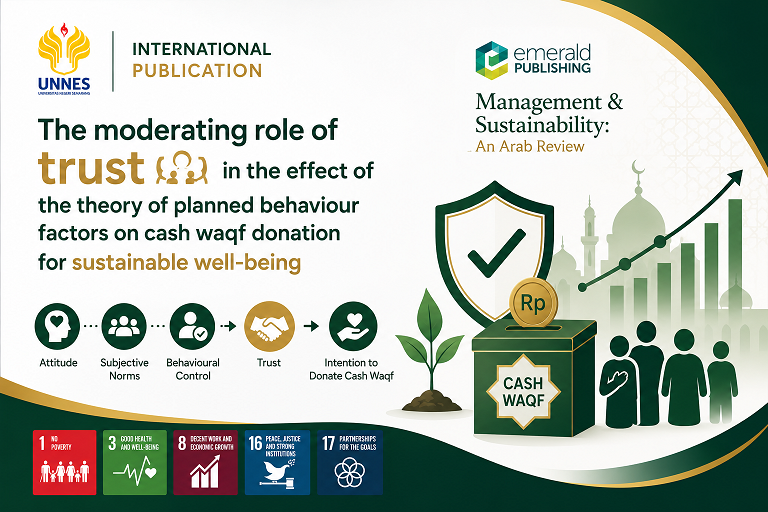
The Department of Islamic Economics and Finance, Faculty of Economics and Business, Universitas Negeri Semarang (FEB UNNES), proudly announces the publication of an international research article entitled “The Moderating Role of Trust in the Effect of the Theory of Planned Behaviour Factors on Cash Waqf Donation for Sustainable Well-Being” in Management & Sustainability: An Arab Review, a reputable international journal published by Emerald Publishing.
The article was authored by Asrori, Hasan Mukhibad, Indah Anisykurlillah, Fitrarena Widhi Rizkyana, Ahmad Nurkhin, and Christian Wiradendi Wolor. The publication demonstrates the department’s commitment to advancing research in Islamic social finance and sustainable development by examining the factors that encourage greater public participation in cash waqf.
Cash waqf has increasingly been recognized as an important Islamic social finance instrument capable of supporting poverty alleviation, strengthening community welfare, and financing sustainable development initiatives. Despite its significant potential, public participation in cash waqf remains highly dependent on the level of trust placed in waqf institutions. This study therefore investigates how waqif trust influences the relationship between behavioral factors and the intention to donate cash waqf.
The research employed the Theory of Planned Behaviour (TPB) as its conceptual framework and introduced trust as a moderating variable to better explain donors’ behavioral intentions. Data were collected from 250 cash waqf donors (waqifs) in Indonesia using convenience and snowball sampling techniques. The proposed research model was analyzed using Partial Least Squares Structural Equation Modeling (PLS-SEM).
The findings reveal that trust in waqf institutions plays a critical role in strengthening the positive influence of both attitude and perceived behavioral control on individuals’ intention to donate cash waqf. Individuals who have greater confidence in the integrity, transparency, and effectiveness of waqf institutions are more likely to increase their participation in cash waqf programs. However, the study also found that trust does not significantly strengthen the relationship between subjective norms and donation intention, suggesting that institutional credibility is more influential than social pressure in encouraging charitable behavior.
The researchers emphasize that strengthening public trust should become a strategic priority for waqf institutions. Improving governance, enhancing accountability in waqf asset management, increasing financial transparency, and expanding public literacy regarding cash waqf are considered essential strategies to encourage broader community participation and maximize the socio-economic impact of Islamic philanthropy.
The study contributes to the development of Islamic economics by extending the Theory of Planned Behaviour through the inclusion of trust as a moderating variable. This theoretical contribution provides a deeper understanding of donor behavior and offers practical recommendations for policymakers, waqf institutions, Islamic financial organizations, and philanthropic practitioners seeking to strengthen sustainable Islamic social finance.
This publication reflects the Department of Islamic Economics and Finance’s continued dedication to producing internationally recognized research that integrates Islamic values with evidence-based policy solutions. The findings reinforce the importance of institutional trust as a foundation for strengthening social finance ecosystems that contribute to inclusive and sustainable development.
The research directly contributes to several United Nations Sustainable Development Goals (SDGs). It supports SDG 1 (No Poverty) by promoting cash waqf as an effective instrument for poverty alleviation and social empowerment. The study advances SDG 3 (Good Health and Well-being) through its broader contribution to sustainable community well-being. It also aligns with SDG 8 (Decent Work and Economic Growth) by encouraging sustainable social financing that supports inclusive economic development. Furthermore, the research contributes to SDG 16 (Peace, Justice and Strong Institutions) by emphasizing the importance of good governance, transparency, accountability, and public trust in waqf institutions. Finally, it supports SDG 17 (Partnerships for the Goals) by encouraging collaboration among governments, Islamic financial institutions, waqf organizations, academics, and communities to strengthen the impact of Islamic social finance.
Through impactful international publications, the Department of Islamic Economics and Finance FEB UNNES continues to strengthen its global academic reputation while producing innovative research that advances Islamic philanthropy, sustainable finance, and community welfare. This achievement reflects the department’s commitment to generating evidence-based solutions that contribute to a more equitable, resilient, and sustainable society.