


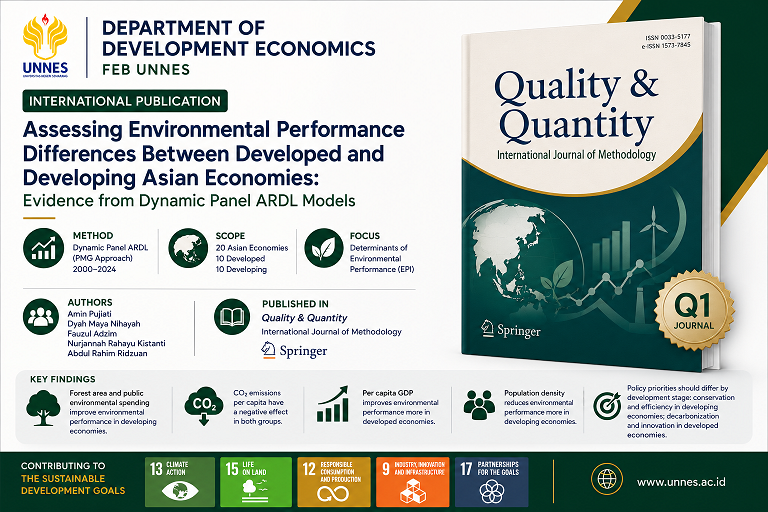
The Department of Development Economics, Faculty of Economics and Business, Universitas Negeri Semarang (FEB UNNES), proudly announces the publication of an international research article entitled “Assessing Environmental Performance Differences Between Developed and Developing Asian Economies: Evidence from Dynamic Panel ARDL Models” in Quality & Quantity: International Journal of Methodology, a prestigious international journal published by Springer Nature.
The article was authored by Amin Pujiati, Dyah Maya Nihayah, Fauzul Adzim, Nurjannah Rahayu Kistanti, and Abdul Rahim Ridzuan, demonstrating the department’s continued commitment to producing internationally recognized research that addresses pressing environmental and sustainable development challenges through rigorous quantitative analysis.
The study investigates how the determinants of environmental performance differ between developed and developing economies in Asia. As environmental degradation continues to intensify due to economic expansion, population growth, and land-use transformation, the research provides valuable evidence to support the design of more effective and context-specific environmental policies.
Using annual panel data from 20 Asian countries—comprising ten developed and ten developing economies—over the period 2000–2024, the researchers employed a Dynamic Panel Autoregressive Distributed Lag (Panel ARDL) model with the Pooled Mean Group (PMG) estimator. Environmental performance was measured using the Environmental Performance Index (EPI), a comprehensive indicator that captures multiple dimensions of environmental quality.
The findings confirm a long-run relationship between environmental performance and its structural determinants. In developing economies, forest conservation and public environmental expenditure significantly improve environmental performance, highlighting the importance of sustainable natural resource management and effective environmental investment. Across both developed and developing countries, carbon dioxide (CO₂) emissions per capita consistently reduce environmental performance, emphasizing the urgency of climate mitigation efforts.
The study further reveals that per capita GDP contributes more positively to environmental performance in developed economies, while population density poses greater environmental pressure in developing countries. These findings indicate that environmental policies should not adopt a one-size-fits-all approach. Instead, policy priorities should reflect each country’s stage of economic development.
Based on these findings, the researchers recommend that developing economies strengthen forest conservation initiatives and improve the efficiency of public environmental spending to enhance ecological sustainability. Meanwhile, developed economies should prioritize decarbonization strategies, green technological innovation, and low-carbon economic transformation to further improve environmental quality.
This publication reflects the Department of Development Economics’ dedication to advancing high-quality international research that integrates environmental economics, sustainable development, and evidence-based policymaking. The study provides valuable insights for governments, international development agencies, environmental policymakers, and researchers seeking effective strategies to balance economic growth with environmental sustainability.
The research makes significant contributions to several United Nations Sustainable Development Goals (SDGs). It directly supports SDG 13 (Climate Action) by providing empirical evidence for policies aimed at reducing carbon emissions and strengthening climate resilience. The study advances SDG 15 (Life on Land) through its emphasis on forest conservation and sustainable ecosystem management. It also contributes to SDG 12 (Responsible Consumption and Production) by encouraging more efficient environmental resource management and public expenditure. Furthermore, the research aligns with SDG 9 (Industry, Innovation and Infrastructure) by highlighting the importance of green innovation and sustainable technological development, while supporting SDG 17 (Partnerships for the Goals) through comparative international research that promotes knowledge sharing across Asian economies.
Through internationally recognized publications, the Department of Development Economics FEB UNNES continues to strengthen its global research reputation while generating policy-relevant evidence that supports sustainable economic development and environmental stewardship. This achievement reinforces the department’s commitment to producing impactful research that contributes to addressing global environmental challenges and achieving a more sustainable future.