


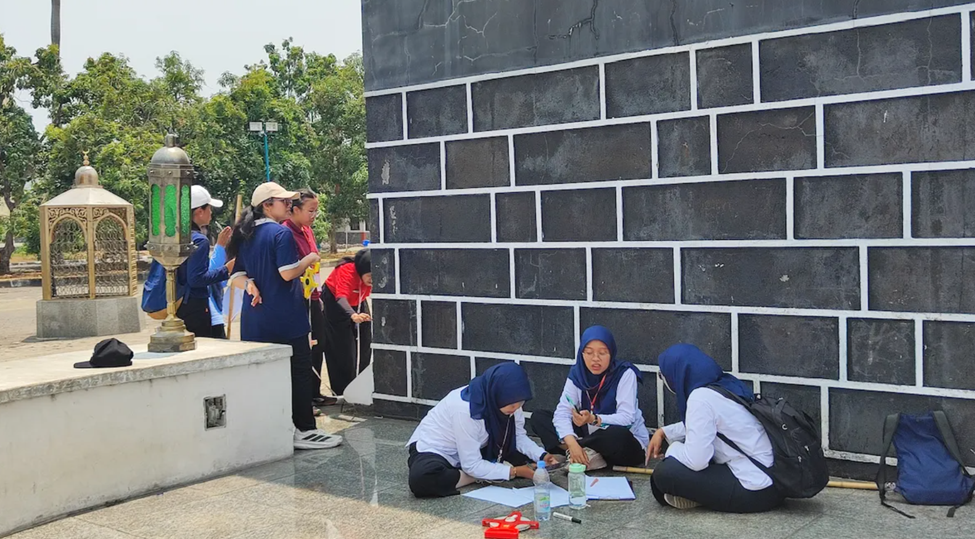
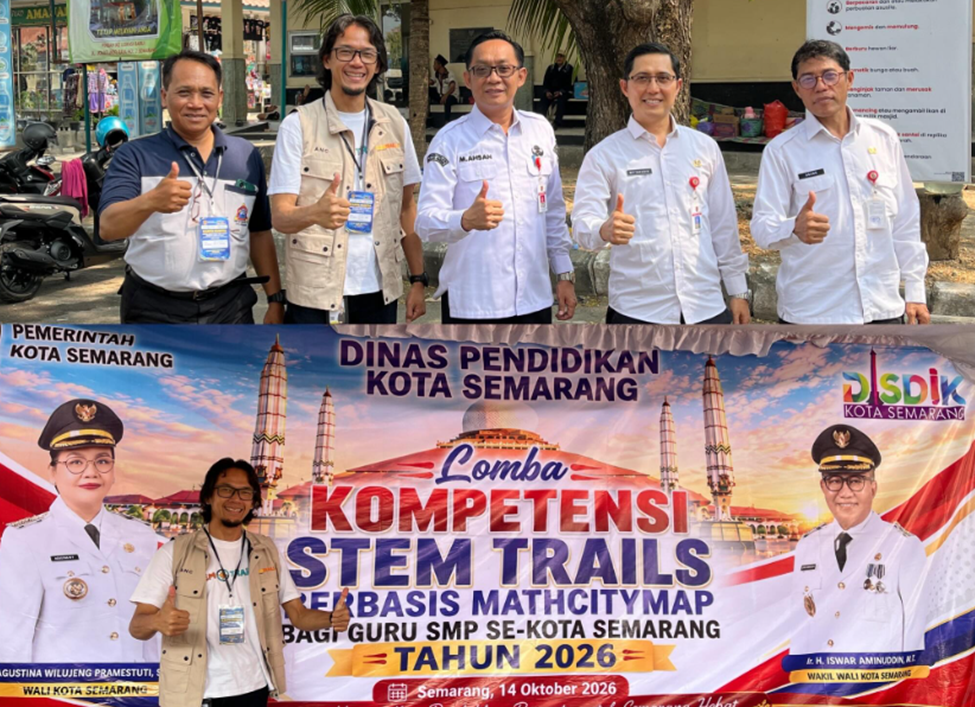
SEMARANG – A total of 108 junior high school teachers in Semarang participated in a MathCityMap-based STEM Trails competition held at the Great Mosque of Central Java (Masjid Agung Jawa Tengah/MAJT) on Wednesday, October 14, 2026. MAJT is one of the largest and most magnificent mosques in Central Java and a prominent religious tourism landmark in Semarang. The activity utilized the mosque’s surroundings and architecture as contextual learning resources for mathematics, science, technology, and engineering.
Participants were divided into 36 groups, each consisting of three teachers from various subjects, including mathematics, science, informatics, and physical education. Using MathCityMap, an application developed in Frankfurt, Germany, participants completed challenges involving real-world objects, such as calculating the area of a pond, estimating paint requirements for a traditional bedug drum area, and comparing the dimensions of a Kaaba replica with those of the original structure. In addition to measurement-based challenges, participants completed a project-based activity involving the construction of bridges using ice cream sticks, considering structural strength and aesthetics. The construction process was documented through worksheets and videos as part of the assessment.
An academic from the Department of Mathematics, Faculty of Mathematics and Natural Sciences, Universitas Negeri Semarang (FMIPA UNNES), Dr. rer. nat. Adi Cahyo Nugroho, explained that the STEM Trails approach integrates Science, Technology, Engineering, and Mathematics (STEM). This approach enables teachers to connect classroom concepts with real-world problems through exploration of their surroundings.
Organized as part of the Teachers’ Day celebration, the activity was expected to strengthen teachers’ competencies, particularly in STEM-based learning, literacy, and numeracy. The use of MAJT as an outdoor learning environment also demonstrated how public facilities and cultural landmarks can serve as engaging and meaningful educational resources.
This initiative aligns with the Sustainable Development Goals (SDGs), particularly SDG 4 (Quality Education) through teacher capacity building and innovative learning approaches, SDG 9 (Industry, Innovation and Infrastructure) through the application of digital technology in education, and SDG 17 (Partnerships for the Goals) through collaboration between university academics and educational stakeholders. Through the contribution of FMIPA UNNES academics, the STEM Trails competition represents an effort to support innovative education by integrating technology, real-world environments, and multidisciplinary learning approaches.