


FMIPA UNNES Research Team Develops Graphene-Based Catalyst to Support Green Hydrogen Technology

Universitas Negeri Semarang/Faculty of Mathematics and Natural Sciences/Berita/FMIPA UNNES Research Team Develops Graphene-Based Catalyst to Support Green Hydrogen Technology
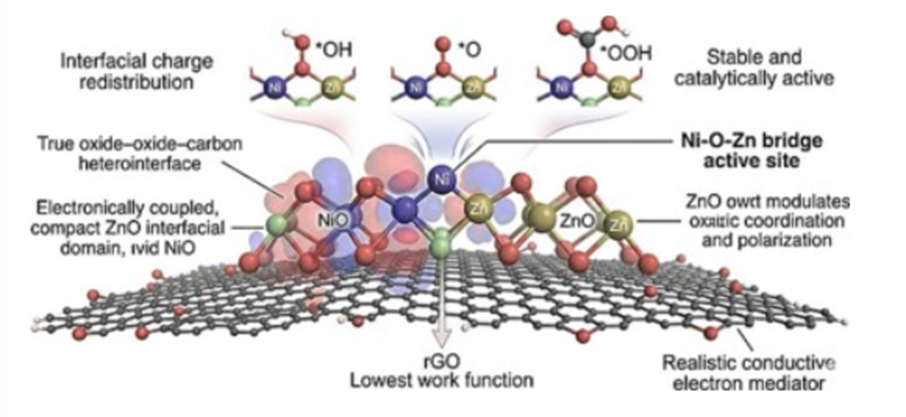
A white-background molecular model diagram showing a hexagonal rGO carbon sheet at the bottom supporting NiO and ZnO atomic clusters with reaction intermediates OH, O, and OOH illustrated at the top.

SEMARANG – The development of clean energy has become a critical necessity to support the energy transition and reduce dependence on fossil fuels. Addressing this challenge, Dr. Nuni Widiarti, together with a research team from the Faculty of Mathematics and Natural Sciences, Universitas Negeri Semarang (FMIPA UNNES), has developed a graphene-based catalyst material design with the potential to support green hydrogen production technology through water electrolysis.

The research resulted in two publications in reputable international journals in 2026, namely “Interfacial Charge Redistribution and Catalytic Activation in rGO-Supported NiO–ZnO Heterostructures” in Results in Chemistry and “Site-Selective Anchoring and Defect-Engineered NiOOH Active-Site Formation in NiO–ZnO/rGO Heterointerfaces for Oxygen Evolution Reaction” in Chemical Physics Impact.
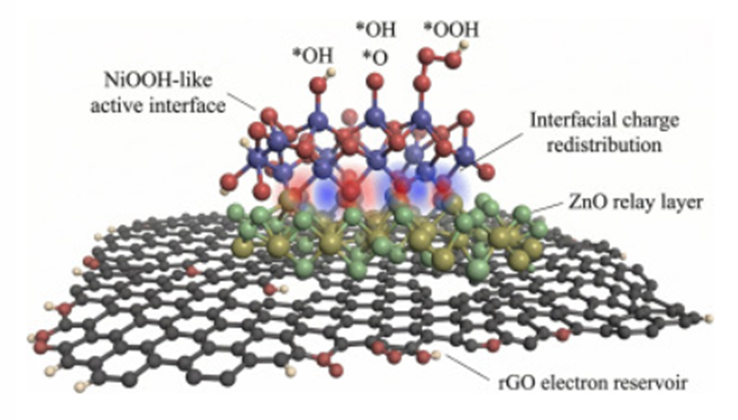
Both studies utilize a Density Functional Theory (DFT) computational approach to analyze the characteristics of catalyst materials based on nickel oxide (NiO), zinc oxide (ZnO), and reduced graphene oxide (rGO). These materials were investigated to support the oxygen evolution reaction (OER), the oxygen-forming reaction that serves as a vital stage in the water electrolysis process to produce hydrogen.

The first study demonstrated that the NiO–ZnO/rGO combination possesses a stable interfacial structure with a binding energy of −30.13 eV. However, this structural stability has not yet yielded optimal OER activity due to excessively strong interactions with reaction intermediates. This finding serves as an essential foundation for understanding the relationship between material structure and catalytic performance.

In the second study, the research team developed a structural defect-engineering approach and the formation of NiOOH-like active sites. Simulation results showed that the two best catalyst configurations achieved a theoretical overpotential of 0.17 volts, indicating the potential to reduce additional voltage requirements in the oxygen evolution reaction.

The positive impact of this research lies in providing a scientific foundation for developing more efficient catalysts in water electrolysis technology. The computational approach also enables the identification of candidate materials prior to laboratory testing, allowing subsequent research to be more targeted. The development of these catalysts holds potential to support green hydrogen production when applied to electrolysis systems powered by renewable electricity.

This research contributes to the Sustainable Development Goals (SDGs), particularly SDG 7 (Affordable and Clean Energy) through the development of supporting materials for green hydrogen technology, SDG 9 (Industry, Innovation and Infrastructure) through advanced material engineering innovation, and SDG 13 (Climate Action) through its potential support for low-carbon energy technology development.

Through these two publications, the FMIPA UNNES research team demonstrates its contribution to advancing materials science in support of future energy technologies. Although still at the computational simulation stage and requiring experimental validation, these research findings are expected to serve as a basis for developing more efficient water electrolysis catalysts and strengthening higher education’s contribution toward a sustainable energy transition.
Related Posts

Leave a Reply

* Kode Akses Komentar:

* Tuliskan kode akses komentar diatas:

GDPR

  • Privacy Policy

Privacy Policy

At unnes.ac.id, the privacy of our visitors is of extreme importance to us. This privacy policy document outlines the types of personal information that is received and collected by unnes.ac.id and how it is used.

Log Files

Like many other Web sites, unnes.ac.id makes use of log files. The information inside the log files includes internet protocol (IP) addresses, type of browser, Internet Service Provider (ISP), date/time stamp, referring/exit pages, and number of clicks to analyze trends, administer the site, track user’s movement around the site, and gather demographic information. IP addresses and other such information are not linked to any information that is personally identifiable.

Cookies

unnes.ac.id uses cookies to store information about visitors’ preferences, to record user-specific information on which pages the site visitor accesses or visits, and to personalize or customize our web page content based upon visitors’ browser type or other information that the visitor sends via their browser.

Third-party ad servers or ad networks use technology in their respective advertisements and links that appear on unnes.ac.id and which are sent directly to your browser. They automatically receive your IP address when this occurs. Other technologies (such as cookies, JavaScript, or Web Beacons) may also be used by our site’s third-party ad networks to measure the effectiveness of their advertising campaigns and/or to personalize the advertising content that you see on the site.

unnes.ac.id has no access to or control over these cookies that are used by third-party advertisers.

You should consult the respective privacy policies of these third-party ad servers for more detailed information on their practices as well as for instructions about how to opt-out of certain practices. unnes.ac.id’s privacy policy does not apply to, and we cannot control the activities of, such other advertisers or web sites.

If you wish to disable cookies, you may do so through your individual browser options. More detailed information about cookie management with specific web browsers can be found at the browsers’ respective websites.

Consent

By using our website, you hereby consent to our privacy policy and agree to its terms.

Update

This Privacy Policy was last updated on: 2023-02-14. Should we update, amend or make any changes to our privacy policy, those changes will be posted here.

Contact Us

If you have any questions, comments, or concerns about our Privacy Policy or our practices with regards to your personal information, please feel free to contact us through the contact form on our website or by emailing us at humas[at]mail.unnes.ac.id.

This Privacy Policy is intended as a general guide to our practices in collecting and using information. If there is any inconsistency between this Privacy Policy and the terms of the Service Agreement or any other terms that may apply to specific services you use, then those specific service terms shall apply.

Terms of Use

By using our website, you agree to abide by this Privacy Policy. If you do not agree with this Privacy Policy, please do not use our website. We reserve the right to update this Privacy Policy from time to time without prior notice. Please review our Privacy Policy periodically to check for changes. Your continued use of our website following the posting of changes to this Privacy Policy means that you accept the changes.

Thank you for reading our Privacy Policy. We are committed to protecting the privacy of our website visitors and will continue to update our Privacy Policy to ensure optimal protection.