


A collaboration between FMIPA and FBS UNNES and the Faculty of Science at Universiti Malaya delivers inclusive, safe, and independence-oriented leaf craft learning.
SELANGOR, MALAYSIA — Universitas Negeri Semarang (UNNES) has strengthened its international contribution to inclusive education through a community service program entitled “Strengthening Leaf to Market: Technology and Innovation for Inclusive Giftable Products Based on Skeleton Leaves and Ecoprint at APIM Semenyih, Selangor, Malaysia.” The program was funded by DPA UNNES through LP2M UNNES.
An online orientation session was held via Zoom on July 6, 2026, as the first meeting to establish a shared understanding of the program’s objectives, stages, division of responsibilities, occupational safety procedures, and sustainability plan. The hands-on training and mentoring activities were subsequently conducted on July 13, 2026, at APIM in Semenyih, Selangor, Malaysia.
The program was implemented through collaboration between the Faculty of Mathematics and Natural Sciences (FMIPA) and the Faculty of Languages and Arts (FBS) at UNNES, together with the Faculty of Science at Universiti Malaya, with support from Dr. Maisarah binti Hasbullah. This multidisciplinary collaboration combined knowledge of biology, occupational safety, inclusive pedagogy, art, product design, and craft product value development.
The community service team was led by Prof. Dr. Ir. Amin Retnoningsih, M.Si., with members Prof. Dr. Ari Yuniastuti, M.Kes.; Prof. Dr. drh. R. Susanti, M.P.; Prof. Dr. Aditya Marianti, M.Si.; Prof. Dr. Noor Aini Habibah, M.Si.; Dr. Dewi Mustikaningtyas, S.Si., M.Si.Med.; Dr. Sigit Saptono, M.Pd.; and Dr. Eko Sugiarto, M.Pd. The program was also supported by students Sania Luthfia Atika, Dafina Armesya Putri, and Hizkia Martanoel Kristian.
The training was designed for accompanying teachers, APIM learners, and guest participants, including adolescents and adults with special needs. To ensure that every participant could take part according to their individual abilities, the practical sessions adopted a station-based workflow and micro-tasking approach.
Each learning stage was designed to be brief, visual, repetitive, and safe. Accompanying teachers supported participants by explaining instructions, assisting with motor activities, documenting the process, and maintaining safety throughout the training.
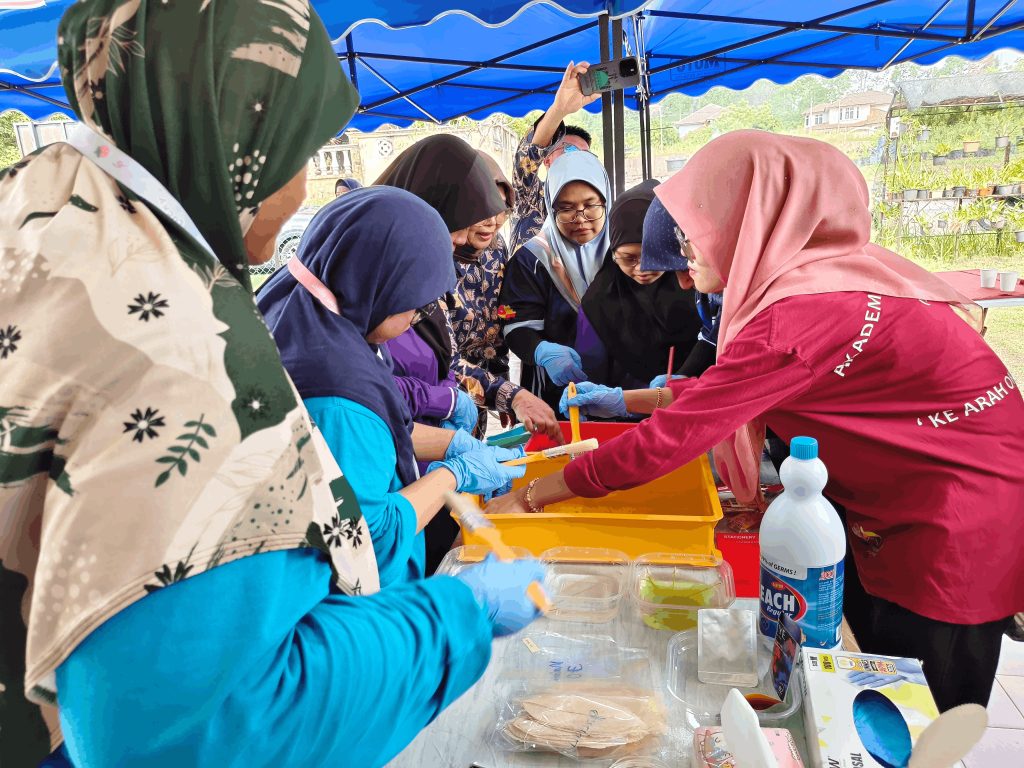
An accompanying teacher demonstrates and provides guidance on the skeleton leaf cleaning process to APIM learners and guest participants.
“From leaves to creations, from creations to giftable products, and from products to a path toward independence.”
Participants practiced four main skills: producing skeleton leaves using abrasive ash, coloring skeleton leaves, creating ecoprint designs using the pounding technique, and making crafts from skeleton leaves and resin. They followed the complete process, from material introduction, cleaning, and coloring to ornament arrangement and product finishing.
Enthusiasm was evident as teachers and learners tried each stage and observed how ordinary leaves could be transformed into attractive craft materials. The approach positioned participants not merely as recipients of training, but as active learners who could contribute according to their individual strengths.
Some participants focused on cleaning leaves, while others selected colors and ornaments, documented activities, prepared packaging, or carried out simple quality checks. This division of tasks introduced participants to teamwork and the basic workflow of craft production.
To support the program’s continuity, the UNNES team provided four illustrated Standard Operating Procedures (SOPs), covering skeleton leaf production using ash, skeleton leaf coloring, ecoprint pounding, and the production of resin and skeleton leaf crafts. These visual SOPs are expected to help accompanying teachers repeat the training consistently after the face-to-face sessions have concluded.
The Leaf to Market program contributes to several Sustainable Development Goals (SDGs), including SDG 4: Quality Education through inclusive vocational learning; SDG 8: Decent Work and Economic Growth through the development of productive skills; and SDG 10: Reduced Inequalities by creating meaningful participation opportunities for learners with special needs.
The use of leaves as biomaterials also supports SDG 12: Responsible Consumption and Production, while the collaboration among UNNES, Universiti Malaya, APIM, and accompanying teachers aligns with SDG 17: Partnerships for the Goals.
The program will continue through implementation, evaluation, and online mentoring sessions via Zoom. These follow-up activities will monitor participants’ skill development, product quality consistency, documentation, and opportunities for product development and marketing.
Through sustained mentoring, APIM is expected to develop an increasingly independent vocational learning system. The program is also expected to provide broader opportunities for learners to build confidence, create meaningful products, and participate in productive activities.