



KARIMUNJAWA – The Faculty of Mathematics and Natural Sciences (FMIPA), Universitas Negeri Semarang (UNNES), developed environment-based numeracy learning through a community service program entitled “Implementation of STEM Trails for Elementary Schools in Karimunjawa to Improve Students’ Numeracy Skills”.
The activity was held on June 11-13, 2026, in Karimunjawa, Jepara. The program involved elementary school teachers from Karimunjawa and Kemujan, namely SDN 1 Karimunjawa, SDN 2 Karimunjawa, SDN 3 Karimunjawa, SDN 4 Karimunjawa, SDN 5 Karimunjawa, SDN 6 Karimunjawa, SDN 7 Karimunjawa, SDN 1 Kemujan, SDN 3 Kemujan, SDN 4 Kemujan, and SDN 5 Kemujan.
Through the STEM Trails approach, the surrounding environment was used as a learning resource that connects science, technology, engineering, and mathematics with everyday life. Beaches, the sea, docks, boats, coastal areas, and island community activities became learning contexts that are close to students’ experiences.
This activity is related to the Sustainable Development Goals (SDGs), particularly SDG 4 on Quality Education. Through environment-based numeracy learning, teachers were encouraged to develop learning activities that are more contextual, meaningful, and relevant to the needs of students in island areas.
During the activity, the teachers did not only attend classroom enrichment sessions, but also took part in direct field practice. They used digital devices, observed real objects, recorded data, discussed findings, and designed learning activities suited to the environmental characteristics of Karimunjawa.
The head of the community service team, Dr. Tri Sri Noor Asih, M.Si., stated that numeracy learning should begin from real experiences that are close to students’ lives.
“Through STEM Trails, students do not only learn numbers and formulas, but also learn to understand their environment, identify real problems, and use mathematics to make wiser decisions,” she said.
In the context of Karimunjawa, numeracy is not only understood as the ability to calculate, but also as a way to understand the surrounding environment. Activities such as estimating distance and travel time between islands, reading directions and maps, observing wave and tidal patterns, measuring certain areas, and estimating clean water needs can become part of the learning process.
Teachers also received enrichment on the concept of STEM Trails, environment-based numeracy learning, and the development of learning trails that connect mathematical concepts with real objects around schools and coastal areas. They were also assisted in designing learning activities that include the characteristics of Karimunjawa and sustainability issues.
This approach is also connected to SDG 10 on Reduced Inequalities because it brings learning innovation to schools in island areas. Through this activity, teachers in Karimunjawa gained the opportunity to develop learning based on technology, the environment, and local contexts that are relevant to students’ conditions.
The STEM Trails facilitator, Dr. rer.nat. Adi Nur Cahyono, M.Pd., explained that this approach encourages the use of the local environment as an authentic and meaningful learning space.
“In Karimunjawa, the sea, beaches, docks, boats, coastal community activities, marine tourism, clean water needs, and marine ecosystems can become meaningful contexts for developing numeracy, critical thinking, and awareness of sustainability,” he said.
According to Adi, when students learn through observing, measuring, estimating, using technology, and discussing issues around them, mathematics becomes more relevant to everyday life. At the same time, students are encouraged to understand their environment and the importance of maintaining the sustainability of island areas.
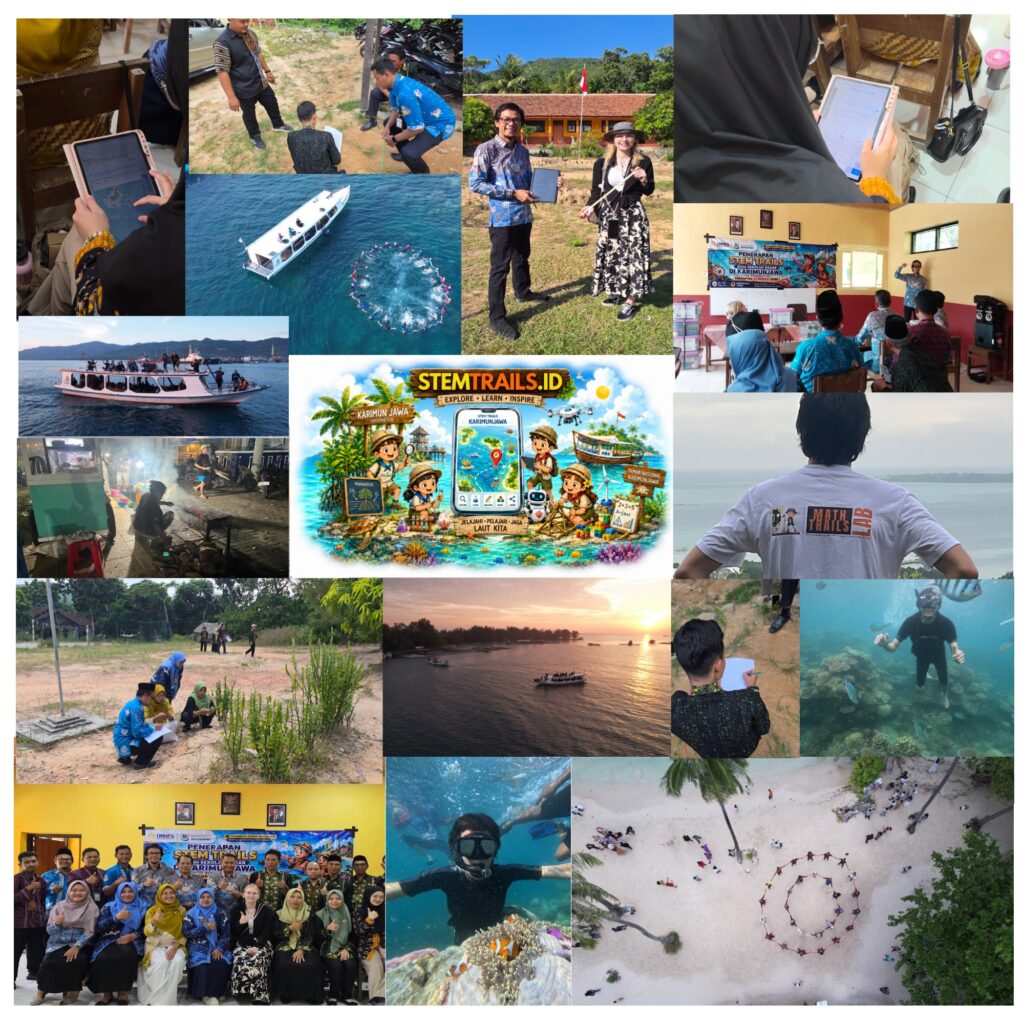
The series of STEM Trails activities in Karimunjawa integrated numeracy learning, digital technology, and coastal environmental exploration as learning resources.
The environmental context of Karimunjawa also provides learning opportunities related to sustainability issues, such as waste management, coastal ecosystem conservation, clean water availability, the impact of tourism activities, environmental change, and the balance between community needs and nature conservation.
Through these issues, numeracy learning can be linked to SDG 13 on Climate Action, SDG 14 on Life Below Water, and SDG 15 on Life on Land. Students are encouraged to understand that data, measurement, and problem-solving can be used to read environmental conditions and support awareness of sustainability.
The community service team consisted of lecturers from the Mathematics Group of FMIPA UNNES, namely Dr. Tri Sri Noor Asih, M.Si.; Dr. Arief Agoestanto, M.Si.; Dr. Walid, S.Pd., M.Si.; Dr. rer.nat. Adi Nur Cahyono, M.Pd.; Wakhid Fitri Albar, S.Pd., M.Sc.; Fashihah, M.Pd.; and Virgania Sari, S.Pd., M.Si.
The activity also involved a female student from Germany who was undertaking an internship program at UNNES. Her involvement was part of the implementation of cooperation between UNNES and Universität Würzburg, Germany, particularly in strengthening international academic collaboration in mathematics education, digital technology, environment-based learning, and sustainability education.
Through this program, FMIPA UNNES seeks to deliver educational innovation that benefits teachers, students, and schools. STEM Trails in Karimunjawa is expected to become an example of environment-based numeracy learning that is contextual, technology-based, and supportive of awareness of environmental sustainability.
This activity also reflects FMIPA UNNES’ contribution to SDG 4, SDG 10, SDG 13, SDG 14, and SDG 15 through numeracy strengthening, expanded access to learning innovation, and the use of the Karimunjawa environment as a meaningful learning resource.