



KARIMUNJAWA – A team of lecturers and students from the Mathematics Group, Faculty of Mathematics and Natural Sciences (FMIPA), Universitas Negeri Semarang (UNNES), conducted a community service program entitled “Strengthening the Competence of Elementary School Teachers in Karimunjawa in Implementing Deep Learning for Students’ Readiness to Face the Academic Competency Test (TKA)”.
The activity was held at SD Negeri 6 Karimunjawa, Jepara Regency, on Thursday, June 12, 2026. A total of 20 elementary school teachers in Karimunjawa participated in the program as part of an effort to improve teachers’ competence in designing more meaningful and contextual mathematics learning.
The program was carried out by lecturers from the Mathematics Group of FMIPA UNNES, namely Dr. Iqbal Kharisudin, M.Sc.; Dr. Dra. Emi Pujiastuti, M.Pd.; Hery Sutarto, S.Pd., M.Pd.; Muhammad Iqbal, S.Kom., M.Kom.; Muhammad Habiburrohman, M.Si.; and Siti Muawanah, S.Pd., M.Sc. The activity also involved students, namely Carissa Azarine Henry, Aufaa Zakki Maulidan, and Kristina Claudia Bata.
This activity is related to the Sustainable Development Goals (SDGs), particularly SDG 4 on Quality Education. Through this training, teachers were encouraged to develop mathematics learning that does not only focus on academic scores, but also strengthens students’ conceptual understanding, reasoning, and problem-solving skills.
The head of the community service team, Dr. Iqbal Kharisudin, M.Sc., explained that the development of the education assessment system requires teachers to provide more meaningful learning that supports students’ thinking skills.
“The Academic Competency Test is not merely intended to measure memorization or routine problem-solving skills. Therefore, teachers need to strengthen learning that helps students understand concepts, reason, and solve problems in various life contexts,” he said.
According to him, Karimunjawa has strong potential for developing contextual learning. Various coastal community activities, such as inter-island travel, seafood trading, marine tourism, and marine resource management, can be used as learning resources that are close to students’ daily lives.
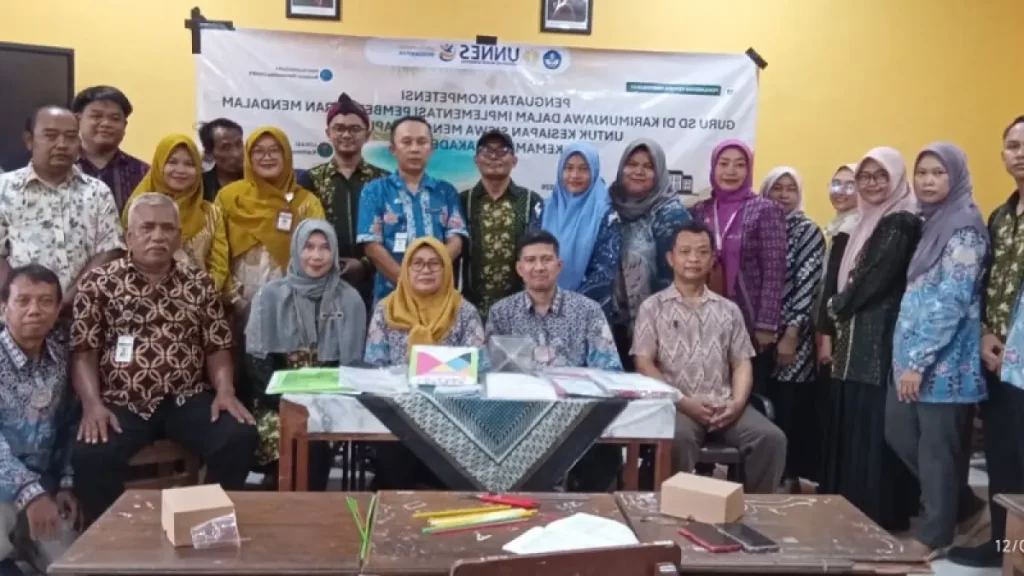
Lecturers and students from the Mathematics Group of FMIPA UNNES with elementary school teachers participating in the community service program at SD Negeri 6 Karimunjawa.
During the training, participants gained an understanding of the objectives and characteristics of the Academic Competency Test at the elementary school level, especially in mathematics. Teachers were also introduced to the concept of deep learning, which places learning as a conscious, meaningful, and enjoyable experience.
Unlike approaches that focus only on repeated practice questions, deep learning encourages students to understand the reasons behind a concept, connect knowledge with real experiences, and reflect on their thinking processes. This approach is considered relevant for building long-term academic competence.
This activity is also connected to SDG 10 on Reduced Inequalities. Training for teachers in island areas such as Karimunjawa is part of an effort to expand access to teacher competence development, so that learning innovation does not only grow in urban areas, but also reaches schools in island regions.
Teachers were guided to design mathematics learning based on the local context of Karimunjawa, develop student worksheets or LKPD containing exploration and reflection activities, and create TKA-style questions that measure conceptual understanding, reasoning, and problem-solving skills.
One of the community service team members, Dr. Emi Pujiastuti, M.Pd., stated that teachers need to view assessment as part of the learning process, not merely as a tool to measure learning outcomes.
“When teachers are able to apply formative assessment properly, they can identify students’ learning progress from the beginning and continuously improve the learning process,” she explained.
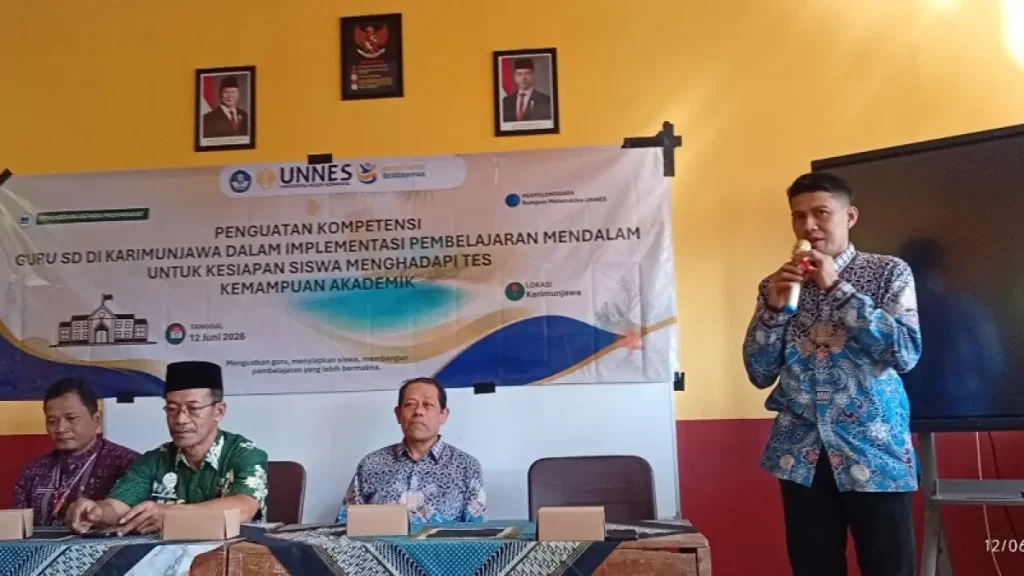
Elementary school teachers in Karimunjawa attended a deep learning training session to support students’ readiness for the Academic Competency Test.
In addition to receiving materials, each participant also produced teaching tools that could be directly implemented or adapted to the conditions of their respective schools. These products included lesson plans, student worksheets, TKA-style questions, assessment rubrics, and follow-up learning plans.
The participants showed strong enthusiasm throughout the activity. The teachers welcomed the approach that integrates the local context of Karimunjawa into mathematics learning because it was considered capable of increasing students’ engagement in the learning process.
One of the participating teachers stated that the training provided new insights into how to prepare students for academic assessment without reducing the quality of classroom learning.
Through this activity, FMIPA UNNES expects elementary school teachers in Karimunjawa to develop mathematics learning that is more contextual, reflective, and relevant to students’ needs. This activity also reflects FMIPA UNNES’ contribution to SDG 4 and SDG 10 through teacher competence strengthening, expanded access to learning innovation, and the development of quality education in island areas.