


Semarang – The Faculty of Mathematics and Natural Sciences (FMIPA), Universitas Negeri Semarang (UNNES), provides four Free Drinking Water Stations that can be accessed by students, lecturers, administrative staff, and visitors as part of its commitment to ensuring access to safe drinking water while promoting responsible water use across the campus. The four stations are located at the FMIPA Mosque, the FMIPA Dean’s Office, Building D1, and the Physics Laboratory, making them easily accessible for members of the academic community during teaching, research, and administrative activities.
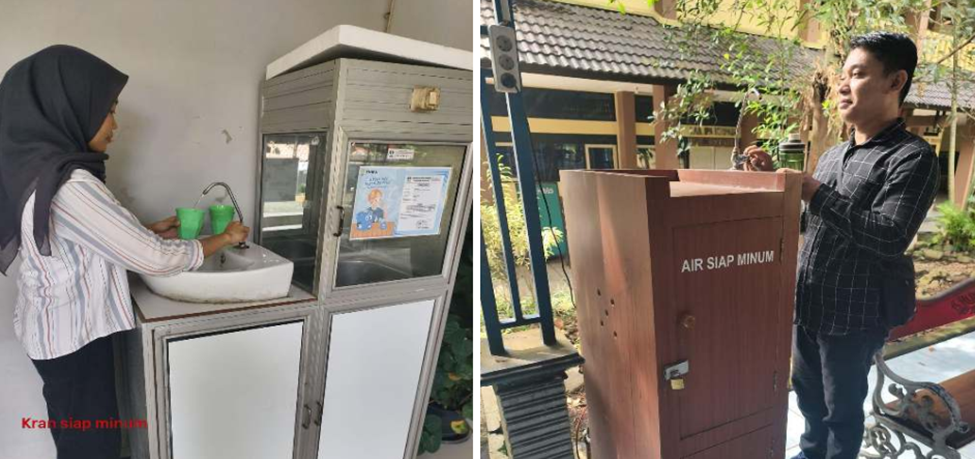
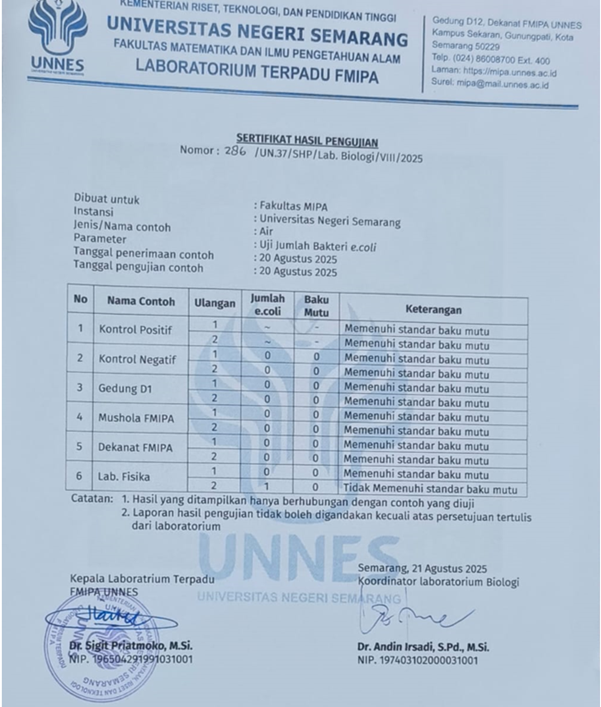
As part of its commitment to ensuring drinking water safety, FMIPA UNNES conducts annual water quality testing through an accredited laboratory. Laboratory test results obtained on 20 August 2025 confirmed that all drinking water stations met the required drinking water quality standards and were safe for consumption. Regular water quality monitoring forms part of the faculty’s efforts to prevent contaminated water from entering the drinking water supply system while ensuring that all users have access to water that meets public health standards.
The availability of these drinking water stations also serves as part of FMIPA UNNES’s campaign to promote responsible and conscious water consumption on campus. Members of the academic community are encouraged to bring reusable water bottles (tumblers) and utilize the refill stations, thereby reducing the use of single-use plastic bottles, minimizing plastic waste generation, and fostering a more sustainable consumption culture.
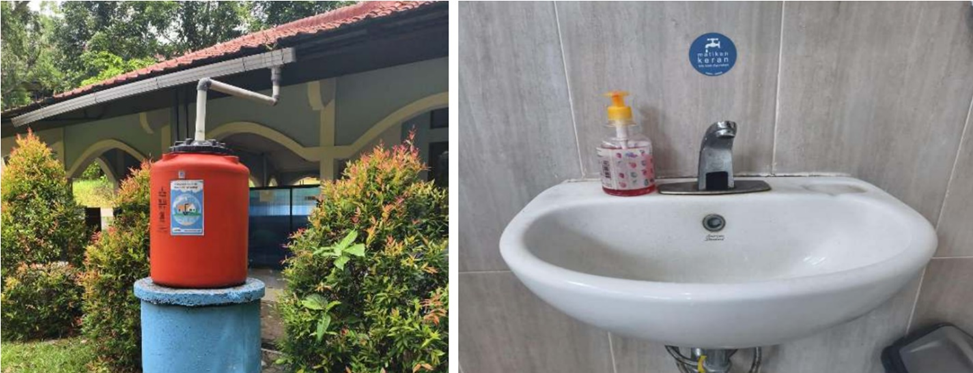
In addition to providing safe drinking water, FMIPA UNNES has implemented various water-efficient infrastructure strategies across the campus. Several restroom facilities have been equipped with automatic faucets designed to reduce water wastage by automatically stopping the water flow after use. This technology forms part of the faculty’s building design strategy to improve water-use efficiency.
FMIPA UNNES has also implemented a rainwater harvesting system through roof gutters connected to rainwater storage tanks. The harvested rainwater is utilized for various non-potable purposes, thereby reducing dependence on clean water supplies. Furthermore, condensate water generated from air conditioning (AC) systems is collected and reused for irrigating campus vegetation. The reuse of rainwater and AC condensate reflects the faculty’s commitment to improving water-use efficiency while supporting sustainable water conservation practices.
To further enhance water efficiency, FMIPA UNNES has designed its campus landscape to minimize irrigation requirements. A large proportion of the FMIPA campus consists of green open spaces populated with mature trees that help maintain the hydrological balance, increase rainwater infiltration, and reduce the need for intensive irrigation. Vegetation inventory data indicate that the most dominant tree species are mahogany (Swietenia mahagoni) with 76 individuals, mango (Mangifera indica) with 45 individuals, and Indian mast tree (Polyalthia longifolia) with 39 individuals. These species are well known for their high tolerance to dry conditions, making them suitable for water-efficient landscape management.
In providing drinking water services, FMIPA UNNES also applies sustainable drinking water technology through its drinking water station system, which treats water to potable standards and distributes it as a refill facility for the academic community. This system not only improves access to safe drinking water but also reduces the consumption of bottled drinking water and supports more sustainable water resource management across the campus.
This initiative contributes to the achievement of the Sustainable Development Goals (SDGs), particularly SDG 6 (Clean Water and Sanitation) through the provision of safe drinking water, routine water quality monitoring, water-saving technologies, rainwater and AC condensate reuse, promotion of responsible water consumption, and water-conserving landscape management. It also supports SDG 12 (Responsible Consumption and Production) by reducing the use of single-use plastic bottles and improving resource-use efficiency, as well as SDG 13 (Climate Action) by strengthening green open spaces and implementing water conservation practices that enhance environmental resilience on campus.