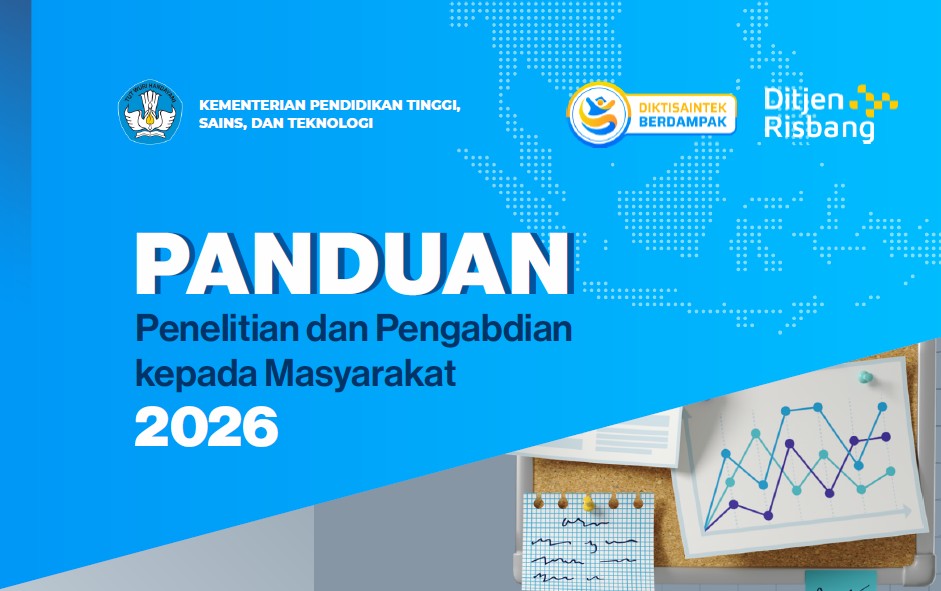
Ministry of Research, Technology and Higher Education Research and Community Service Guidelines for 2026

Universitas Negeri Semarang > Faculty of Social Sciences and Political Science > News > Ministry of Research, Technology and Higher Education Research and Community Service Guidelines for 2026

Higher education is a vital component of the national education system, serving not only to advance the nation’s intellectual capacity but also to drive innovation and the development of science and technology. Amid the dynamics of globalization, the transformation of higher education has become crucial to supporting social, ecological, and economic development, as well as achieving sustainable development goals.

To enhance the nation’s competitiveness in the era of globalization, higher education is expected to develop science and technology and produce academic individuals who are cultured, creative, tolerant, and resilient for the progress of the nation. Therefore, universities are obliged to implement education, research, and community service as outlined in the Tri Dharma of Higher Education, as mandated in Law Number 20 of 2003 Article 20 Paragraph (2) on the National Education System and Law Number 12 of 2012 on Higher Education.

The Directorate General of Research and Development (Ditjen Risbang) recognizes the importance of research and community service in higher education institutions. Therefore, Ditjen Risbang continues to strive to improve the quality of research and community service through research development that generates innovations beneficial to various stakeholders, including the government, industry, and society. Funding for research and community service originates from the State University Operational Assistance (BOPTN) budget and is allocated to lecturers within the Ministry of Higher Education, Science, and Technology (Kemdiktisaintek) based on the provisions of applicable regulations.

As an effort to support the implementation of the Tri Dharma of Higher Education, Ditjen Risbang through the Directorate of Research and Community Service (DPPM) has prepared the 2026 Research and Community Service Guidelines Book. Research and community service programs provide opportunities for university lecturers to collaborate and produce research that can serve as solutions and innovations in addressing societal needs and challenges, and such research outcomes may be disseminated and applied through community service activities. This guideline book is prepared to improve the quality and quantity of research and community service activities while aligning strategies and policies with the priority programs of Kemdiktisaintek in fostering and strengthening a scientific culture of research and development and addressing national social and economic issues.

The 2026 Research and Community Service Guidelines Book emphasizes the importance of research focusing on national problems and challenges, covering areas such as artificial intelligence, information and communication technology (ICT), automation, new and renewable energy, food and health technology, transportation and infrastructure, as well as advanced materials and nanotechnology.

These research focuses are aligned with the fields, themes, and topics outlined in Presidential Regulation Number 38 of 2018 on the National Research Master Plan 2017–2045. In addition, as a form of appreciation for Indonesia’s rich cultural diversity, research and community service are also expected to address issues of local wisdom that reflect the values, norms, and knowledge and technological systems embedded in society.

Finally, it is hoped that the publication of this guideline book will direct research and community service activities in higher education institutions toward producing inventions and innovations that address societal needs and enhance the competitiveness of the Indonesian nation.

Jakarta, November 2025
Directorate General of Research and Development

Attachment: 2026 Research and Community Service Guidelines

Related Posts

Leave a Reply

* Kode Akses Komentar:

* Tuliskan kode akses komentar diatas:

GDPR

  • Privacy Policy

Privacy Policy

At unnes.ac.id, the privacy of our visitors is of extreme importance to us. This privacy policy document outlines the types of personal information that is received and collected by unnes.ac.id and how it is used.

Log Files

Like many other Web sites, unnes.ac.id makes use of log files. The information inside the log files includes internet protocol (IP) addresses, type of browser, Internet Service Provider (ISP), date/time stamp, referring/exit pages, and number of clicks to analyze trends, administer the site, track user’s movement around the site, and gather demographic information. IP addresses and other such information are not linked to any information that is personally identifiable.

Cookies

unnes.ac.id uses cookies to store information about visitors’ preferences, to record user-specific information on which pages the site visitor accesses or visits, and to personalize or customize our web page content based upon visitors’ browser type or other information that the visitor sends via their browser.

Third-party ad servers or ad networks use technology in their respective advertisements and links that appear on unnes.ac.id and which are sent directly to your browser. They automatically receive your IP address when this occurs. Other technologies (such as cookies, JavaScript, or Web Beacons) may also be used by our site’s third-party ad networks to measure the effectiveness of their advertising campaigns and/or to personalize the advertising content that you see on the site.

unnes.ac.id has no access to or control over these cookies that are used by third-party advertisers.

You should consult the respective privacy policies of these third-party ad servers for more detailed information on their practices as well as for instructions about how to opt-out of certain practices. unnes.ac.id’s privacy policy does not apply to, and we cannot control the activities of, such other advertisers or web sites.

If you wish to disable cookies, you may do so through your individual browser options. More detailed information about cookie management with specific web browsers can be found at the browsers’ respective websites.

Consent

By using our website, you hereby consent to our privacy policy and agree to its terms.

Update

This Privacy Policy was last updated on: 2023-02-14. Should we update, amend or make any changes to our privacy policy, those changes will be posted here.

Contact Us

If you have any questions, comments, or concerns about our Privacy Policy or our practices with regards to your personal information, please feel free to contact us through the contact form on our website or by emailing us at humas[at]mail.unnes.ac.id.

This Privacy Policy is intended as a general guide to our practices in collecting and using information. If there is any inconsistency between this Privacy Policy and the terms of the Service Agreement or any other terms that may apply to specific services you use, then those specific service terms shall apply.

Terms of Use

By using our website, you agree to abide by this Privacy Policy. If you do not agree with this Privacy Policy, please do not use our website. We reserve the right to update this Privacy Policy from time to time without prior notice. Please review our Privacy Policy periodically to check for changes. Your continued use of our website following the posting of changes to this Privacy Policy means that you accept the changes.

Thank you for reading our Privacy Policy. We are committed to protecting the privacy of our website visitors and will continue to update our Privacy Policy to ensure optimal protection.