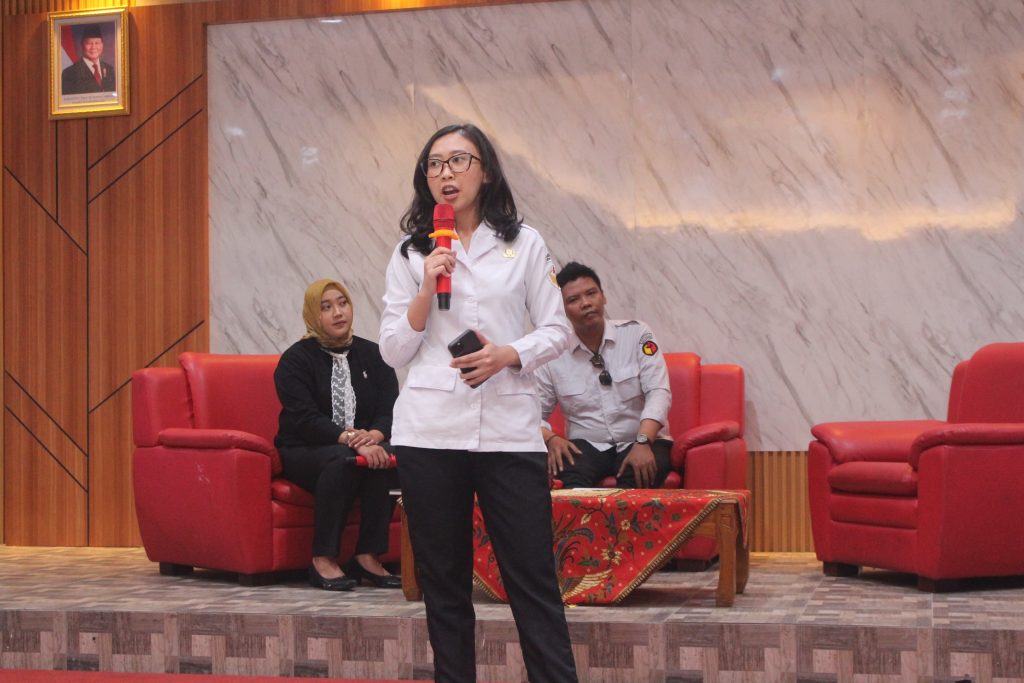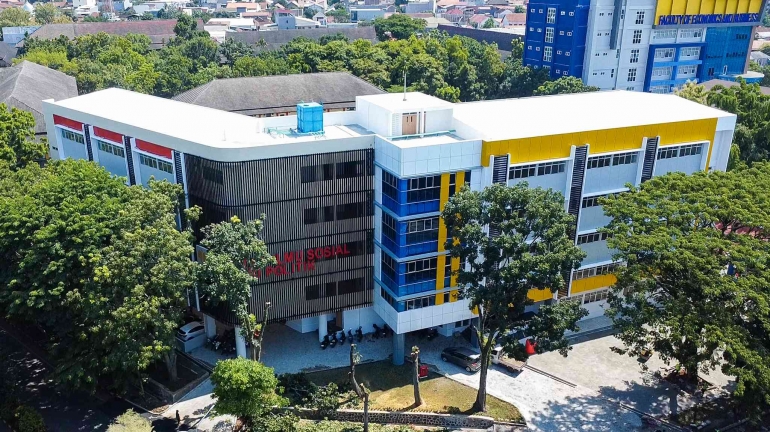


The Faculty of Social and Political Sciences (FISIP) collaborated with the Semarang City Election Supervisory Committee (Bawaslu) to hold a public lecture. This activity is part of the implementation of the partnership between FISIP and Bawaslu Semarang City, as outlined in the Implementation of Arrangement for the development of the Tri Dharma of Higher Education — education, research, and community service.
The guest speaker was Dwijaya Samudra Suryaman, a member of Bawaslu Semarang City and Coordinator of the Division for Prevention, Public Participation, and Public Relations. In his presentation, Dwijaya explained the legal foundations of election monitoring, including Law Number 7 of 2017 on General Elections, as well as several Bawaslu regulations related to prevention of violations, handling of reports, and participatory monitoring.
“Prevention is carried out through various supervisory measures by election monitors, as well as by involving public participation and media publications,” Dwijaya stated on Wednesday (October 8) at the C7 FISIP Auditorium, 3rd floor, Sekaran, Gunungpati, Semarang.
According to him, Bawaslu’s main duties include preventing and taking action against election violations, preventing money politics, and ensuring the neutrality of parties prohibited from participating in campaigns. Dwijaya also described various types of election violations, ranging from administrative violations and criminal offenses to ethical breaches by election organizers.
Students actively responded to the discussion. Khoirul Anam, a Civic Education (PPKn) student, emphasized the importance of understanding monitoring mechanisms to effectively prevent money politics.
Meanwhile, Muhammad Ferdiansyah highlighted Bawaslu’s role in preventing fraud during the vote recapitulation process. “In several cases, there have been vote shifts benefiting certain candidates. Bawaslu plays an important role in ensuring that the recapitulation process runs according to regulations,” he said.
Another PPKn student, Kirania Nafisatul Azahra, stressed the importance of individual awareness in rejecting money politics. “Money politics can create instability. Prevention must be carried out on a massive scale so that the election results truly reflect the people’s choice,” she stated.
Dwijaya also emphasized that without public supervision, elections risk losing their integrity. “Elections without oversight can lead to disenfranchisement, money politics, vote manipulation, and even conflict among supporters,” he concluded.
Through this activity, FISIP UNNES and Bawaslu Semarang City hope to foster volunteerism and active participation among students as agents of change in maintaining elections that are honest, fair, and uphold integrity.