

Semarang, August 15, 2026 — The Faculty of Mathematics and Natural Sciences (FMIPA) of Universitas Negeri Semarang (UNNES), through the Community Partnership Empowerment (PKM) program of DPPM Kemdiktisaintek 2026, encourages the strengthening of urban farming in Tugurejo Village, Semarang City. The program, titled “Revitalization of Narrow-Land Urban Farming Affected by Tidal Floods to Ensure Food Security in Tugurejo, Semarang,” was implemented to enhance the community’s capacity to utilize limited land while facing tidal flood inundation and brackish water conditions.
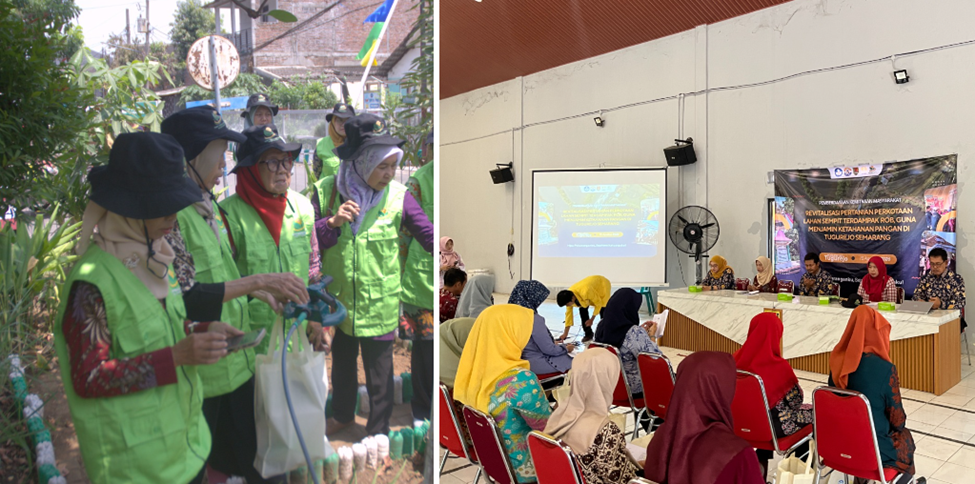
This program stems from the condition of Tugurejo as a coastal area facing various environmental pressures. Recent research on household adaptive capacity in Tugurejo shows that the community faces exposure to tidal floods, seawater intrusion, and other environmental pressures, while most households fall into the moderate adaptive capacity category. The research also recommends strengthening social networks, increasing climate literacy, and urban farming as part of the empowerment strategy for coastal communities.
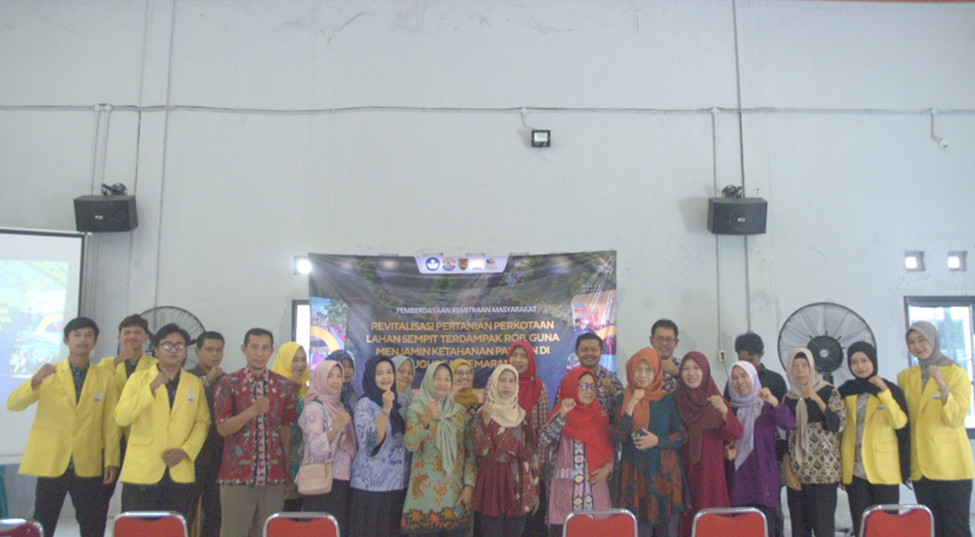
The activity was chaired by Amnan Haris, M.Ling., along with Rifa’ Atunnisa, Ph.D., and Prof. Wiyanto, all three of whom are lecturers at FMIPA UNNES. The event was also attended by the Head of Tugurejo Village MT. Munjaenah, S.E., the Head of the Wema Mekar Women Farmers Group (KWT) Dwi Yulianti, Abdul Karim from BPP Tugu District, the Head of RW 05, the Heads of RT 01–07, KWT members, representatives of the Mawar Merah Waste Bank, and the PKK of RW 05.
Various materials were provided according to the community’s needs. Participants received education on brackish water irrigation and filtration, soil health, the use of organic fertilizers, and plant management suited to land conditions affected by tidal floods. Participants were also introduced to family medicinal plants (TOGA) as an alternative for utilizing narrow land to support household needs as well as food security.
One of the innovations introduced was Internet of Things (IoT)-based drip irrigation. This technology allows for more measured water delivery directly to the plant root zone, enabling water usage to be carried out more efficiently. The introduction of this technology is an initial step toward urban farming practices that are more adaptive to limited land and water resources.
The program is also directed so that the community not only acquires knowledge but is capable of applying it independently. Capacity building for KWT and community groups is expected to increase the productivity of narrow land, support household food availability, and open up opportunities for developing economic activities based on urban farming.
This approach aligns with research findings in Tugurejo showing the importance of urban farming as one of the community empowerment strategies, especially in areas with limited productive land and coastal environmental pressures. The research also found that social capital, particularly participation in community organizations, is a highly important asset in strengthening household adaptive capacity.
In terms of sustainability, this activity is expected to provide positive impacts in the form of increasing the community’s capacity to manage land and water, strengthening household food security, increasing climate adaptation literacy, and the development of urban farming practices that are more efficient and suited to coastal conditions.
This activity also contributes to the Sustainable Development Goals (SDGs), primarily SDG 1 (No Poverty) through strengthening the capacity and livelihood resilience of vulnerable communities, SDG 2 (Zero Hunger) through strengthening household food security, SDG 11 (Sustainable Cities and Communities) through the development of adaptive urban farming, and SDG 13 (Climate Action) through increasing the community’s adaptation capacity to the impacts of climate change. This connection is also reinforced by the Tugurejo research, which explicitly identifies the contribution of the community empowerment strategy to SDG 1, SDG 11, and SDG 13.
By connecting the results of scientific studies with direct intervention in the community, this 2026 DPPM Kemdiktisaintek PKM program becomes an example of applying higher education knowledge to answer real problems in coastal areas. Urban farming is positioned not only as a cultivation activity but as an instrument to strengthen food security, adaptation capacity, and the resilience of the Tugurejo community against the pressures of climate change.