
FMIPA UNNES Research Team Develops Natural-Based Nanomaterials for UV Protection and Antioxidants

Universitas Negeri Semarang/Faculty of Mathematics and Natural Sciences/Berita/FMIPA UNNES Research Team Develops Natural-Based Nanomaterials for UV Protection and Antioxidants
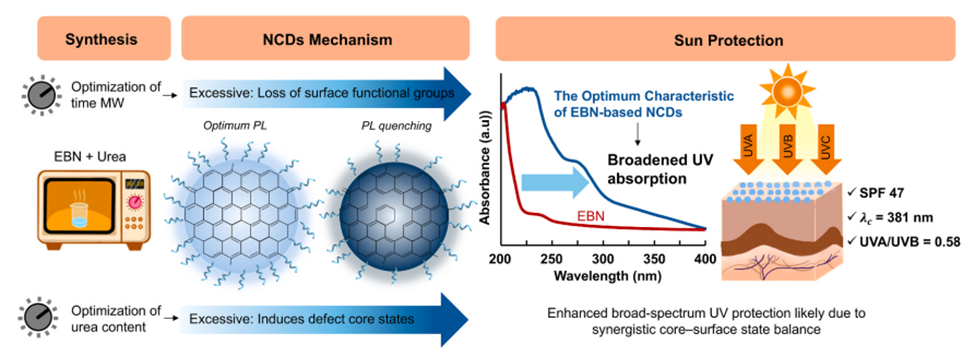
A white-background scientific graphical abstract divided into Synthesis, NCDs Mechanism, and Sun Protection sections, illustrating a microwave synthesis unit, carbon dot molecular structures, a UV absorbance graph from 200 to 400 nm, and a skin diagram blocking UVA, UVB, and UVC rays.

SEMARANG – The utilization of natural ingredients as sources of high-tech materials continues to be developed to support sustainable innovation. Prof. Mahardika Prasetya Aji, together with a research team from the Faculty of Mathematics and Natural Sciences, Universitas Negeri Semarang (FMIPA UNNES), has developed carbon nanoparticles (carbon dots) derived from parijoto fruit and edible bird’s nest that hold potential as antioxidant and ultraviolet (UV) radiation-protective materials.

The research resulted in two publications in reputable Scopus-indexed international journals in 2026, namely “Carbon Dots Nanoparticles Derived from Showy Asian Grapes (Medinilla speciosa) for Free Radical Scavenger” in Materials Science and Technology and “Facile Approach to Broaden UV-Absorbing Sun Protection via Structural Transformation of Edible Bird Nest into Nitrogen-Doped Carbon Dots” in Next Materials.

Both studies utilize nanomaterial technology to transform natural ingredients into ultra-small carbon particles with specific functional properties. Through a microwave-assisted process, the research team successfully produced materials with potential applications in health and body protection.

In the first study, the peel of parijoto fruit (Medinilla speciosa) was processed into carbon nanoparticles exhibiting an antioxidant activity of 73.82% at a test concentration of 5 mg/mL. This result demonstrates the material’s potential in scavenging free radicals, serving as a foundation for developing functional ingredients for biomedical applications and health products.

Meanwhile, the second study utilized edible bird’s nest as the base material for producing nitrogen-doped carbon dots. Test results indicated UV radiation absorption capability with a Sun Protection Factor (SPF) value of 46.46 and broad-spectrum UV protection coverage. These findings open opportunities for developing natural-based UV-protective materials, although further safety and efficacy testing is still required before application in sunscreen products.

The positive impact of both studies lies in opening opportunities to utilize biological resources into value-added nanomaterials for health protection technology. The development of materials based on parijoto and edible bird’s nest also expands raw material alternatives in functional material innovation while encouraging research that harnesses natural resource potential.

This research supports the Sustainable Development Goals (SDGs), particularly SDG 9 (Industry, Innovation and Infrastructure) through nanomaterial technology development, and has the potential to support SDG 3 (Good Health and Well-being) through the development of candidate antioxidant and UV-protective materials. In addition, this research is relevant to SDG 12 (Responsible Consumption and Production) through the exploration of natural ingredients as sources of functional materials, although its sustainability benefits still require further evaluation.

Through these two publications, Prof. Mahardika Prasetya Aji and the FMIPA UNNES team demonstrate their contribution to developing bio-based nanotechnology. These research findings are expected to serve as a scientific foundation for functional material innovations beneficial to health and sustainable technology development.
Related Posts

Leave a Reply

* Kode Akses Komentar:

* Tuliskan kode akses komentar diatas:

GDPR

  • Privacy Policy

Privacy Policy

At unnes.ac.id, the privacy of our visitors is of extreme importance to us. This privacy policy document outlines the types of personal information that is received and collected by unnes.ac.id and how it is used.

Log Files

Like many other Web sites, unnes.ac.id makes use of log files. The information inside the log files includes internet protocol (IP) addresses, type of browser, Internet Service Provider (ISP), date/time stamp, referring/exit pages, and number of clicks to analyze trends, administer the site, track user’s movement around the site, and gather demographic information. IP addresses and other such information are not linked to any information that is personally identifiable.

Cookies

unnes.ac.id uses cookies to store information about visitors’ preferences, to record user-specific information on which pages the site visitor accesses or visits, and to personalize or customize our web page content based upon visitors’ browser type or other information that the visitor sends via their browser.

Third-party ad servers or ad networks use technology in their respective advertisements and links that appear on unnes.ac.id and which are sent directly to your browser. They automatically receive your IP address when this occurs. Other technologies (such as cookies, JavaScript, or Web Beacons) may also be used by our site’s third-party ad networks to measure the effectiveness of their advertising campaigns and/or to personalize the advertising content that you see on the site.

unnes.ac.id has no access to or control over these cookies that are used by third-party advertisers.

You should consult the respective privacy policies of these third-party ad servers for more detailed information on their practices as well as for instructions about how to opt-out of certain practices. unnes.ac.id’s privacy policy does not apply to, and we cannot control the activities of, such other advertisers or web sites.

If you wish to disable cookies, you may do so through your individual browser options. More detailed information about cookie management with specific web browsers can be found at the browsers’ respective websites.

Consent

By using our website, you hereby consent to our privacy policy and agree to its terms.

Update

This Privacy Policy was last updated on: 2023-02-14. Should we update, amend or make any changes to our privacy policy, those changes will be posted here.

Contact Us

If you have any questions, comments, or concerns about our Privacy Policy or our practices with regards to your personal information, please feel free to contact us through the contact form on our website or by emailing us at humas[at]mail.unnes.ac.id.

This Privacy Policy is intended as a general guide to our practices in collecting and using information. If there is any inconsistency between this Privacy Policy and the terms of the Service Agreement or any other terms that may apply to specific services you use, then those specific service terms shall apply.

Terms of Use

By using our website, you agree to abide by this Privacy Policy. If you do not agree with this Privacy Policy, please do not use our website. We reserve the right to update this Privacy Policy from time to time without prior notice. Please review our Privacy Policy periodically to check for changes. Your continued use of our website following the posting of changes to this Privacy Policy means that you accept the changes.

Thank you for reading our Privacy Policy. We are committed to protecting the privacy of our website visitors and will continue to update our Privacy Policy to ensure optimal protection.