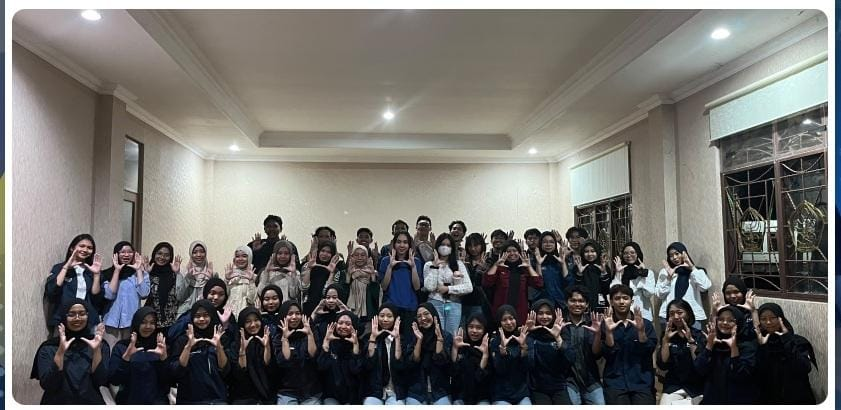


FMIPA UNNES Holds International Guest Lecture on Environmental Mineralogy and Geochemistry

Universitas Negeri Semarang/Faculty of Mathematics and Natural Sciences/Berita/FMIPA UNNES Holds International Guest Lecture on Environmental Mineralogy and Geochemistry
Students attend an international guest lecture on environmental mineralogy and geochemistry at FMIPA UNNES.

Semarang, July 29, 2026 — The Faculty of Mathematics and Natural Sciences at Universitas Negeri Semarang (FMIPA UNNES) held an international guest lecture entitled Environmental Mineralogy, Geochemistry and Sediment Archives for Sustainable Environmental Management on Wednesday, July 29, 2026, at the Smart Classroom of the D3 Building, FMIPA UNNES. The event featured international speaker Łukasz Kruszewski, Ph.D., an Associate Professor at the Institute of Geological Sciences, Polish Academy of Sciences, Poland.

The guest lecture provided an academic platform for students and lecturers to broaden their understanding of the role of environmental mineralogy, geochemistry, and sediment archives in supporting sustainable environmental management. During his presentation, Dr. Kruszewski explained how mineral characteristics, geochemical composition, and sediment records can be used to reconstruct environmental changes, identify pollution sources, evaluate environmental quality, and support evidence-based decision-making in natural resource management.

The event was attended by students from the Science Education, Environmental Science, and Physics fields at FMIPA UNNES. Participants showed strong enthusiasm during the interactive discussion, which addressed various global environmental issues, including heavy metal pollution, sediment dynamics, and the application of geochemical analysis in mitigating environmental problems.

The event was also attended by Prof. Dr. Supriyadi, M.Si., and Dr. Khumaedi, M.Si., from the Physics Department at UNNES; Dr. Andhina Putri Heriyanti, S.T., M.Si., Coordinator of the Environmental Science Study Program; Fidia Fibriana, Ph.D., Coordinator of the Science Education Study Program; and Prof. Dr. Tri Retnaningsih Soeprobowati, M.App.Sc., Director of CPalim, the Cluster for Paleolimnology at Universitas Diponegoro.

Several lecturers from the Environmental Science Study Program at UNNES were also present, including Yogiswara Danurrachman, M.Ling.; Rifa Atunnisa, Ph.D.; Trida Ridho Fariz, M.Sc.; Amnan Haris, M.Ling.; M. Ahganiya Naufal, M.Si.; and Abdul Jabbar, M.Ling. The participation of study program leaders, multidisciplinary lecturers, academics, and students from various fields demonstrated FMIPA UNNES’s commitment to strengthening interdisciplinary collaboration in addressing increasingly complex environmental challenges.
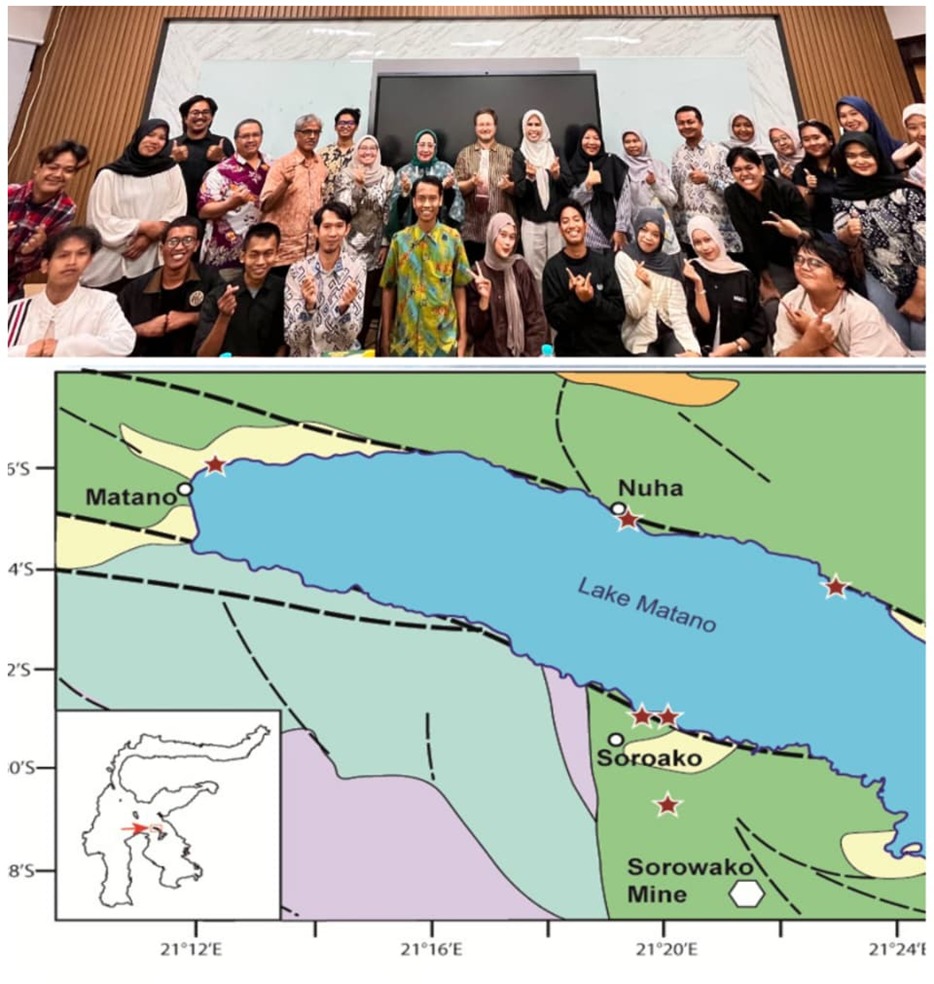
The speaker, lecturers, and students pose together after the guest lecture. The documentation also features a map of Lake Matano as an illustration of environmental and sediment archive studies.

Through the guest lecture, participants gained a deeper understanding of the importance of geoscientific approaches in supporting sustainable development. Environmental mineralogy and geochemistry contribute not only to fundamental research but also to a wide range of applications, including environmental quality monitoring, natural resource management, conservation, and the mitigation of human impacts on ecosystems.

In addition to strengthening international academic relations between UNNES and the Institute of Geological Sciences at the Polish Academy of Sciences, the event is expected to initiate collaborative research, joint scientific publications, academic exchanges, and innovation development in environmental science, geology, and earth sciences.

The guest lecture also supported the achievement of several Sustainable Development Goals (SDGs), including SDG 4: Quality Education through the improvement of higher education quality and international knowledge transfer; SDG 6: Clean Water and Sanitation through a deeper understanding of environmental quality and pollution; SDG 13: Climate Action through the use of sediment archives as records of environmental and climatic changes; SDG 15: Life on Land through strengthened scientific data-based management of terrestrial ecosystems; and SDG 17: Partnerships for the Goals through enhanced international academic cooperation between UNNES and the Polish Academy of Sciences.
Related Posts

Leave a Reply

* Kode Akses Komentar:

* Tuliskan kode akses komentar diatas:

GDPR

  • Privacy Policy

Privacy Policy

At unnes.ac.id, the privacy of our visitors is of extreme importance to us. This privacy policy document outlines the types of personal information that is received and collected by unnes.ac.id and how it is used.

Log Files

Like many other Web sites, unnes.ac.id makes use of log files. The information inside the log files includes internet protocol (IP) addresses, type of browser, Internet Service Provider (ISP), date/time stamp, referring/exit pages, and number of clicks to analyze trends, administer the site, track user’s movement around the site, and gather demographic information. IP addresses and other such information are not linked to any information that is personally identifiable.

Cookies

unnes.ac.id uses cookies to store information about visitors’ preferences, to record user-specific information on which pages the site visitor accesses or visits, and to personalize or customize our web page content based upon visitors’ browser type or other information that the visitor sends via their browser.

Third-party ad servers or ad networks use technology in their respective advertisements and links that appear on unnes.ac.id and which are sent directly to your browser. They automatically receive your IP address when this occurs. Other technologies (such as cookies, JavaScript, or Web Beacons) may also be used by our site’s third-party ad networks to measure the effectiveness of their advertising campaigns and/or to personalize the advertising content that you see on the site.

unnes.ac.id has no access to or control over these cookies that are used by third-party advertisers.

You should consult the respective privacy policies of these third-party ad servers for more detailed information on their practices as well as for instructions about how to opt-out of certain practices. unnes.ac.id’s privacy policy does not apply to, and we cannot control the activities of, such other advertisers or web sites.

If you wish to disable cookies, you may do so through your individual browser options. More detailed information about cookie management with specific web browsers can be found at the browsers’ respective websites.

Consent

By using our website, you hereby consent to our privacy policy and agree to its terms.

Update

This Privacy Policy was last updated on: 2023-02-14. Should we update, amend or make any changes to our privacy policy, those changes will be posted here.

Contact Us

If you have any questions, comments, or concerns about our Privacy Policy or our practices with regards to your personal information, please feel free to contact us through the contact form on our website or by emailing us at humas[at]mail.unnes.ac.id.

This Privacy Policy is intended as a general guide to our practices in collecting and using information. If there is any inconsistency between this Privacy Policy and the terms of the Service Agreement or any other terms that may apply to specific services you use, then those specific service terms shall apply.

Terms of Use

By using our website, you agree to abide by this Privacy Policy. If you do not agree with this Privacy Policy, please do not use our website. We reserve the right to update this Privacy Policy from time to time without prior notice. Please review our Privacy Policy periodically to check for changes. Your continued use of our website following the posting of changes to this Privacy Policy means that you accept the changes.

Thank you for reading our Privacy Policy. We are committed to protecting the privacy of our website visitors and will continue to update our Privacy Policy to ensure optimal protection.