



SURABAYA – Professor of the Faculty of Mathematics and Natural Sciences (FMIPA), Universitas Negeri Semarang (UNNES), Prof. Dr. Niken Subekti, M.Si., served as a facilitator in the Batch I Training on Vector, Disease-Carrying Animal, and Residential Pest Control for Responsible Personnel, organized by UPT Pelatihan Kesehatan Masyarakat Murnajati East Java.
The training was held from January 12 to 22, 2026, at the Surabaya Campus. Prof. Niken delivered her session on January 19, 2026, focusing on termite bionomics and surveillance as part of vector, disease-carrying animal, and residential pest control.
The training was designed to strengthen the competence of responsible personnel in understanding biological aspects, surveillance, and control strategies for organisms that may affect environmental health. Through this program, participants were expected to gain stronger technical capacity in managing health-related risks in residential and public environments.
This activity is related to the Sustainable Development Goals (SDGs), particularly SDG 3 on Good Health and Well-being. By strengthening competence in vector and residential pest control, the training supports efforts to create healthier environments and reduce health risks that may arise from disease-carrying organisms and residential pests.
In her session, Prof. Niken presented materials on termite bionomics and surveillance. These topics are important because residential pest control requires not only technical treatment, but also a scientific understanding of biological characteristics, life behavior, distribution patterns, and environmental factors that influence the presence of target organisms.
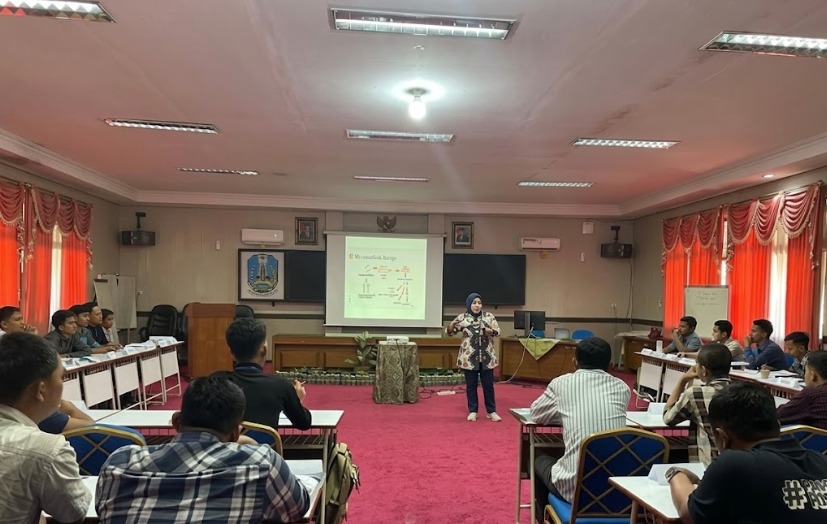
Prof. Dr. Niken Subekti, M.Si., delivers a session on termite bionomics and surveillance during the vector and residential pest control training.
Through the training session, participants gained knowledge of basic identification, monitoring, and management of residential pests, particularly termites. Understanding termite bionomics is essential because termites may cause damage to buildings, public facilities, and residential environments if they are not properly monitored and controlled.
In addition to bionomics, participants were also introduced to surveillance as a basis for decision-making in residential pest control. Surveillance is needed to identify field conditions, risk levels, and control strategies that are appropriate to the characteristics of each environment.
Prof. Niken’s involvement in this training reflects FMIPA UNNES’ scientific contribution to strengthening human resource capacity in environmental health. As a biology academic, Prof. Niken has relevant expertise in organism studies, ecology, and science-based residential pest control.
The training is also connected to SDG 4 on Quality Education because it focuses on improving participants’ knowledge and professional competence through expert-based learning. The materials helped participants understand vector and residential pest control in a more scientific, measurable, and field-oriented way.
The training also reinforces the role of higher education institutions in connecting scientific knowledge with practical needs in society. Through this activity, academic knowledge is not limited to classrooms and research, but is also applied to support professional competence in the environmental health sector.
FMIPA UNNES views the involvement of lecturers in cross-institutional activities as part of the faculty’s contribution to the development of science and community service. Collaboration between higher education institutions and health training centers is important to improve the quality of training based on expertise, field data, and professional needs.
Through this activity, FMIPA UNNES expects academic contributions in vector and residential pest control training to continue expanding. Synergy between higher education institutions, health agencies, and field personnel is expected to support healthier, safer, and more sustainable residential environment management. This activity also reflects FMIPA UNNES’ contribution to SDG 3 and SDG 4 through health education, capacity building, and the application of biological science in vector and residential pest control.