


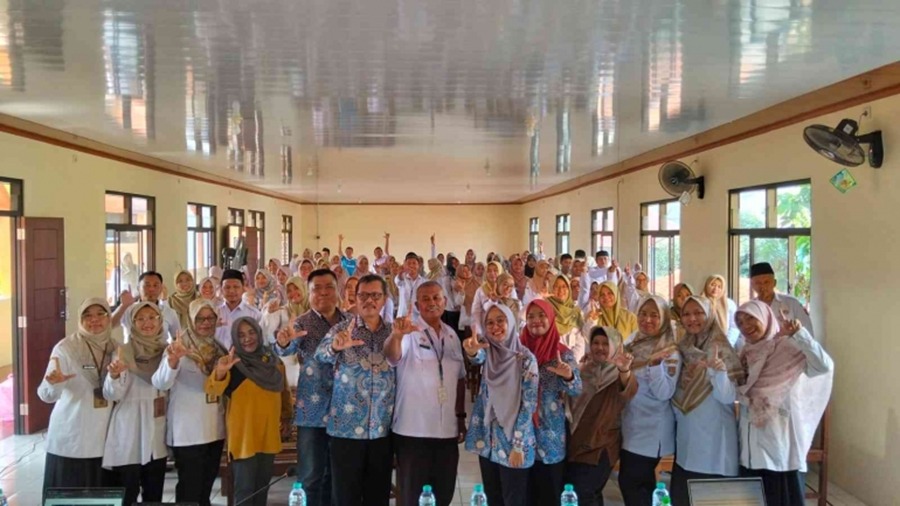
SEMARANG – Universitas Negeri Semarang (UNNES) has once again demonstrated its commitment to supporting educational transformation through technology-driven community service activities. A UNNES Community Service Team led by Devy Lestari, S.Pd., M.Pd., held a program entitled “Strengthening Elementary School Teachers’ Competencies in Developing Internet of Things (IoT)-Based Science and Social Studies (IPAS) Learning Media at the Dewi Kunthi Teachers’ Working Group (KKG) in Semarang” on Wednesday, May 6, 2026, at SD Negeri Sekaran 01, Gunungpati District, Semarang City. The activity was attended by teachers from 10 elementary schools affiliated with KKG Gugus Dewi Kunthi. The program aimed to enhance teachers’ competencies in utilizing technology as a more contextual, interactive, and real-data-based IPAS learning medium.
During the activity, the community service team introduced an innovative learning medium called SciSense Edu, a sensor-based learning device capable of measuring environmental light, temperature, and humidity in real time. This medium is designed to help students carry out scientific processes directly through observing, measuring, analyzing, and drawing conclusions from data in their surrounding environment. Visualizations of the device’s usage and instructional implementation guidelines were also compiled into a pocket guide on IoT-based IPAS learning innovation.
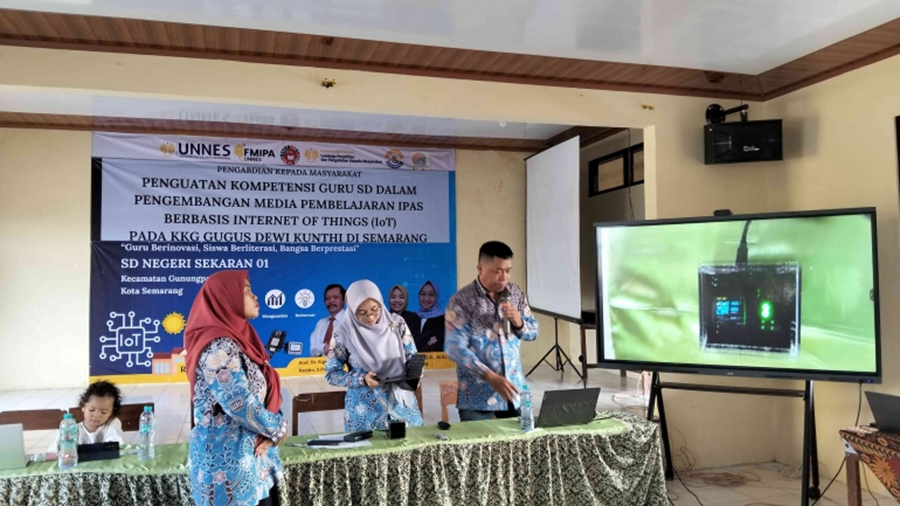
The head of the community service team, Devy Lestari, S.Pd., M.Pd., explained that IPAS learning needs to be directed toward real-world learning experiences so that students not only grasp theoretical concepts, but also develop scientific and critical thinking skills. “Through SciSense Edu, students can learn using real data from their surrounding environment. Learning becomes more meaningful because students do not merely listen to the teacher’s explanation, but also conduct observations and analyses directly,” she said.
The community service program featured several speakers from the team, namely Prof. Dr. Sigit Priatmoko, M.Si., Harjito, S.Pd., M.Sc., and Endah Fitriani Rahayu, S.Si., M.Sc. The topics covered included the importance of laboratory activities in science learning, data literacy in IPAS instruction, the utilization of the Internet of Things (IoT) in education, and hands-on practice using SciSense Edu. During the practical session, teachers measured temperature, light, and humidity at several points around the school environment using IoT sensors. The measurement results were then analyzed together as an example of implementing scientific investigation- and data literacy-based learning.
The Principal of SD Negeri Sekaran 01 and Chair of KKG Gugus Dewi Kunthi, Santoso, expressed his appreciation for the community service activity. According to him, the training provided teachers with new experience in developing instruction aligned with technological advancements and current student needs. “This activity is highly beneficial for our teachers. Until now, IoT-based technology learning has rarely been implemented in elementary schools. Through this training, teachers gained both insights and hands-on practice that are very applicable in the classroom,” he remarked.
A similar sentiment was shared by one of the participants, Rio from SD IT Mutiara Hati. He noted that using SciSense Edu makes IPAS learning more engaging and easier for students to understand. “Usually, IPAS learning is mostly theoretical. With this tool, students can immediately see real data from their surroundings, making the lesson feel more alive and making students more enthusiastic,” he said.
Beyond the training session, the community service team also prepared a sustainability program as a tangible form of post-activity implementation. Teachers were asked to apply SciSense Edu in classroom instruction at their respective schools and document it in the form of learning highlight videos. The best implementation videos will receive certificates of appreciation from the community service team in recognition of teacher innovation.
According to Devy Lestari, program sustainability is a crucial element so that instructional innovations are genuinely applied in schools. “We hope teachers do not stop at the training alone, but truly implement data- and technology-based learning in the classroom so that it can improve the quality of IPAS instruction in elementary schools,” she added.
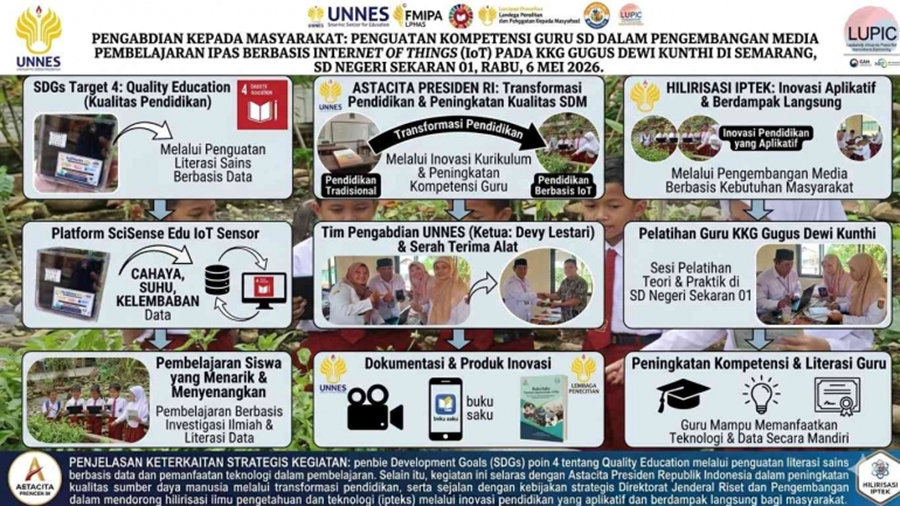
This community service program supports the achievement of the Sustainable Development Goals (SDGs), namely:
- SDG 4 (Quality Education): By strengthening teacher competencies and data-based science literacy in IPAS learning.
- SDG 9 (Industry, Innovation and Infrastructure): Through the introduction and utilization of sensor technology and Internet of Things (IoT) innovations as learning media in elementary schools.
- SDG 17 (Partnerships for the Goals): Through collaboration among higher education institutions, elementary schools, and the Teachers’ Working Group (KKG) in developing and implementing instructional innovations.
Furthermore, this activity aligns with the Astacita vision of the President of the Republic of Indonesia in enhancing human resource quality through educational transformation, and is in line with the strategic policy of the Directorate General of Research and Development in promoting the downstreaming of science and technology (ipteks) through practical educational innovations that deliver direct impact to society.
Through this initiative, UNNES hopes that collaboration between higher education institutions and schools will continue to strengthen instructional innovation, improve teachers’ technological literacy, and prepare a younger generation that is more critical, creative, and adaptive to changing times.