


Semarang – The Faculty of Mathematics and Natural Sciences (FMIPA), Universitas Negeri Semarang (UNNES), held the FMIPA Dialogue Forum (Sarasehan FMIPA) 2025 under the theme “Uniting Aspirations, Building Innovation, Realizing a Progressive FMIPA” on Friday, 13 June 2025, at the D4 Building Hall, FMIPA UNNES. The event, initiated and technically organized by the Student Executive Board (BEM) of FMIPA UNNES and facilitated by the faculty, served as an open forum where students could directly communicate their aspirations, constructive criticism, suggestions, and innovative ideas to the faculty leadership for the continuous advancement of FMIPA UNNES.
The dialogue forum was attended by the Dean of FMIPA UNNES, Prof. Dr. Edy Cahyono, M.Si., accompanied by the Vice Dean for Academic Affairs and Student Affairs, Zaenal Abidin, S.Si., M.Cs., Ph.D., the Vice Dean for Planning and Resources, Dr. Isnarto, M.Si., the Vice Dean for Business, Research, and Cooperation, Prof. Dr. Sutikno, M.T., as well as the heads of the faculty administrative divisions: RM Praptono Putra Dwi Kurniawan, S.S. (Academic and Student Affairs Administration), Niken Dhuharini, S.Pd. (Finance and Business Administration), and Elsry Widaratri, S.E., M.M. (General Affairs, Human Resources, and Cooperation Administration).
The event also involved all Heads of Study Programs, Laboratory Coordinators, members of the FMIPA Student Executive Board (BEM), and representatives from student associations (HIMA) and other student organizations (Ormawa) across FMIPA UNNES. Their participation reflected a shared commitment to fostering open communication and collaborative governance within the faculty.
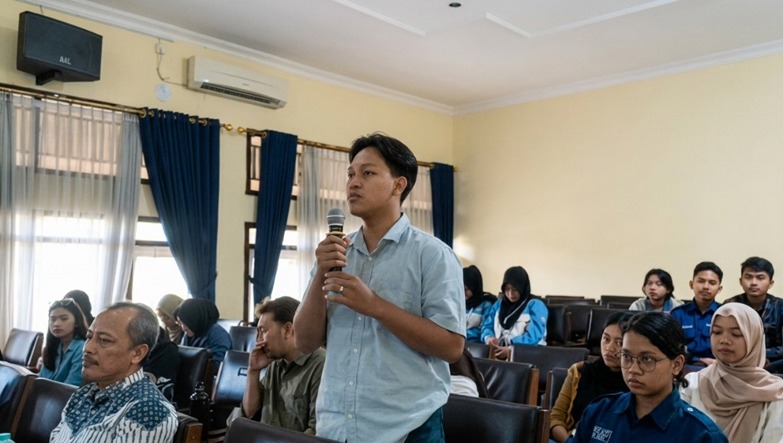
During the discussion session, students presented various aspirations related to academic services, learning facilities, administrative services, student activities, laboratory development, and innovative ideas aimed at enhancing the quality of education and student services at FMIPA UNNES. Faculty leaders responded directly to these concerns through an open and constructive dialogue, demonstrating the faculty’s commitment to continuous evaluation and improvement.
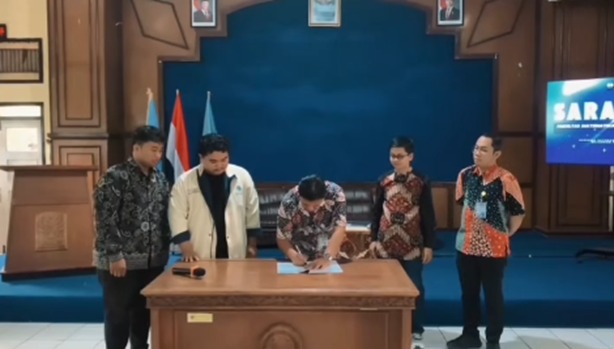
Student representatives sign and submit the results of the 2025 FMIPA UNNES Dialogue Forum as a formal record of student aspirations and recommendations.
Dean of FMIPA UNNES, Prof. Dr. Edy Cahyono, M.Si., emphasized that the dialogue forum serves as an important communication platform for strengthening collaboration between students and faculty leadership. Through this forum, students are provided with opportunities to voice their perspectives directly, while the faculty gains valuable input that supports the refinement of policies and the enhancement of academic and student services.
As an aspiration program initiated by the FMIPA Student Executive Board (BEM), the FMIPA Dialogue Forum 2025 exemplifies effective collaboration between student organizations and the faculty. This partnership demonstrates that faculty development is not solely the responsibility of administrators but also requires the active participation of students as strategic partners in creating an innovative, responsive, and student-centered academic environment.
The dialogue generated valuable recommendations that will contribute to future program planning, service improvements, and more responsive decision-making processes within the faculty. Beyond strengthening relationships between students and faculty leaders, the forum also promoted a culture of transparency, constructive dialogue, and collaboration, supporting the realization of a more inclusive and progressive faculty governance system.
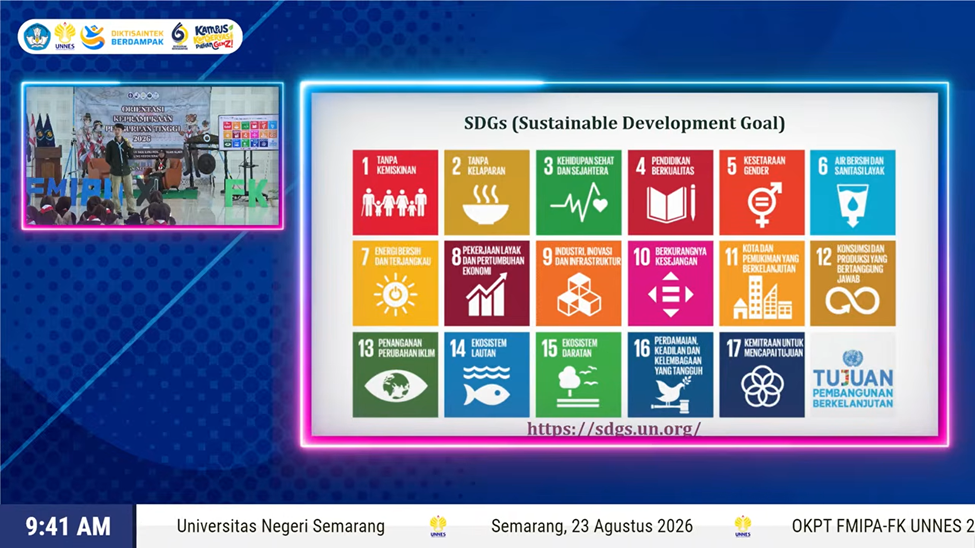
This initiative also contributes to the achievement of the United Nations Sustainable Development Goals (SDGs), Goal 16: Peace, Justice and Strong Institutions, particularly Target 16.7: “Ensure responsive, inclusive, participatory and representative decision-making at all levels.” By facilitating meaningful dialogue among faculty leaders, administrative staff, and student representatives, FMIPA UNNES continues to promote transparent, inclusive, and participatory decision-making as an essential component of good university governance.