



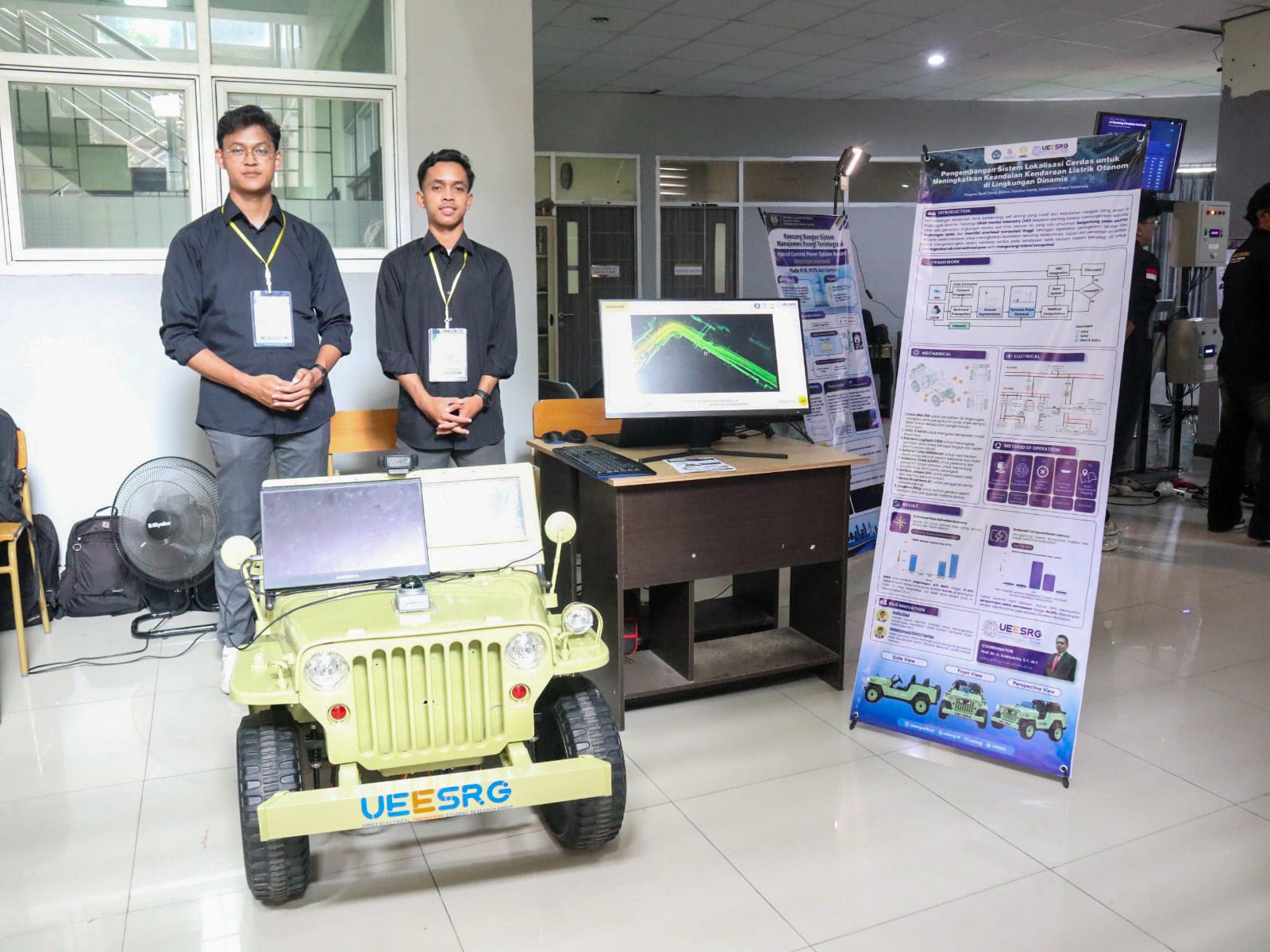
SEMARANG — Two Computer Engineering students from the Faculty of Engineering, Universitas Negeri Semarang (FT UNNES), Saiful Rizqi and Muhammad Hilmi Farras, unveiled an advanced autonomous electric vehicle prototype during the EXPO Capstone exhibition at Building E11, FT UNNES, on Wednesday (November 11, 2026). The intelligent vehicle platform focuses on enhancing positional accuracy and operational reliability through the implementation of LiDAR-Inertial Odometry (LIO).
The project addresses one of the core challenges in autonomous mobility: enabling a vehicle to perceive its surroundings (perception) and accurately determine its real-time position and orientation (localization) to support safe autonomous navigation. To achieve this, Rizqi and Farras engineered a tightly integrated hardware architecture combining spatial mapping sensors, computer vision, inertial tracking, and high-performance edge AI computing.
For environmental perception, the vehicle utilizes a Livox Mid-360 LiDAR sensor to capture comprehensive 3D point cloud spatial data, paired with a Logitech camera for visual input and an Inertial Measurement Unit (IMU) to measure vehicle acceleration and angular velocity. All multi-sensor streams are processed in real time by an NVIDIA Jetson Orin, which serves as the primary onboard computing unit executing autonomous perception, localization, and decision-making algorithms.
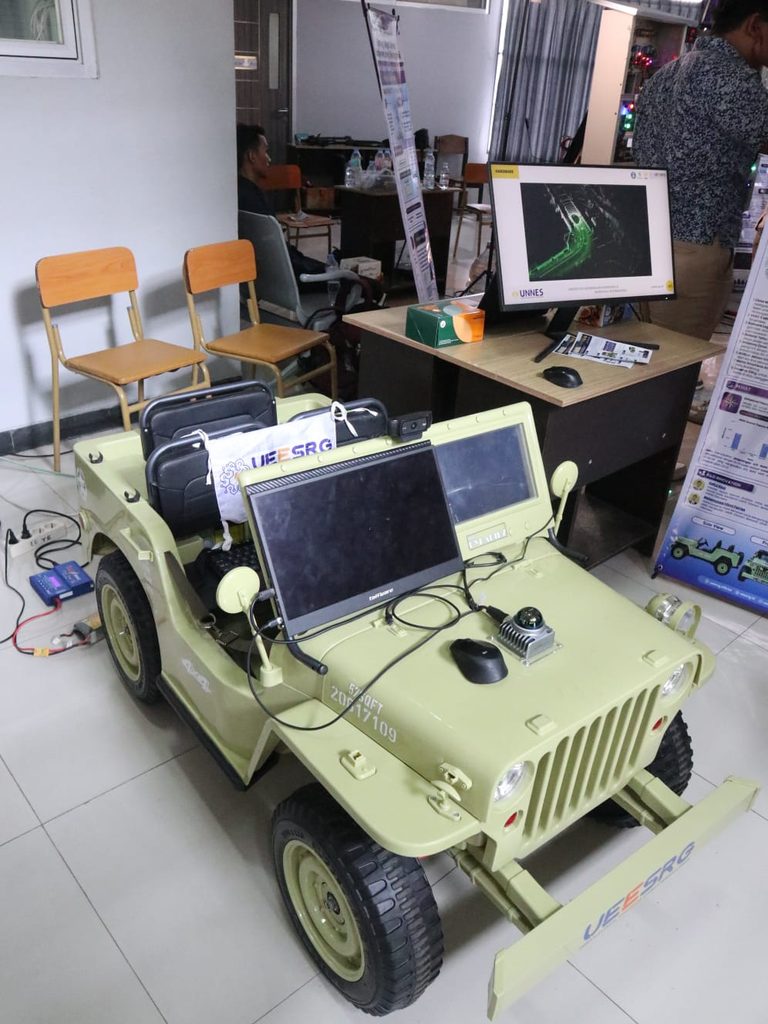
On the propulsion and actuation side, the electric vehicle is driven by a rear-wheel brushless AC motor regulated by a VESC 6 MKVI electronic speed controller, while a 25 kg DSservo actuator governs the steering mechanism. The entire hardware suite is powered by a Tattu 10000 mAh battery pack and supported by high-speed wireless telemetry via an Intel AX201 antenna.
The centerpiece of the engineering design is the integration of LiDAR-Inertial Odometry (LIO), a sensor-fusion approach that combines 3D LiDAR spatial geometry with high-frequency IMU motion data. By tightly coupling both data streams, the system estimates vehicle trajectory, position, and orientation with superior precision and stability—forming a dependable foundation for autonomous navigation.
The team completed the prototype on September 1, 2026, following an intensive 70-day cycle of mechanical integration, embedded systems engineering, and algorithmic testing. Built with a total budget of IDR 42 million (Rp42,000,000)—an extraordinary scale of investment for a student-led innovation project—the vehicle reflects the integration of industrial-grade sensors and edge AI hardware.
Showcased at FT UNNES’s EXPO Capstone, the autonomous electric vehicle directly advances SDG 9 (Industry, Innovation, and Infrastructure) by fostering domestic research in next-generation mobility, clean transportation technology, and intelligent automation. Through ambitious, industry-caliber engineering, UNNES Computer Engineering students are helping lay the groundwork for resilient, sustainable transportation infrastructure.