



SEMARANG — Three Computer Engineering students from the Faculty of Engineering, Universitas Negeri Semarang (FT UNNES)—Muhammad Naufal Nashir, Mu’alfi Fahrul Fanani Sachroni, and Satria Krisna Prabantara—unveiled CHOLOVATE (Smart Greenhouse Cabai), an automated precision agriculture system, during the EXPO Capstone exhibition at Building E11, FT UNNES, on Wednesday (November 11, 2026).
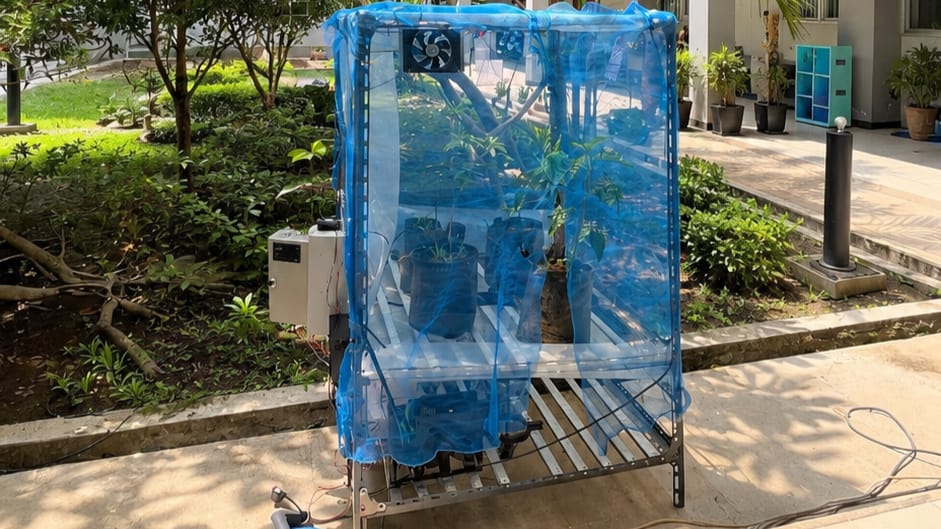
Measuring 1 by 1 meter, the prototype was engineered to address key challenges in chili cultivation, a high-value horticultural crop highly vulnerable to microclimate fluctuations, nutrient imbalances, and foliar diseases. To overcome the limitations of manual crop management, the team designed CHOLOVATE as an interconnected two-tier architecture that automates plant health diagnostics, chemical dosing, and environmental regulation.
On the upper tier housing the cultivation zone, an inspection camera captures visual data of chili leaves to monitor plant health. These diagnostic findings are transmitted via a UART serial cable to the primary ESP32-S3 microcontroller inside the control box, which processes the data and triggers targeted hardware responses on the lower tier.
The lower tier operates as an automated fluid mixing and distribution station. Four peristaltic dosing pumps draw concentrated solutions—specifically Nutrient A, Nutrient B, fungicide, and insecticide—from storage reservoirs into three separate mixing chambers. Inside each chamber, DC stirrer motors blend the solutions thoroughly before high-pressure pumps deliver the mixture either to root-level drip irrigation lines or to overhead misting sprayer nozzles, depending on whether the plants require nourishment or pest and disease treatment.
Concurrently, the ESP32-S3 continuously polls an extensive sensor array comprising a DHT22 air temperature and humidity sensor, a soil moisture sensor, a soil pH sensor, a Total Dissolved Solids (TDS) nutrient concentration sensor, and three HC-SR04 ultrasonic sensors that track liquid levels across the mixing reservoirs.
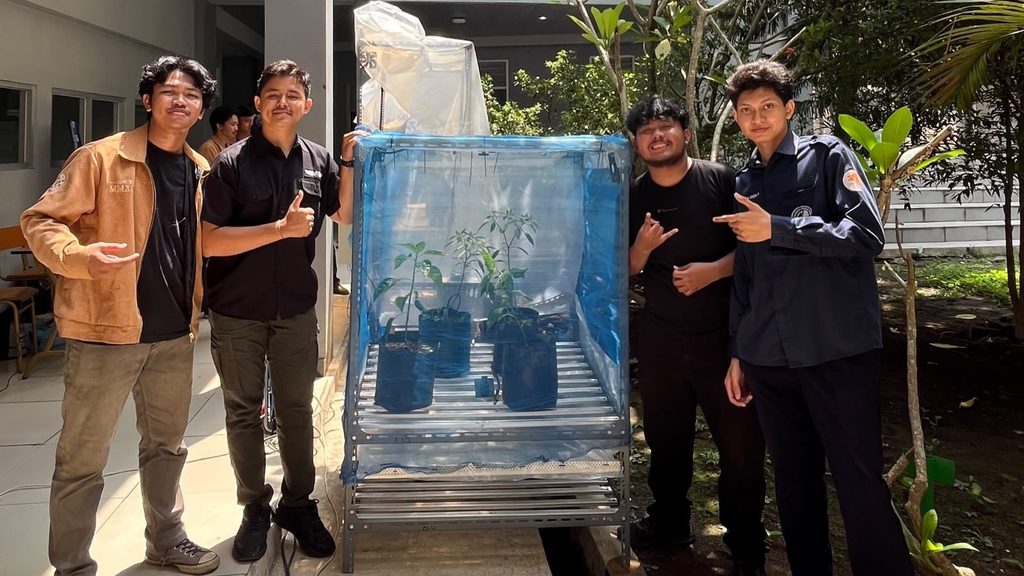
To maintain optimal growing conditions, the controller dynamically adjusts the speed of a pair of 12V DC fans—configured as a front intake and a rear exhaust—via an L298N motor driver module to expel excess heat. More than a dozen pumps are managed safely through a 16-channel relay module reinforced with fuses and flyback protection diodes. All real-time environmental metrics and pump statuses are displayed locally on a control-box LCD screen and streamed via Wi-Fi to a cloud platform, enabling full remote monitoring and control.
The team completed the CHOLOVATE prototype on September 5, 2026, following an intensive 220-day engineering cycle covering structural fabrication, embedded systems integration, software development, and operational testing. Built with a total budget of IDR 8 million (Rp8,000,000), the project reflects a comprehensive integration of industrial-grade sensors, fluid actuators, and electrical safety mechanisms.
Showcased at FT UNNES’s EXPO Capstone, CHOLOVATE directly advances SDG 9 (Industry, Innovation, and Infrastructure) by modernizing agricultural infrastructure through intelligent automation and resilient engineering design. Through high-impact applied research, UNNES Computer Engineering students demonstrate how technological innovation can drive agro-industrial transformation and build sustainable food production infrastructure.