



Innovations in natural-based cosmetics continue to be developed to meet the demand for skincare products that not only effectively cleanse the face but also offer additional benefits for skin health.
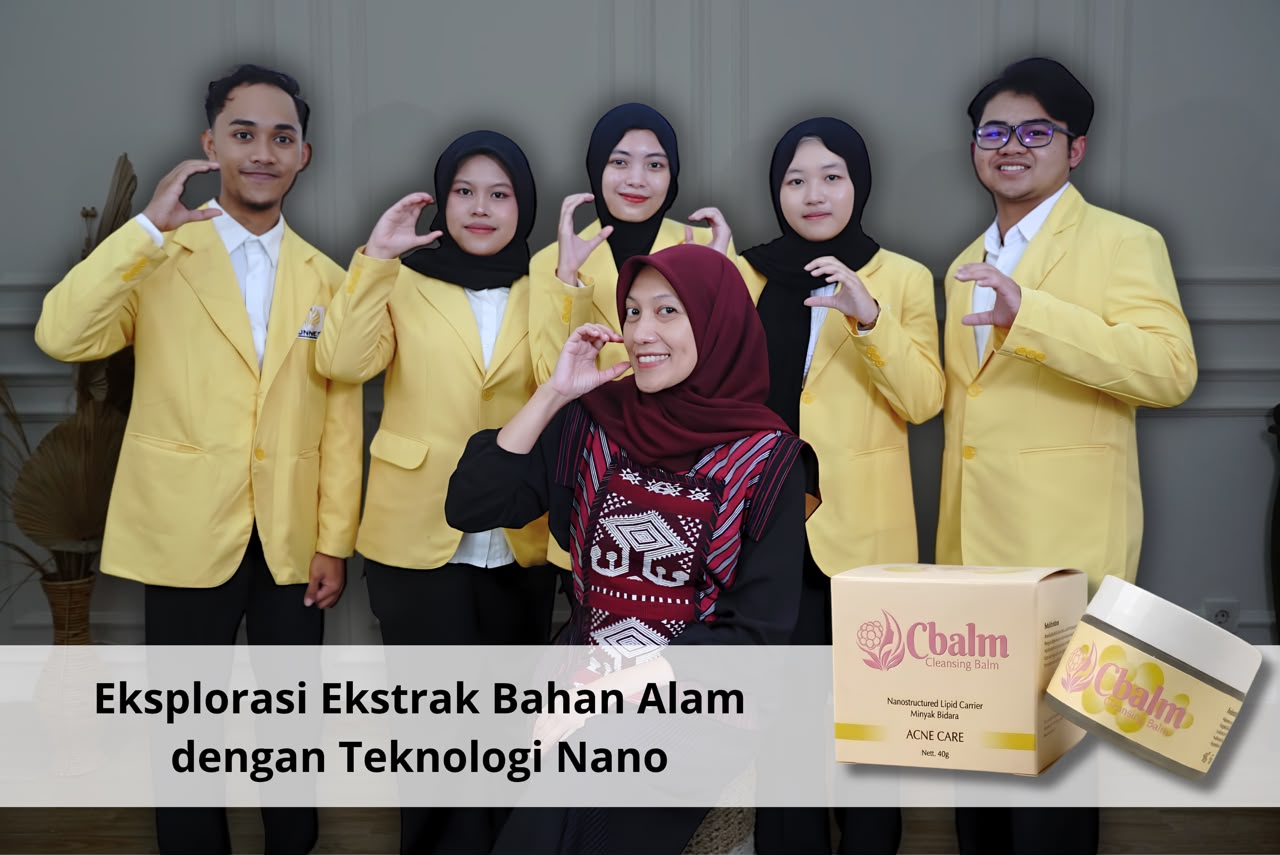
Addressing this need, a Student Creativity Program for Exact Science Research (PKM-RE) team from Universitas Negeri Semarang (UNNES) developed a cleansing balm based on Nanostructured Lipid Carriers (NLC) and bidara (jujube) oil. This product has the potential to remove makeup residue while also exhibiting antibacterial activity against acne.
This innovation was developed by a PKM-RE team led by Salma Oktavina, alongside team members Niken Ayu Saputri Ananda, Muhammad Firdaus Kurniawan, Sabila Nurfaiza, and Lucky Raihan Tri Septian.
The team—comprising students from the Beauty Education, Pharmacy, Medicine, and Chemical Engineering study programs—successfully secured funding for the 2026 Student Creativity Program for Exact Science Research (PKM-RE) from the Ministry of Higher Education, Science, and Technology (Kemendiktisaintek) of the Republic of Indonesia.
This research, conducted under the guidance of Dr. Eny Widhia Agustin, M.K.M., aims to develop a cleansing balm formulation based on bidara (Jujube) oil Nanostructured Lipid Carriers (NLC) that exhibits favorable physical characteristics and stability.
The formulation is designed to effectively remove makeup residue and potentially inhibit the growth of acne-causing bacteria. The funding secured represents support from the Ministry of Higher Education, Science, and Technology (Kemendiktisaintek) for student innovation and research that contributes to the advancement of science and public health.
The study was motivated by the rising use of decorative cosmetics—such as foundations, sunscreens, and waterproof products—that are difficult to remove with standard facial cleansers. Residual makeup can mix with sebum and dead skin cells, potentially clogging pores and triggering acne breakouts.
In this study, bidara oil was incorporated into an NLC system using a hot emulsification method combined with sonication. NLC technology was selected for its ability to enhance stability and active ingredient delivery capacity, as well as to optimize the release of active compounds onto the skin’s surface.
Subsequently, the bidara oil NLCs were formulated into a cleansing balm intended to provide a comfortable cleansing experience without leaving a greasy residue.
The research was carried out at the Research Laboratory of the Faculty of Medicine at Universitas Negeri Semarang and the Microbiology Laboratory at Universitas Diponegoro. The research stages included the preparation of bidara oil NLCs, nanoparticle characterization, cleansing balm formulation, physical quality and stability testing, antibacterial activity testing, and evaluation of the product’s cleansing efficacy.
Physical quality testing encompassed organoleptic properties, homogeneity, pH, viscosity, spreadability, melting point, cycling tests, and centrifugation to ensure the quality of the resulting formulation. Meanwhile, the evaluation of antibacterial activity began with the disc diffusion method, measuring the inhibition zone diameter against acne-causing bacteria. If the initial test results do not yet indicate optimal activity, the research proceeds to determine the Minimum Inhibitory Concentration (MIC) and Minimum Bactericidal Concentration (MBC). These tests aim to identify the lowest concentration of the formulation capable of effectively inhibiting or killing acne-causing bacteria.
In addition to assessing antibacterial activity, this study evaluates the cleansing balm’s ability to remove cosmetic residues quantitatively using UV-Vis spectrophotometry. Testing is conducted on the volunteers’ inner elbows using various cosmetics—such as foundation, lipstick, mascara, and eyeliner—to objectively measure the product’s cleansing effectiveness.
This innovation supports health research based on Indonesia’s biodiversity and aligns with the Sustainable Development Goals (SDGs), specifically Goal 3 (Good Health and Well-being) and Goal 9 (Industry, Innovation and Infrastructure).
Through this research, the UNNES PKM-RE team aims to contribute to the development of innovative, safe, and sustainable functional cosmetics based on natural ingredients.