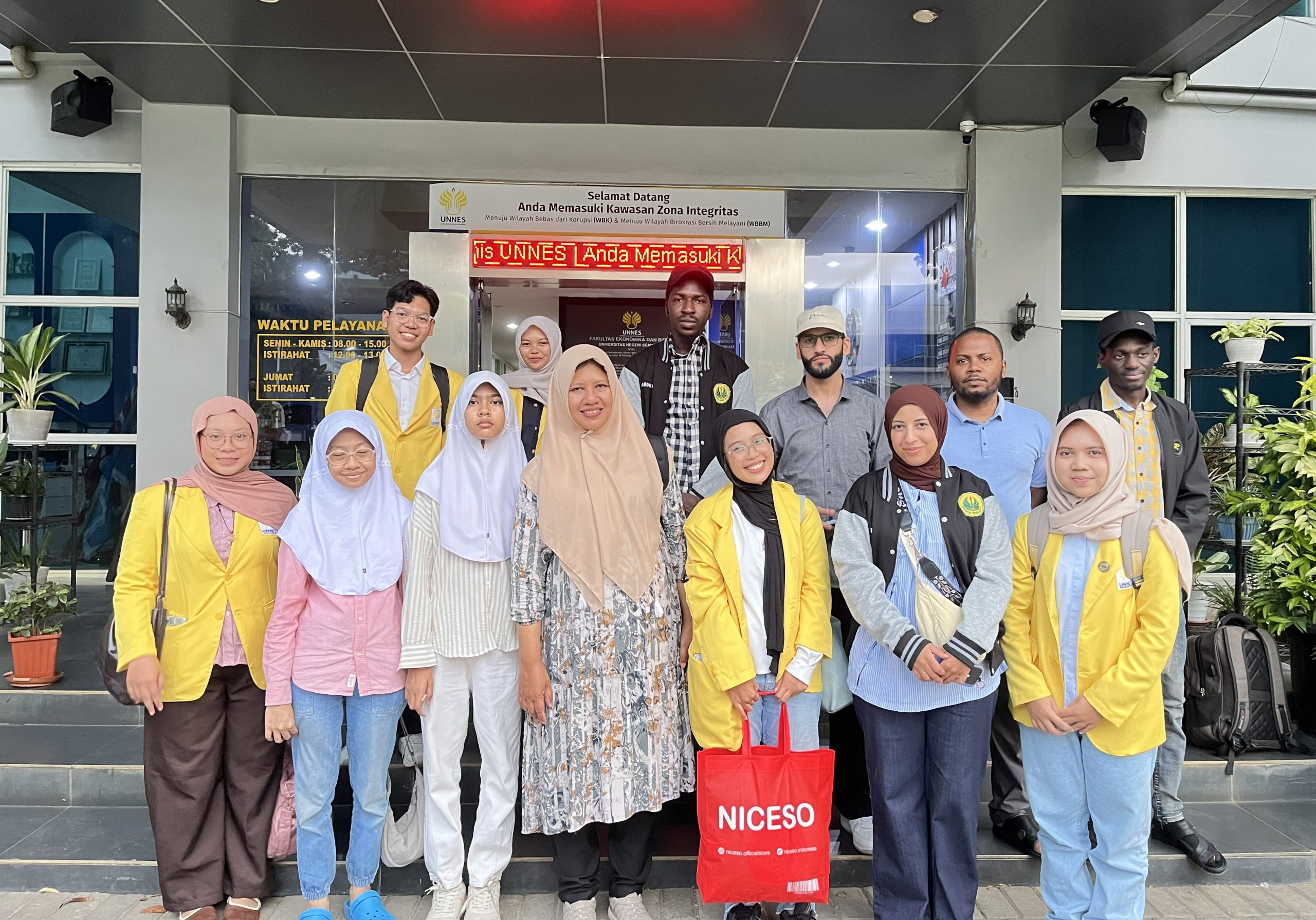
SEMARANG, Indonesia — The Faculty of Economics and Business at Universitas Negeri Semarang (FEB UNNES) has once again demonstrated its commitment to global and sustainable education by organizing the Summer Course Session 2 themed “Community-Based Learning: Entrepreneurship, Local Culture, and Sustainable Rural Development.” The program was held over three days, from April 3 to April 5, 2026, in the Banyumanik area of Semarang.
The program involved students from partner universities, namely Universitas Muria Kudus (UMK), Universitas Wahid Hasyim (UNWAHAS), and Universitas Negeri Jakarta (UNJ). More than just an academic program, this initiative was designed as a community-based learning experience that integrates local entrepreneurship, culture, and sustainable development practices.
The first day began with registration, a welcome lunch, and a campus tour of UNNES, providing international participants with insights into the university’s academic environment and facilities. In the evening, participants enjoyed traditional Central Javanese cuisine as an introduction to the upcoming cultural experience.
On the second day, activities focused on exploring community life in Srondol Wetan Village. Participants joined morning exercises with local residents, had traditional breakfast, and engaged in discussions with community leaders, including the village head and local officials. These activities provided practical insights into village governance and community empowerment.
The program continued with hands-on community-based entrepreneurship activities, including training on making traditional foods such as ketupat and lepet alongside local MSME actors. Participants also engaged in urban farming by planting vegetables and explored local culture through gamelan performances and traditional attire such as kebaya and beskap.
On the final day, participants took part in activities at the Semarang Car Free Day (CFD) area. Here, they practiced their Indonesian language skills while directly experiencing informal economic activities by interacting with local vendors, including tasting local specialties such as Es Teler Boim.
The program was coordinated by FEB UNNES lecturers, including Ms. Wijang and Ms. Nunuk, and supported by student Liaison Officers (LO) who served as cultural bridges between participants and the local community.
The Vice Dean III for Business, Research, and Cooperation of FEB UNNES, Dorojatun Prihandono, S.E., M.M., Ph.D., stated that this program is part of the university’s internationalization strategy as well as an effort to strengthen community-based contextual learning. “Through this program, students not only learn entrepreneurial concepts but also gain direct understanding of how local economies, culture, and sustainability are interconnected. This is a concrete step toward developing graduates who are adaptive, globally minded, and rooted in local wisdom,” he explained.
The implementation of this Summer Course not only enhances students’ competencies but also contributes directly to the achievement of the Sustainable Development Goals (SDGs). It promotes quality education through experiential learning, strengthens inclusive economic growth by engaging with local MSMEs, and enhances understanding of sustainable communities rooted in local wisdom. Furthermore, activities such as urban farming and traditional food practices foster awareness of responsible production and consumption. The program also reflects strong partnerships across institutions and cultures, supporting global collaboration.
Through this initiative, FEB UNNES emphasizes that economics and business education should not be limited to theoretical knowledge but must also involve real-world practice that creates tangible societal impact. This Summer Course serves as clear evidence that meaningful learning can emerge from social interaction, local culture, and real economic activities, in line with the vision of inclusive and transformative sustainable education.