
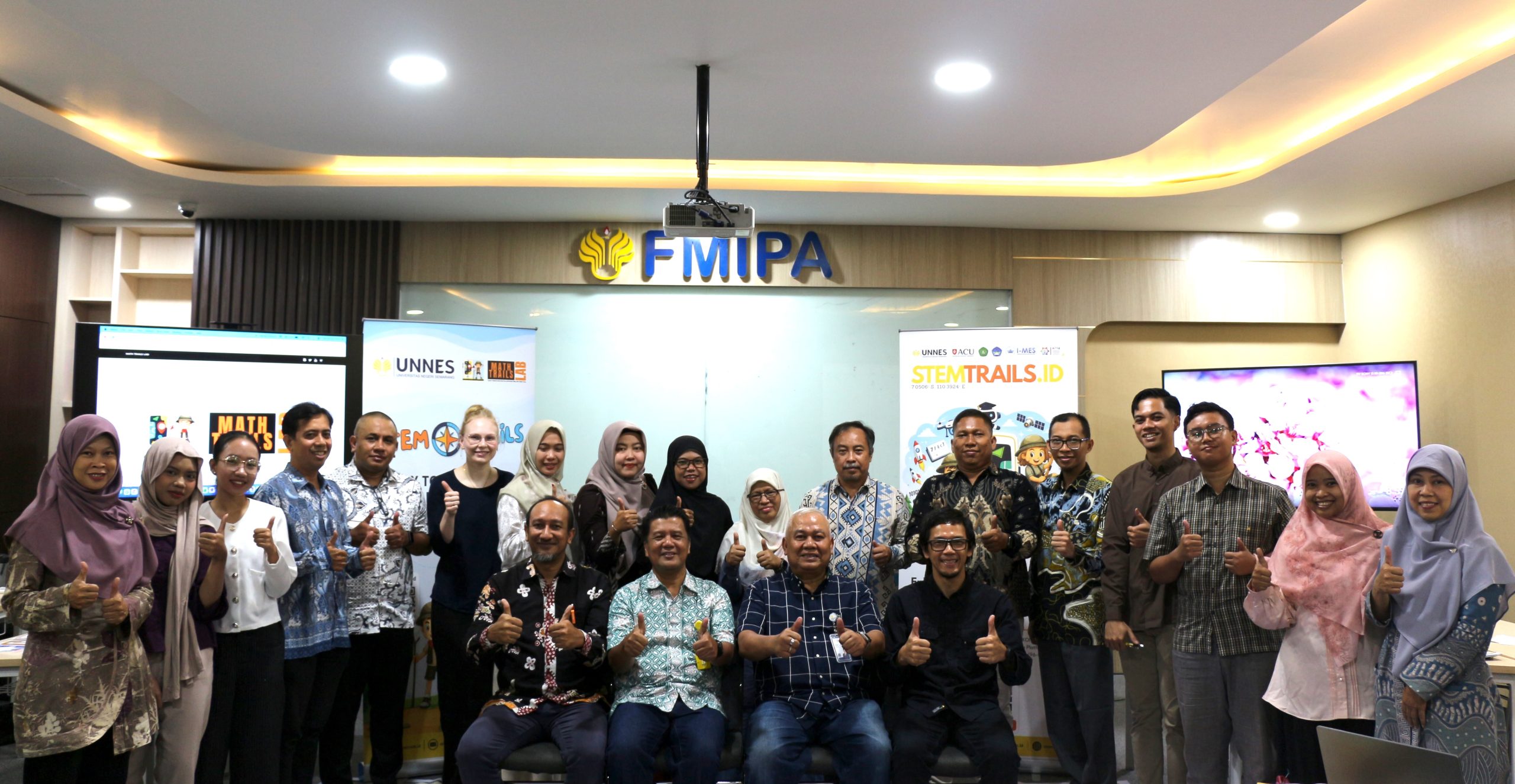
Universitas Negeri Semarang (UNNES) memulai proyek riset internasional yang berfokus pada penguatan numerasi siswa sekolah dasar melalui pemanfaatan teknologi. Program tersebut diwujudkan melalui workshop STEMTrails bertajuk “Code, Count, Connect: Enhancing Inclusive Numeracy through AI and Coding Integrated STEM Trails in Indonesia” yang didukung KONEKSI (Australia-Indonesia Knowledge Partnership Platform).
Kegiatan yang berlangsung di Fakultas Matematika dan Ilmu Pengetahuan Alam (FMIPA) UNNES pada Sabtu (16/5) ini menjadi awal kolaborasi antara akademisi, praktisi pendidikan, dan sekolah mitra dalam pengembangan pembelajaran berbasis STEM (Science, Technology, Engineering, and Mathematics).
Workshop dihadiri mitra penelitian, di antaranya Universitas Mulawarman, Universitas Pattimura, Komite Penggerak Numerasi Indonesia (KPNI), dan Indonesian Mathematics Educators Society (I-MES).
Proyek STEMTrails dilaksanakan oleh konsorsium yang terdiri atas UNNES, Australian Catholic University (ACU), Universitas Mulawarman, Universitas Pattimura, I-MES, dan KPNI. Kolaborasi ini menjadi bagian dari penguatan kemitraan pendidikan Indonesia dan Australia dalam mendukung pembelajaran berbasis teknologi yang inklusif.
Ketua Lembaga Penelitian dan Pengabdian kepada Masyarakat (LPPM) UNNES, Prof. Dr. R. Benny Riyanto, S.H., M.Hum., C.N., membuka kegiatan sekaligus menegaskan pentingnya riset inovatif yang memberikan dampak langsung bagi masyarakat.
Sementara itu, Dekan FMIPA UNNES, Prof. Dr. Edy Cahyono, M.Si., menyampaikan dukungannya terhadap integrasi Artificial Intelligence (AI) dan coding dalam pembelajaran di sekolah dasar.
Ketua Tim Peneliti, Dr. rer. nat. Adi Nur Cahyono, menjelaskan bahwa implementasi penelitian akan dilakukan di tiga wilayah, yakni Semarang, Samarinda, dan Ambon. Masing-masing wilayah akan melibatkan 100 siswa sekolah dasar dalam proses penelitian.
“Implementasi penelitian akan kami lakukan di tiga daerah, yaitu Semarang, Samarinda, dan Ambon. Di tiap wilayah, kami akan melibatkan 100 siswa sekolah dasar dalam proses penelitian. Melalui pendekatan yang inklusif, kami mengintegrasikan AI dan coding untuk membuat matematika menjadi lebih hidup dan terkoneksi dengan lingkungan sekitar mereka,” ujar Dr. Adi Nur Cahyono
Untuk wilayah Semarang, guru dari SDN Sekaran 2 dan SD Islam Bintang Juara turut mengikuti workshop sebagai persiapan implementasi program di sekolah.
Melalui proyek STEMTrails, tim peneliti berharap hasil riset dapat mendukung peningkatan kemampuan numerasi siswa sekolah dasar secara inklusif. Selain itu, penelitian ini juga diharapkan mampu menghasilkan rekomendasi bagi pengembangan kebijakan pembelajaran di masa mendatang.
Program ini melibatkan berbagai pemangku kepentingan di tingkat nasional maupun daerah, di antaranya Kementerian Pendidikan Dasar dan Menengah, Kementerian Pendidikan Tinggi, Sains, dan Teknologi, serta SEAMEO QITEP in Mathematics. Keterlibatan berbagai pihak tersebut diharapkan dapat memperkuat implementasi program sekaligus mendukung pengembangan model pembelajaran secara lebih luas.
Kepala Bidang GTK Dinas Pendidikan Kota Semarang, Dr. Miftahudin, menyampaikan bahwa STEMTrails diharapkan dapat menjadi salah satu program pendidikan di Kota Semarang pada masa mendatang, sebagaimana MathCityMap yang sebelumnya dikembangkan bersama Frankfurt University, UNNES, dan MGMP Kota Semarang serta telah menjadi program rutin Dinas Pendidikan Kota Semarang.
Program ini juga mendukung pencapaian Sustainable Development Goals (SDGs), khususnya SDG 4 tentang pendidikan berkualitas dan SDG 10 tentang pengurangan kesenjangan.
Melalui proyek STEMTrails, tim peneliti berharap hasil riset dapat mendukung peningkatan kemampuan numerasi siswa sekolah dasar secara inklusif serta menghasilkan rekomendasi bagi pengembangan kebijakan pembelajaran di masa mendatang.