

Dedicated hazardous-waste requirements and a broader green-campus framework guide waste segregation, storage, treatment, and disposal across the university.
Semarang, Indonesia — Universitas Negeri Semarang (UNNES) addresses waste disposal through institutional policies and operational practices that cover both general campus waste and hazardous materials. Its approach combines waste reduction, segregation, resource recovery, controlled storage, and arrangements for further treatment and disposal.
Campus activities generate different waste streams, from food scraps, leaves, and packaging to electronic equipment, wastewater, and laboratory residues. UNNES’s waste-management framework distinguishes these materials according to their characteristics, with dedicated requirements for hazardous and toxic waste, known in Indonesia as Bahan Berbahaya dan Beracun (B3).
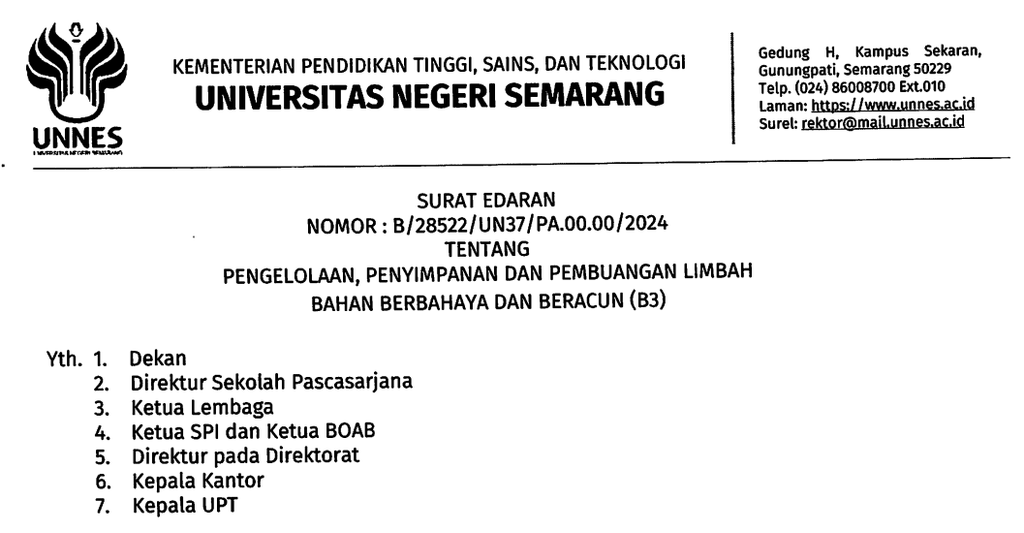
The principal institutional directive is Circular Letter No. B/28522/UN37/PA.00.00/2024 on the Management, Storage, and Disposal of Hazardous and Toxic Waste. This policy directly addresses the university’s responsibility to manage hazardous materials generated through its operations.
A Dedicated Institutional Policy for Hazardous Waste
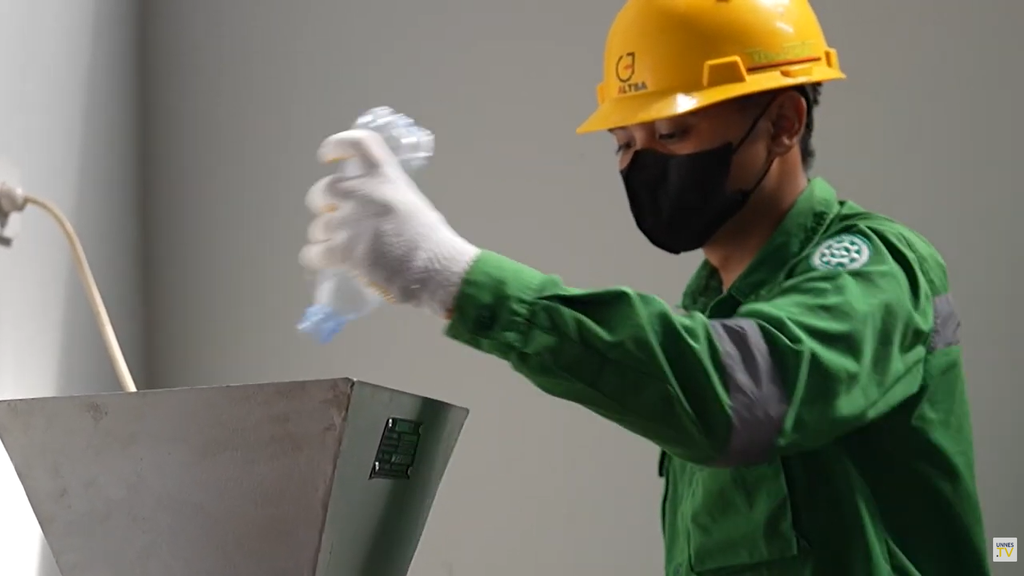
The circular establishes requirements for university work units to identify, separate, store, and coordinate the disposal of hazardous waste. It connects responsibilities at the point of waste generation with subsequent handling by external service providers.
Identification and segregation are the first steps. University units must distinguish hazardous materials from non-hazardous waste and classify them appropriately. This prevents laboratory residues and other potentially harmful materials from entering ordinary waste-collection streams.
The policy also requires suitable containers to prevent leakage or damage. Storage areas must be separated from operational activities, equipped with warning signs, and arranged to minimise contamination risks.
Each work unit is responsible for coordinating hazardous-waste management, storage, and disposal with appropriate third-party providers in accordance with applicable national environmental regulations. These provisions establish a university-level process extending beyond waste collection to storage and disposal arrangements.
Green Campus Regulation Supports Waste Reduction and Segregation
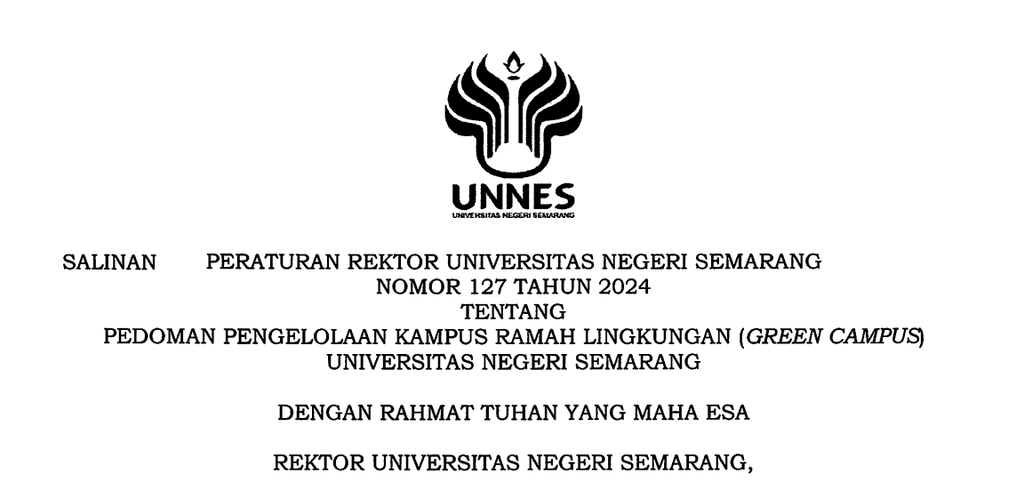
The hazardous-waste directive operates alongside Rector Regulation No. 127 of 2024 on Guidelines for Environmentally Friendly Campus Management (Green Campus). The regulation provides a broader framework for managing university facilities and activities in an environmentally responsible manner.
Within the waste-management framework described in the university’s supporting material, UNNES applies the principles of reduce, reuse, recycle, and recovery. Waste is separated into organic, inorganic, and hazardous categories to support appropriate handling.
This classification serves a practical purpose. Organic materials can enter composting processes, suitable inorganic materials can be recovered, and hazardous waste can follow a specialised management pathway. Separating these streams helps prevent contamination of materials intended for reuse or recycling.
The combination of a general campus regulation and a dedicated hazardous-waste circular places waste management within institutional governance while recognising that different materials require different procedures.
Laboratory Waste Management at FMIPA
The Faculty of Mathematics and Natural Sciences (FMIPA) illustrates the application of hazardous-waste management to teaching and research. Laboratory activities may generate chemical residues, contaminated materials, and other waste requiring specialised handling according to their characteristics.
The faculty practices described in the supporting material involve handling and storing hazardous waste under applicable procedures before collection by a third-party service provider. The waste is then transported for further management at hazardous-waste facilities.
This process connects laboratory-level segregation and temporary storage with external treatment arrangements. It also distinguishes the faculty’s responsibility for waste generated on campus from the subsequent responsibilities of transporters and receiving facilities.
Annual hazardous-waste management reports are described as part of the university’s documentation. Such records support oversight by documenting waste handling and transfers. Where manifests, contracts, and receiving records are available, they can establish the waste quantities, collection dates, service providers, and destinations associated with individual transfers.
The information supplied for this article describes the management process but does not identify particular contractors or quantities treated.
General Waste Processing at the Integrated Waste Management Site
UNNES’s Integrated Waste Management Site (Tempat Pengolahan Sampah Terpadu, or TPST) supports the sorting and processing of general waste from campus activities and, according to the university’s account, the surrounding community.
Organic waste, including food scraps, leaves, and other plant materials, is processed into compost. The resulting material can support campus green-space maintenance or be marketed to the public, creating a practical use for organic residues.
Inorganic waste is sorted by material type, including plastic and non-plastic materials, to facilitate recovery and further handling. This separation supports the identification of materials that can be reused or recycled and those requiring disposal.
The TPST complements the university’s hazardous-waste arrangements. Its general sorting and composting functions do not establish that hazardous laboratory waste is treated at the facility. B3 materials remain subject to the dedicated requirements for identification, containment, storage, and coordinated disposal.
Managing Electronic Waste and Wastewater as Separate Streams
The university’s operational account also describes the segregation and transfer of electronic waste for further handling. This stream requires attention to the components and characteristics of discarded equipment, because electronic items may contain materials requiring specialised management.
Collection is one stage of the process. Documentation of the receiving party and subsequent handling is needed to demonstrate the full treatment or disposal pathway.
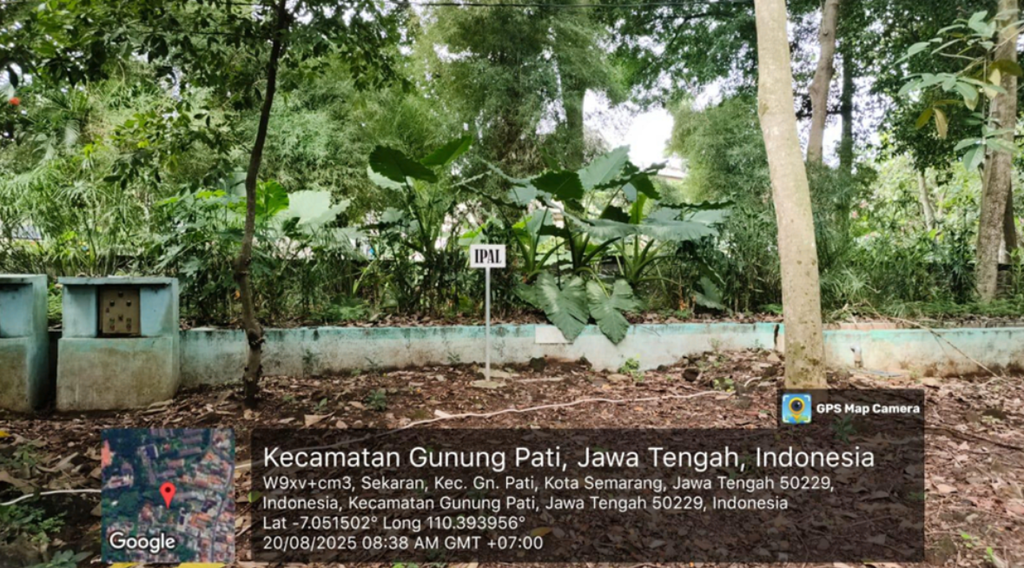
Wastewater, meanwhile, is managed through wastewater treatment installations, known as IPAL. Liquid-waste treatment is distinct from solid-waste processing and the storage of hazardous laboratory residues.
Maintaining these distinctions is important for campus operations. The presence of an IPAL does not mean that every laboratory chemical can enter the wastewater system; handling must remain appropriate to the characteristics of the waste and the treatment arrangements available.
Treatment Residues and Material Recovery
The supporting account describes the use of an incinerator for certain waste streams and the utilisation of resulting ash in paving-block production. This represents a reported material-recovery practice requiring its own assessment.
The suitability of ash for reuse depends on its source, composition, and applicable environmental requirements. The description of paving-block production alone does not demonstrate that hazardous constituents have been removed or that the material meets the relevant requirements for beneficial use.
For that reason, the university’s dedicated B3 policy and described laboratory handling process provide the clearest evidence for hazardous-waste management. Incineration and ash reuse remain separate operational claims whose environmental performance depends on supporting treatment and testing records.
Connecting Waste Disposal with Environmental Protection
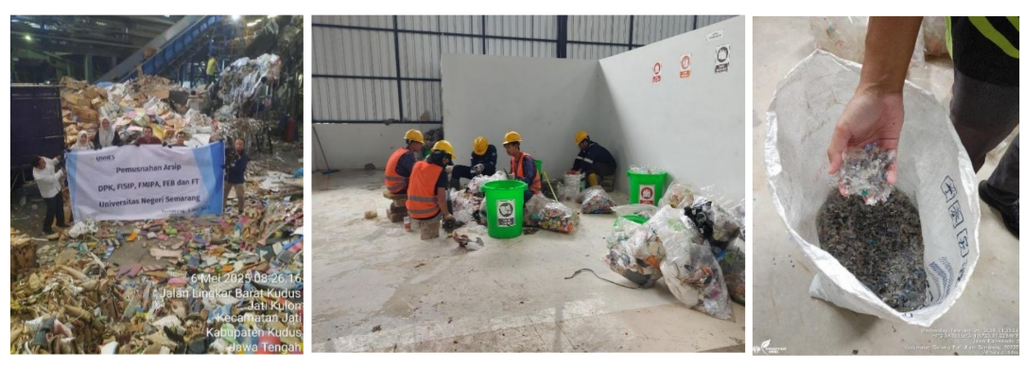
UNNES’s framework addresses waste management at several stages: reducing waste generation, separating materials at source, recovering usable resources, storing hazardous waste appropriately, and arranging further treatment and disposal.
These measures are intended to reduce uncontrolled releases into campus soil, drainage channels, and surrounding environments. They also support the protection of students, staff, waste handlers, and communities near university operations.
The dedicated hazardous-waste circular establishes that waste disposal covering hazardous materials is an institutional responsibility at UNNES. The Green Campus Regulation, TPST operations, wastewater facilities, and described laboratory practices provide the wider operational context for implementing that responsibility.
Through this combination of policy and differentiated waste-handling processes, UNNES incorporates pollution prevention and responsible disposal into the management of its academic and campus activities.