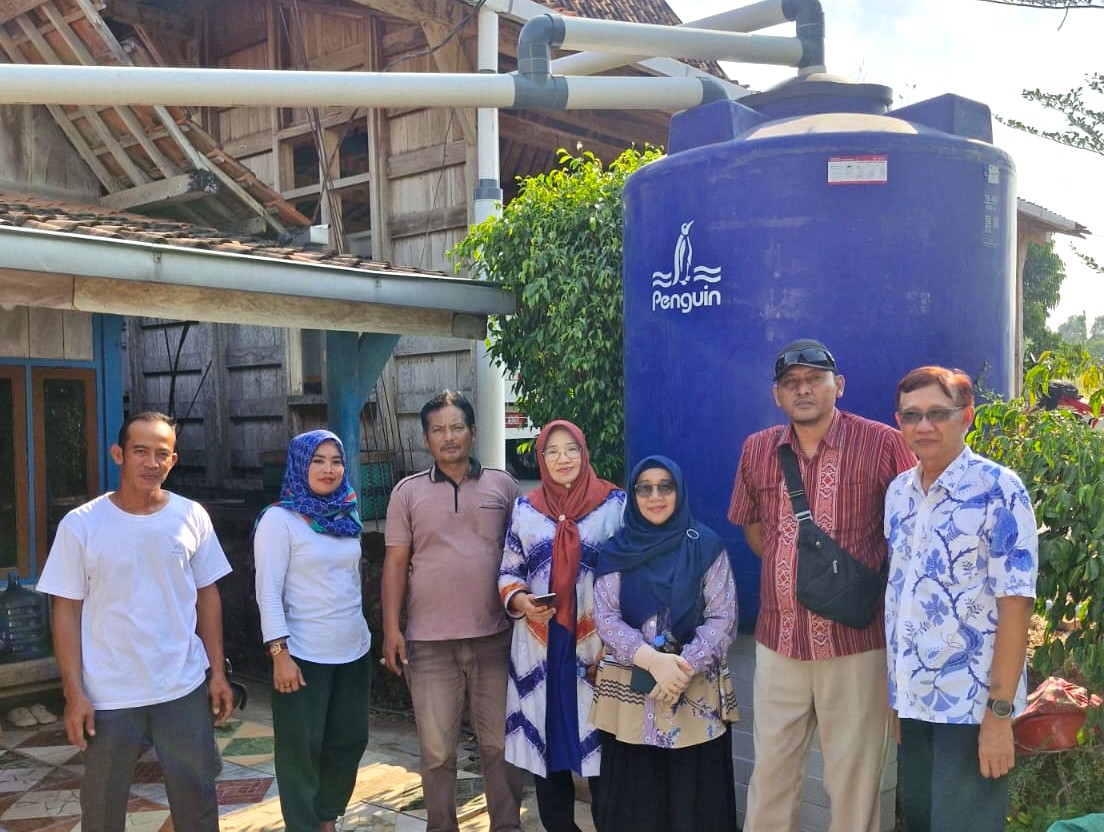
For years, residents of Jambangan Village in Geyer District, Grobogan Regency, have faced difficulties obtaining clean water, especially during prolonged dry seasons. Some household wells dry up, forcing families to purchase water or travel elsewhere to meet their daily needs. In response, a community service team from Universitas Negeri Semarang (UNNES) has worked with residents to develop a pilot rainwater harvesting installation, locally known as Instalasi Pemanenan Air Hujan (IPAH).
The initiative aims to make better use of rainfall by collecting and storing it for future needs. It also introduces a practical way for residents to take part in managing local water resources. Rather than treating the installation as a stand-alone facility, the UNNES team has involved the community throughout its development so that residents understand how it works and how to care for it.
The project is led by Prof. Dr. Tri Marhaeni Pudji Astuti, M.Hum., together with Prof. Dr. Dewi Liesnoor Setyowati, M.Si., Fajar, S.Pd., M.Pd., and Jamhur, M.T. It is funded by the Directorate of Research and Community Service under Indonesia’s Ministry of Higher Education, Science, and Technology in 2026.
Jambangan was selected because its residents regularly experience water shortages when the dry season extends for a long period. Local geographical conditions also make it difficult to retain and make full use of rainwater. As a result, rainfall that could serve as a reserve is often lost before it can be used by the community.
To respond to these conditions, the UNNES team partnered with the Pendowo Limo Community Forest Farmers Group (Kelompok Tani Hutan Rakyat, or KTHR). The group is supported by its adviser, Budi Setiawan, S.Hut., M.M., and chaired by Rencono Saputro. The partnership brought together academic expertise and residents’ knowledge of the village’s water challenges.
The activities were carried out over three visits. During the first visit, the team coordinated with village officials and met with the village head, the group’s adviser, and its chair. These discussions helped the team understand the difficulties residents face and agree on a form of assistance suited to local needs.
On the second visit, the team surveyed the area to identify a suitable location for the rainwater harvesting installation and clean-water storage tank. Once the site had been selected, UNNES experts and residents worked together to build the pilot system. Residents were directly involved in the construction, giving them an opportunity to learn about the installation through hands-on practice.
The third visit focused on education and discussion. At Rencono Saputro’s home, the team explained the principles of rainwater harvesting and how the installation should be maintained. Residents also shared their experiences of water shortages and discussed environmental conditions in their neighbourhoods.
Prof. Marhaeni described rainwater harvesting as one possible response to Jambangan’s water shortage. Water collected during the rainy season could provide an additional reserve when other sources become scarce. Capturing some of the rainfall may also help reduce surface runoff during heavy rain.
She encouraged residents to look after the installation so that it remains useful in the long term. She also hopes the pilot will inspire households to consider building similar systems of their own. To support that goal, the UNNES team provided guidance on routine care and maintenance, recognising that the benefits of the facility depend on its continued use.
Rencono welcomed the programme, saying the training had introduced a useful approach to the village’s water problem. He expressed hope that similar activities would continue and reach other hamlets and neighbourhoods in Jambangan, allowing more residents to benefit.
The pilot project offers a starting point for community-based water conservation. By participating in coordination, site selection, construction, and maintenance discussions, residents have gained both knowledge and practical experience. That involvement could help the village manage the facility and consider how the approach might be expanded.
If maintained and adopted more widely, rainwater harvesting could help some households reduce their dependence on purchased water during dry periods. It may also allow the community to put rainfall to use instead of letting it flow away during the rainy season. The extent of those benefits will depend on local rainfall, storage capacity, maintenance, and further development of the system.
The initiative is most closely linked to Sustainable Development Goal (SDG) 6: Clean Water and Sanitation, particularly its focus on sustainable water management. It also supports SDG 11: Sustainable Cities and Communities by helping a village strengthen its response to drought and environmental pressures. Its relationship with SDG 7: Affordable and Clean Energy is indirect, as the system uses a simple, low-energy approach but is primarily designed to address water needs.
Through the pilot IPAH, UNNES and the people of Jambangan are exploring how locally available rainwater can become a more useful resource. The project shows how academic knowledge, straightforward technology, and active community participation can come together to address a long-standing village challenge.