

A dedicated rector regulation provides an institutional framework for assessing invasive-species risks, preventing introductions, and controlling their spread within the university.
Semarang, Indonesia — Universitas Negeri Semarang (UNNES) has adopted a dedicated policy to reduce the impacts of invasive alien species on its campus ecosystems. Rector Regulation No. 113 of 2024 on the Control of Invasive Alien Species at UNNES, adopted on 29 October 2024, establishes an institutional framework for prevention and control. The university’s official legal information system lists the regulation as being in force.
The policy addresses risks to biodiversity, ecosystems, economic interests, and human health. It brings invasive-species management into university governance through provisions covering risk assessment, introduction controls, quarantine, and measures to prevent further spread.
Preventing Introductions and Assessing Invasive Risks
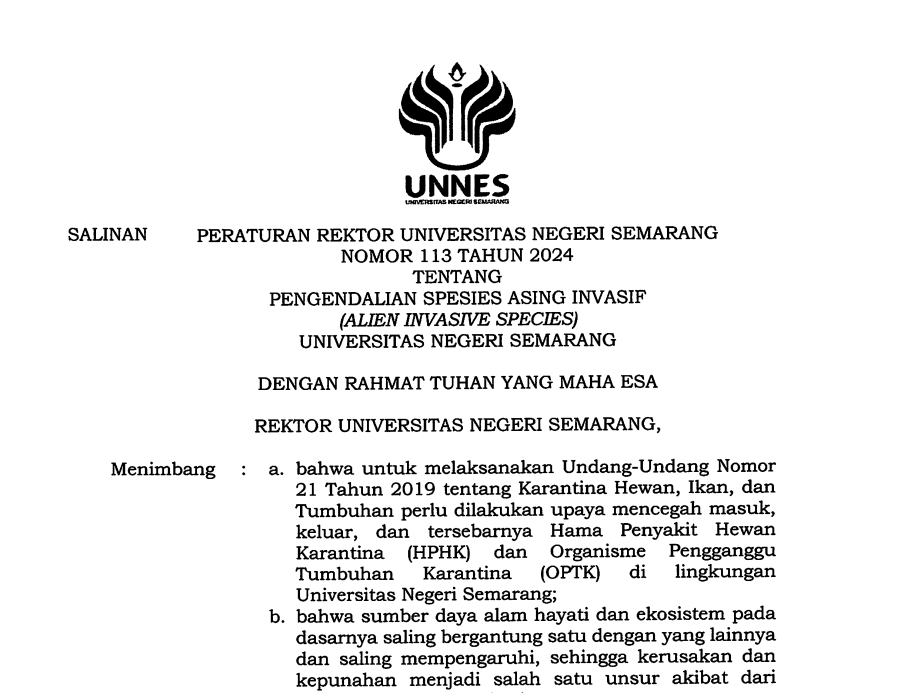
Articles 2–4 establish the objectives and principles of prevention and control. Article 6 addresses risk analysis and the assessment of invasive status, providing a basis for determining appropriate responses. The control measures described include eradication, destruction, and population control to limit further spread.
Articles 7–10 address quarantine, the assessment of potential carriers, and oversight of alien-species introductions into the university environment. Article 11 provides for sanctions for violations.
These provisions connect prevention with intervention: the policy addresses both the entry of potentially harmful species and the management of species that present invasive risks within campus areas.
Biodiversity Information Supports Campus Environmental Management
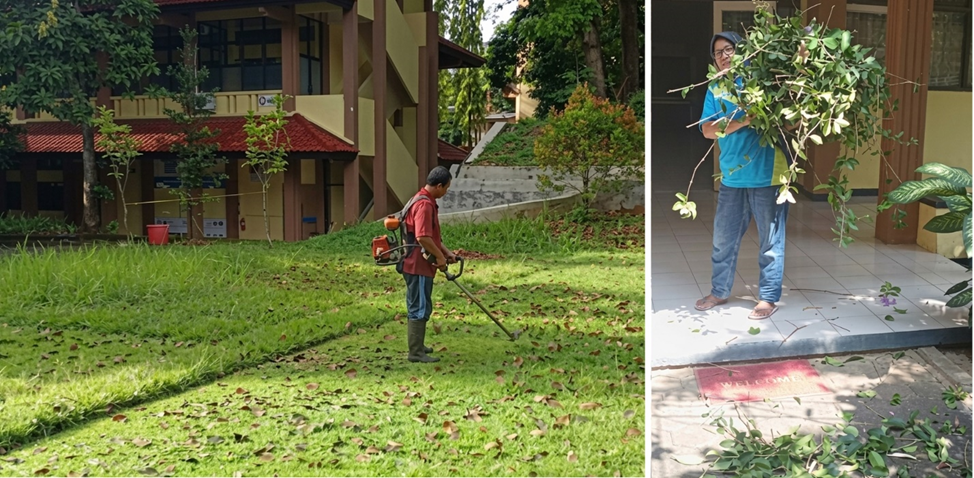
Species identification is important for distinguishing invasive-species management from ordinary landscape maintenance. An unwanted plant or weed does not, by itself, demonstrate the presence of an invasive alien species. Evidence of species identity, occurrence, spread, and ecological risk is needed to substantiate targeted control activities.
UNNES’s biodiversity research provides supporting information for campus environmental management. At the Faculty of Mathematics and Natural Sciences (FMIPA), a 2025 tree inventory recorded 318 trees representing 58 species. An official faculty report published on 25 November 2025 connected the inventory with green-space management, including plant care and the retention of trees of conservation value as campus facilities develop. unnes.ac.id
This inventory documents campus vegetation and conservation interests. It does not establish a dedicated inventory of invasive alien species or demonstrate that particular species have been subjected to control under the 2024 regulation.
Routine Maintenance and Targeted Species Control
FMIPA’s documented maintenance includes grass cutting, plant care, and landscape management. These activities contribute to the upkeep of campus green spaces, but their description does not identify invasive target species or report changes in their populations following treatment. unnes.ac.id
Accordingly, routine vegetation maintenance provides context for campus environmental management. It should be distinguished from targeted invasive-species control, which requires evidence linking an identified species and its assessed risks to a specific intervention.
The available documentation does not establish a campus-specific invasive-species monitoring series, a measured reduction in invasive populations, or verified ecological recovery following treatment. The clearest institutional evidence is therefore the dedicated regulation and its provisions for prevention, assessment, and control.
A Formal Foundation for Protecting Campus Biodiversity
Rector Regulation No. 113 of 2024 establishes UNNES’s institutional commitment to reducing invasive-species impacts within the university environment. Its provisions give the university a framework for managing introduction risks and responding to invasive species, while campus biodiversity research and vegetation management provide complementary environmental information.
The policy demonstrates that invasive-species prevention and control are recognised university responsibilities. Documented management outcomes remain distinct from the policy commitment itself.