
UNNES and Australia Strengthen Educational Collaboration Through AI and Coding-Based STEMTrails

Universitas Negeri Semarang > Sustainable Development Goals Universitas Negeri Semarang > Unit > FMIPA > UNNES and Australia Strengthen Educational Collaboration Through AI and Coding-Based STEMTrails

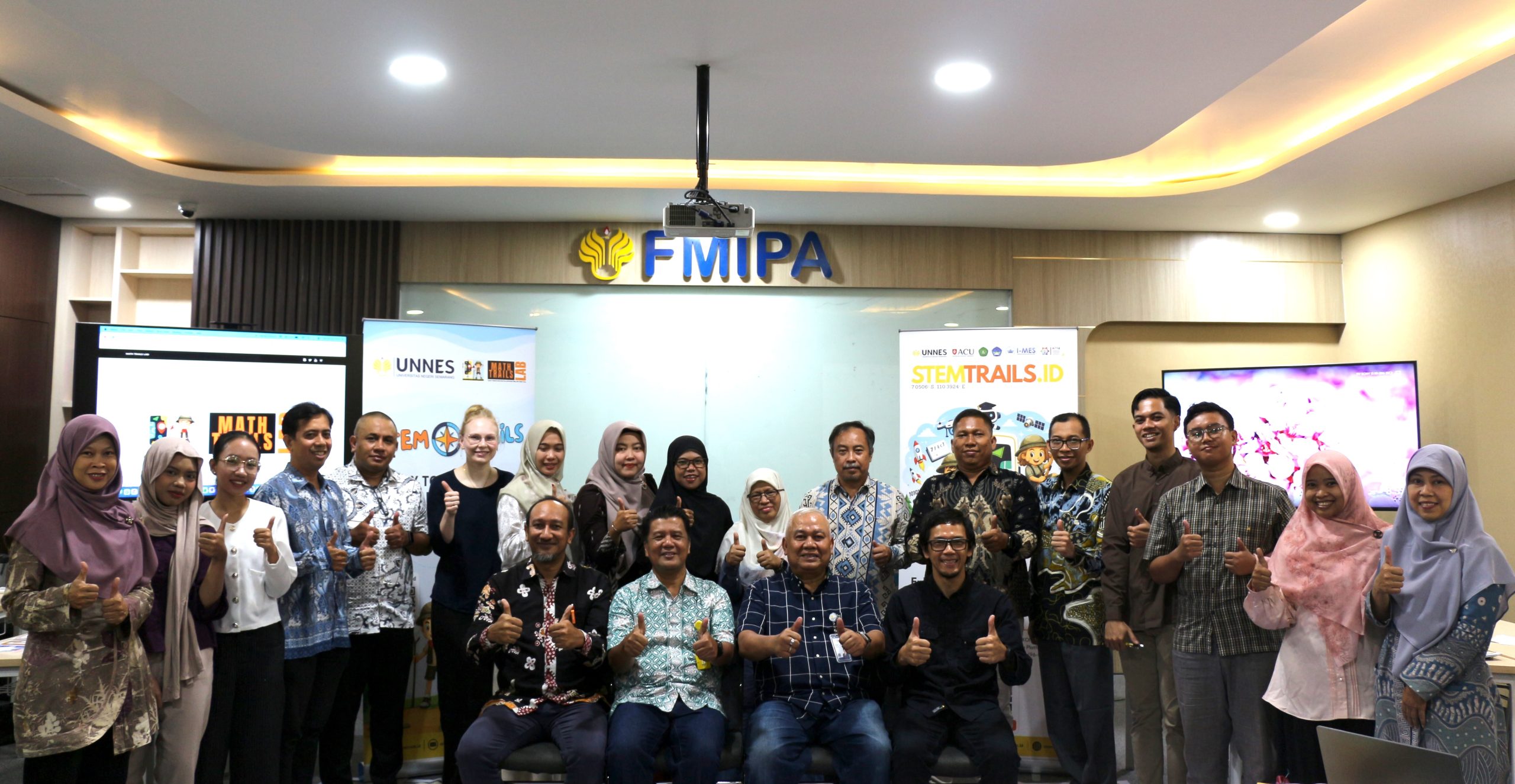
niversitas Negeri Semarang (UNNES) has launched an international research project aimed at strengthening elementary school students’ numeracy skills through the integration of technology. The initiative was introduced through a STEMTrails workshop titled “Code, Count, Connect: Enhancing Inclusive Numeracy through AI and Coding Integrated STEM Trails in Indonesia,” supported by KONEKSI (Australia-Indonesia Knowledge Partnership Platform).

Held at the Faculty of Mathematics and Natural Sciences (FMIPA) UNNES on Saturday (May 16), the workshop marked the beginning of a collaborative effort among academics, education practitioners, and partner schools to develop STEM-based learning approaches integrating Science, Technology, Engineering, and Mathematics.

The workshop brought together research partners from Universitas Mulawarman, Universitas Pattimura, the Indonesian Numeracy Movement Committee (KPNI), and the Indonesian Mathematics Educators Society (I-MES).

The STEMTrails project is conducted by a consortium consisting of UNNES, Australian Catholic University (ACU), Universitas Mulawarman, Universitas Pattimura, I-MES, and KPNI. This collaboration reflects a growing educational partnership between Indonesia and Australia in promoting inclusive, technology-driven learning.

Chair of the Institute for Research and Community Service (LPPM) UNNES, Prof. Dr. R. Benny Riyanto, S.H., M.Hum., C.N., officially opened the workshop and emphasized the importance of innovative research that creates direct benefits for society.

Meanwhile, Dean of FMIPA UNNES, Prof. Dr. Edy Cahyono, M.Si., expressed his support for integrating Artificial Intelligence (AI) and coding into elementary school education.

Lead researcher Dr. rer. nat. Adi Nur Cahyono explained that the research implementation will take place in three regions: Semarang, Samarinda, and Ambon. Each region will involve 100 elementary school students in the study.

“We will implement the research in three regions: Semarang, Samarinda, and Ambon. In each area, 100 elementary school students will participate in the research process. Through an inclusive approach, we integrate AI and coding to make mathematics more engaging and connected to students’ surrounding environments,” said Dr. Adi Nur Cahyono.

For the Semarang implementation, teachers from SDN Sekaran 2 and SD Islam Bintang Juara also participated in the workshop as preparation for the program’s application in schools.

Through the STEMTrails project, the research team hopes the study will contribute to improving elementary students’ numeracy skills in an inclusive manner. The project is also expected to generate recommendations for future educational policy development.

The program involves various stakeholders at both national and regional levels, including the Ministry of Primary and Secondary Education, the Ministry of Higher Education, Science, and Technology, and SEAMEO QITEP in Mathematics. Their involvement is expected to strengthen the implementation of the program and support the broader development of innovative learning models.

Head of the Teacher and Education Personnel Division at the Semarang City Education Office, Dr. Miftahudin, stated that STEMTrails has the potential to become one of Semarang’s future educational programs, similar to MathCityMap, which was previously developed through collaboration between Frankfurt University, UNNES, and the Semarang City Mathematics Teachers Association (MGMP) and has since become a regular program of the Semarang City Education Office.

The initiative also supports the achievement of the Sustainable Development Goals (SDGs), particularly SDG 4 on Quality Education and SDG 10 on Reduced Inequalities.

Through STEMTrails, the research team expects the project to strengthen inclusive numeracy education for elementary school students while producing valuable recommendations for the future development of educational policies.
Related Posts

Leave a Reply

* Kode Akses Komentar:

* Tuliskan kode akses komentar diatas:

GDPR

  • Privacy Policy

Privacy Policy

At unnes.ac.id, the privacy of our visitors is of extreme importance to us. This privacy policy document outlines the types of personal information that is received and collected by unnes.ac.id and how it is used.

Log Files

Like many other Web sites, unnes.ac.id makes use of log files. The information inside the log files includes internet protocol (IP) addresses, type of browser, Internet Service Provider (ISP), date/time stamp, referring/exit pages, and number of clicks to analyze trends, administer the site, track user’s movement around the site, and gather demographic information. IP addresses and other such information are not linked to any information that is personally identifiable.

Cookies

unnes.ac.id uses cookies to store information about visitors’ preferences, to record user-specific information on which pages the site visitor accesses or visits, and to personalize or customize our web page content based upon visitors’ browser type or other information that the visitor sends via their browser.

Third-party ad servers or ad networks use technology in their respective advertisements and links that appear on unnes.ac.id and which are sent directly to your browser. They automatically receive your IP address when this occurs. Other technologies (such as cookies, JavaScript, or Web Beacons) may also be used by our site’s third-party ad networks to measure the effectiveness of their advertising campaigns and/or to personalize the advertising content that you see on the site.

unnes.ac.id has no access to or control over these cookies that are used by third-party advertisers.

You should consult the respective privacy policies of these third-party ad servers for more detailed information on their practices as well as for instructions about how to opt-out of certain practices. unnes.ac.id’s privacy policy does not apply to, and we cannot control the activities of, such other advertisers or web sites.

If you wish to disable cookies, you may do so through your individual browser options. More detailed information about cookie management with specific web browsers can be found at the browsers’ respective websites.

Consent

By using our website, you hereby consent to our privacy policy and agree to its terms.

Update

This Privacy Policy was last updated on: 2023-02-14. Should we update, amend or make any changes to our privacy policy, those changes will be posted here.

Contact Us

If you have any questions, comments, or concerns about our Privacy Policy or our practices with regards to your personal information, please feel free to contact us through the contact form on our website or by emailing us at humas[at]mail.unnes.ac.id.

This Privacy Policy is intended as a general guide to our practices in collecting and using information. If there is any inconsistency between this Privacy Policy and the terms of the Service Agreement or any other terms that may apply to specific services you use, then those specific service terms shall apply.

Terms of Use

By using our website, you agree to abide by this Privacy Policy. If you do not agree with this Privacy Policy, please do not use our website. We reserve the right to update this Privacy Policy from time to time without prior notice. Please review our Privacy Policy periodically to check for changes. Your continued use of our website following the posting of changes to this Privacy Policy means that you accept the changes.

Thank you for reading our Privacy Policy. We are committed to protecting the privacy of our website visitors and will continue to update our Privacy Policy to ensure optimal protection.