The Faculty of Social and Political Sciences (FISIP) at Universitas Negeri Semarang (UNNES) organized a biopore revitalization and planting program as part of its commitment to strengthening the culture of conservation within the campus environment. The activity involved approximately 150 students from the Social Studies Education Program as part of the implementation of the Conservation Education course.
The event began with a group exercise session attended by all participants in the courtyard of Building C8. Since early morning, an enthusiastic atmosphere could be seen as students, lecturers, and committee members joined the exercise before carrying out the biopore planting activities around the faculty area.
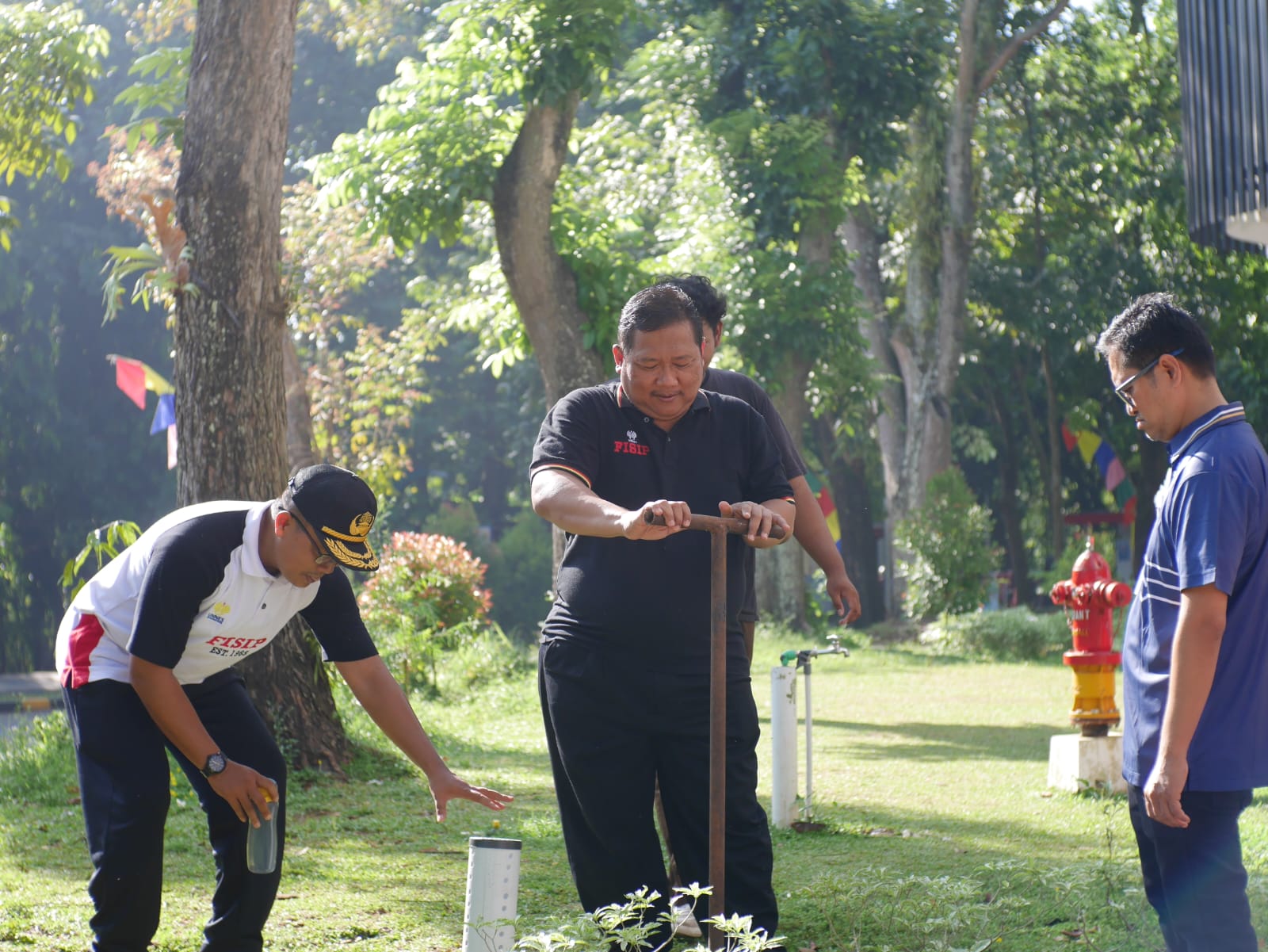
Following the exercise session, participants started drilling holes in the ground using biopore drilling tools in turns. The students showed great enthusiasm while working together in groups to prepare the designated planting spots.
During the activity, around 50 biopores were installed across four locations within the faculty area, including in front of Buildings C5, C6, C2, and the C8 complex. To ensure effective implementation, participants were divided into three groups so the work could be distributed evenly across all locations.
Dean of FISIP, Prof. Dr. Arif Purnomo, S.Pd., S.S., M.Pd., officially opened the event. In his remarks, he expressed hope that the revitalization of biopores would bring tangible environmental benefits to the campus.
“We hope that this biopore planting activity can improve water absorption, reduce standing water, and help prevent flooding,” he stated.
The activity was also directly supervised by the Head of the Conservation and Sustainable Development Goals (SDGs) Task Force of FISIP, Rudi Salam, S.Pd., M.Pd., who guided the technical implementation in the field. He divided participants into three groups according to the planting locations to ensure all areas were properly covered.
Through this initiative, FISIP not only encourages students to understand conservation concepts theoretically in the classroom, but also promotes direct environmental action to support sustainability efforts.
The biopore planting initiative is expected to improve water infiltration, reduce puddles during rainfall, and contribute to the achievement of Sustainable Development Goals (SDGs), particularly SDG 6 on clean water and proper sanitation through sustainable environmental and water management practices.
Similar activities are expected to continue regularly in order to strengthen environmental awareness and conservation commitment among the academic community on campus.