Morodemak Village in Demak Regency, Central Java, has become the focus of an international academic study examining the impact of the climate crisis on coastal communities. The Faculty of Social and Political Sciences (FISIP) at Universitas Negeri Semarang (UNNES), together with scholars from Japan and Bangladesh, conducted a field visit to observe areas severely affected by tidal flooding and coastal abrasion caused by rising sea levels.
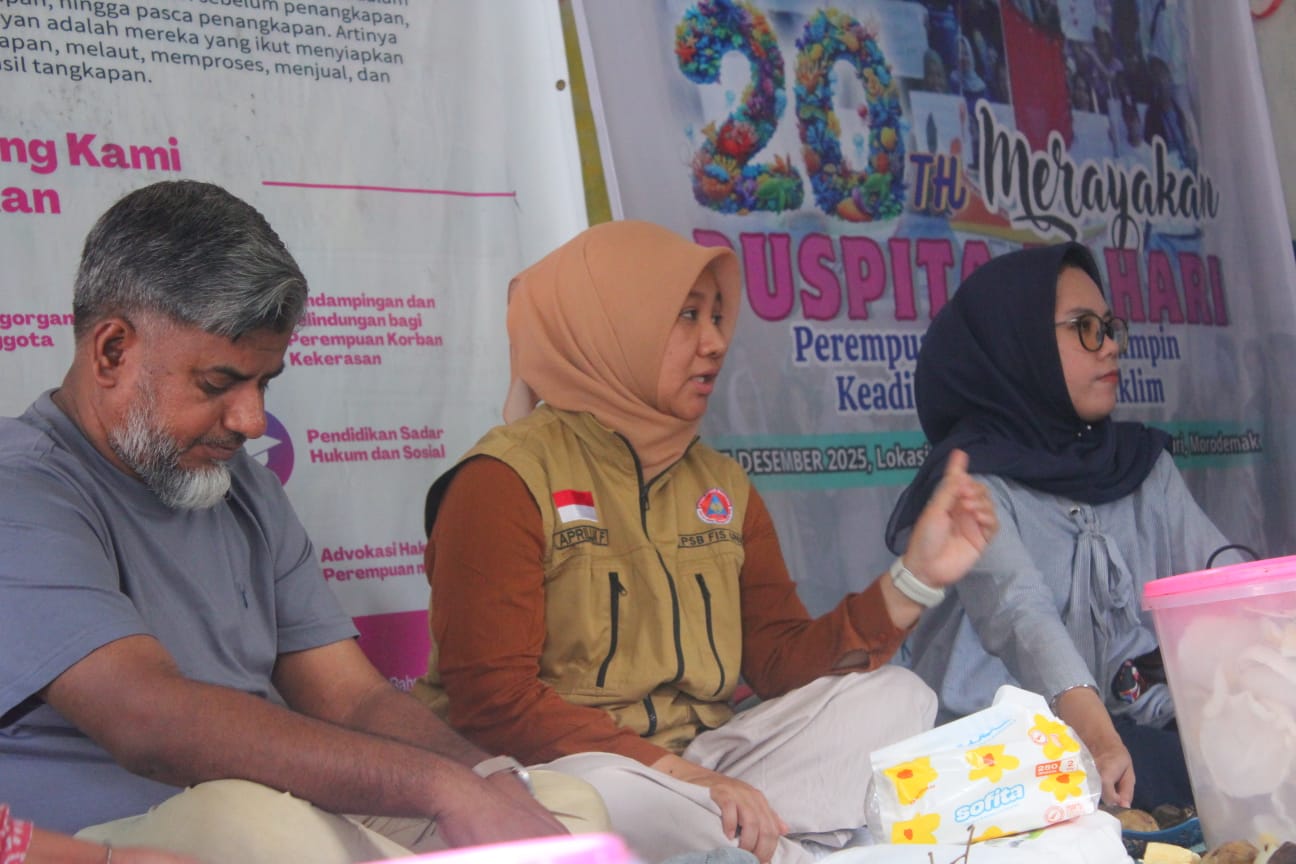
The activity formed part of a broader study on the resilience of coastal communities in responding to ecological threats. Particular attention was given to women fishers’ communities that stand on the frontline of environmental change, including the Puspita Bahari community.
The field research involved disaster expert Prof. Md. Anwarul Abedin from Bangladesh Agricultural University and Gulsan Ara Parfin from Ritsumeikan University, Japan.
Alongside lecturers from FISIP UNNES, the delegation examined the living conditions of coastal residents and explored various adaptation strategies developed by the community to sustain their livelihoods amid recurring tidal floods and shoreline erosion.
The international delegates also engaged in discussions with Masnu’ah, head of the Puspita Bahari Community. She emphasized that the struggle of coastal communities extends beyond economic survival and includes the fight for recognition of women fishers’ rights.
“Our community continues to advocate to the government while embracing other coastal communities to protect our living space. This is also part of the struggle for gender equality, so that women fishers are recognized and receive equal rights,” she stated.
For the international academics, Morodemak offers a vivid example of how grassroots communities build resilience in the face of the climate crisis. Despite the threat of submerged coastal areas, women fishers remain actively engaged in developing alternative economic opportunities while preserving marine ecosystem sustainability.
UNNES’ interdisciplinary approach, combining geography, sociology, and anthropology, was regarded as essential for producing more comprehensive solutions to coastal crises and strengthening regional disaster mitigation policy recommendations.
The program continued with an international studium generale on disaster mitigation organized by the Geography Department at the C7 Hall of FISIP UNNES in Sekaran, Gunungpati, Semarang. The forum, titled “Resilient and Disaster Mitigation Strategies of Japan and Bangladesh,” featured Prof. Md. Anwarul Abedin and Gulsan Ara Parfin as keynote speakers.
Speaking before hundreds of students, Prof. Md. Anwarul Abedin highlighted the crucial role of young people in protecting the environment and addressing future disaster risks.
“As the younger generation who will one day hold leadership roles, you have the responsibility to preserve the earth, land, and water as the sources of life,” he remarked.
In his presentation, Prof. Md. Anwarul Abedin discussed issues related to water crises and land subsidence occurring in both Bangladesh and Indonesia amid extreme weather conditions.
Meanwhile, Gulsan Ara Parfin explained Japan’s disaster preparedness systems, including responses to earthquakes, tsunamis, and typhoons.
She noted that storms have been the most frequent disaster in Japan over the past two decades, followed by earthquakes. Nevertheless, earthquakes remain the deadliest disasters, particularly the devastating 2011 earthquake and tsunami tragedy.
The discussion also emphasized the importance of environmental management, especially forest conservation as a buffer for ecosystems and watersheds. Japan’s experience demonstrates that collaboration between governments, communities, and the private sector is key to building sustainable disaster management systems.
Students showed strong enthusiasm throughout the discussion session. One Geography Education student, Joan Thalita, stated that community involvement plays a vital role in improving preparedness for environmentally based disasters.
The event also reflected UNNES’ commitment to the Sustainable Development Goals (SDGs), particularly SDG 13 on Climate Action.
Through this international collaboration, the initiative is expected to strengthen the capacity of coastal communities and promote adaptive strategies that are responsive to environmental challenges in coastal regions.