Bridging Theory and Reality, FIPP UNNES Holds Guest Lecture “Learning from Life: The Art of Understanding the Development ofChildren with Special Needs”

Universitas Negeri Semarang > Sustainable Development Goals Universitas Negeri Semarang > Unit > FIPP > Bridging Theory and Reality, FIPP UNNES Holds Guest Lecture “Learning from Life: The Art of Understanding the Development ofChildren with Special Needs”

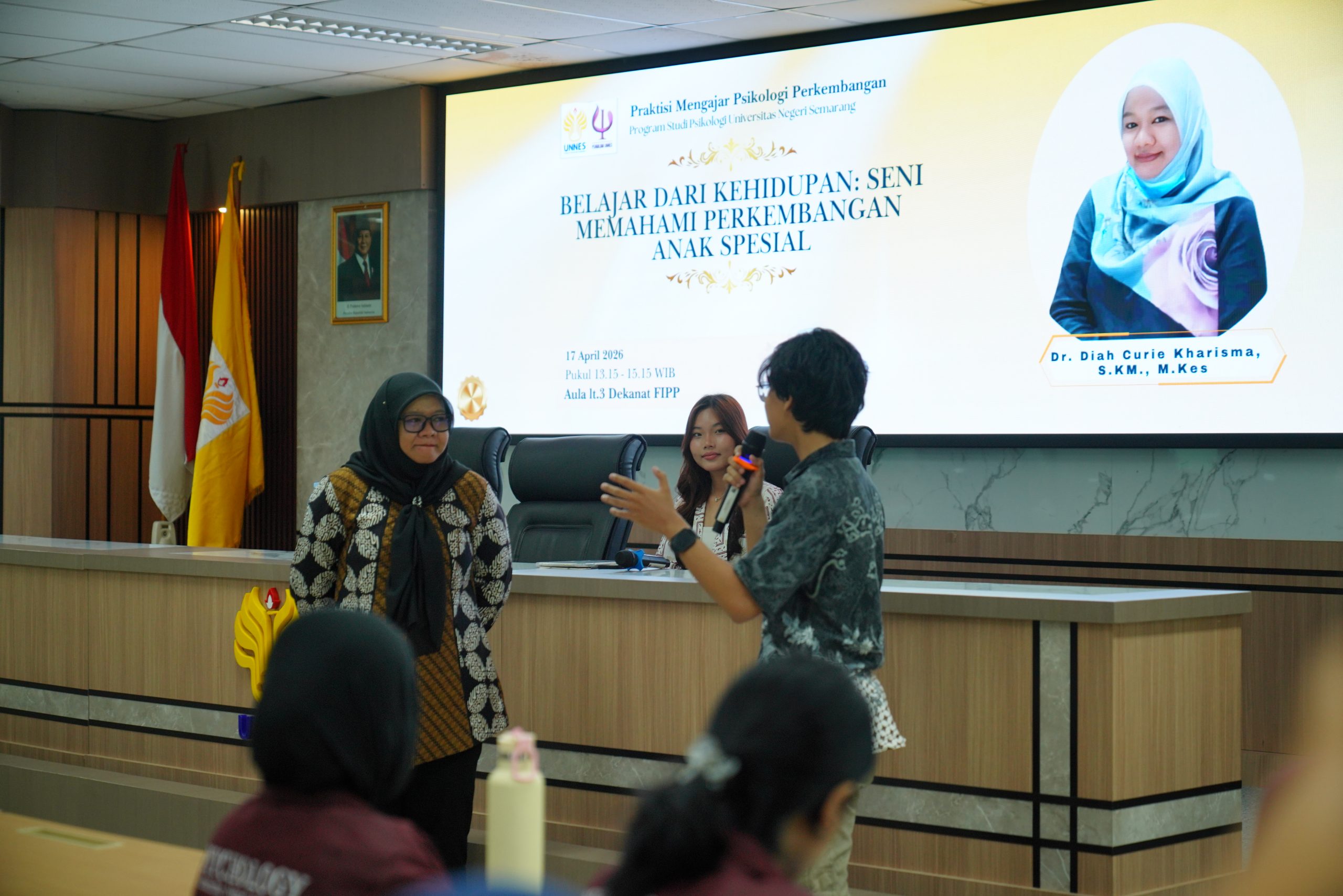
SEMARANG, April 17, 2026 – The Psychology Study Program, Faculty of Education and Psychology (FIPP) UNNES, successfully held a guest lecture entitled “Learning from Life: The Art of Understanding the Development of Children with Special Needs.” The event, held on the 3rd Floor of the Dean’s Hall, served as a crucial catalyst in strengthening collaboration between academics and practitioners in line with SDGs 4 (quality education) and 17 (partnership for the goals).
The event was officially opened by the Head of the Psychology Study Program, FIPP UNNES, Anna Undarwati, S.Psi., M.A., Ph.D. In her remarks, she emphasized that understanding Children with Special Needs is a crucial competency for psychology students. He also appreciated the unique synergy of the organizing committee, which was jointly managed by the Developmental Psychology Lecturer Team and Psychology Students from the Class of 2025.


Presenting a Practitioner’s Perspective
This guest lecture featured expert speaker Dr. Diah Curie Kharisma, SKM, M.Kes., a Technical Policy Analyst from the Central Java Provincial Health Training Center (Bapelkes). Addressing approximately 250 students from the Class of 2025, Dr. Diah explored how developmental theories learned in lectures often encounter different dynamics in real life.
“Theory is a map, but life is the real terrain,” said Dr. Diah. She explained that in children with special needs, development often does not progress linearly. “There are unexpected ‘jumps,’ and sometimes stagnation. This is where the art of understanding lies: we must recognize that mental age does not always align with chronological age.”
In-Depth Material: From Medical to Psychological
In interactive presentation sessions, students were invited to examine material that bridged clinical and psychosocial aspects, including:

  • CRS Case Study: A discussion of Congenital Rubella Syndrome (CRS), providing a concrete illustration of the impact of medical conditions on children’s sensory and cognitive impairments.
  • New Paradigm: An invitation to shift from a focus on “deficiencies” to a focus on “potential and strengths” (Strength-Based Approach).
  • Family Resilience: Exploring the phenomenon of Parenting Stress and how psychologists must act as supporters for parents, who are the primary therapeutic partners for children.

Cross-Generation Synergy
The success of this event reflects the internal solidarity within the Psychology Department of FIPP UNNES. The collaboration between the Developmental Psychology Lecturer Team’s experience and the 2025 students’ creativity successfully created a conducive and inspiring learning environment.
A committee representative stated that the students’ involvement in this committee aimed to hone their managerial soft skills and deepen their understanding of the topics they were studying in the Developmental Psychology course.
The event concluded with a dynamic question-and-answer session, during which students critically discussed the real-world challenges aspiring psychologists will face in addressing the diversity of human development in the future.
Related Posts

Leave a Reply

* Kode Akses Komentar:

* Tuliskan kode akses komentar diatas:

GDPR

  • Privacy Policy

Privacy Policy

At unnes.ac.id, the privacy of our visitors is of extreme importance to us. This privacy policy document outlines the types of personal information that is received and collected by unnes.ac.id and how it is used.

Log Files

Like many other Web sites, unnes.ac.id makes use of log files. The information inside the log files includes internet protocol (IP) addresses, type of browser, Internet Service Provider (ISP), date/time stamp, referring/exit pages, and number of clicks to analyze trends, administer the site, track user’s movement around the site, and gather demographic information. IP addresses and other such information are not linked to any information that is personally identifiable.

Cookies

unnes.ac.id uses cookies to store information about visitors’ preferences, to record user-specific information on which pages the site visitor accesses or visits, and to personalize or customize our web page content based upon visitors’ browser type or other information that the visitor sends via their browser.

Third-party ad servers or ad networks use technology in their respective advertisements and links that appear on unnes.ac.id and which are sent directly to your browser. They automatically receive your IP address when this occurs. Other technologies (such as cookies, JavaScript, or Web Beacons) may also be used by our site’s third-party ad networks to measure the effectiveness of their advertising campaigns and/or to personalize the advertising content that you see on the site.

unnes.ac.id has no access to or control over these cookies that are used by third-party advertisers.

You should consult the respective privacy policies of these third-party ad servers for more detailed information on their practices as well as for instructions about how to opt-out of certain practices. unnes.ac.id’s privacy policy does not apply to, and we cannot control the activities of, such other advertisers or web sites.

If you wish to disable cookies, you may do so through your individual browser options. More detailed information about cookie management with specific web browsers can be found at the browsers’ respective websites.

Consent

By using our website, you hereby consent to our privacy policy and agree to its terms.

Update

This Privacy Policy was last updated on: 2023-02-14. Should we update, amend or make any changes to our privacy policy, those changes will be posted here.

Contact Us

If you have any questions, comments, or concerns about our Privacy Policy or our practices with regards to your personal information, please feel free to contact us through the contact form on our website or by emailing us at humas[at]mail.unnes.ac.id.

This Privacy Policy is intended as a general guide to our practices in collecting and using information. If there is any inconsistency between this Privacy Policy and the terms of the Service Agreement or any other terms that may apply to specific services you use, then those specific service terms shall apply.

Terms of Use

By using our website, you agree to abide by this Privacy Policy. If you do not agree with this Privacy Policy, please do not use our website. We reserve the right to update this Privacy Policy from time to time without prior notice. Please review our Privacy Policy periodically to check for changes. Your continued use of our website following the posting of changes to this Privacy Policy means that you accept the changes.

Thank you for reading our Privacy Policy. We are committed to protecting the privacy of our website visitors and will continue to update our Privacy Policy to ensure optimal protection.