Ten international students from Universitas Negeri Semarang (UNNES) took part in an Indonesian language learning program through direct communication practice at the UNNES Ecofarm Educational Tourism Garden on Wednesday, April 22, 2026. This activity served as an innovative approach to enhancing the Indonesian language proficiency of international students by providing a contextual, practical, and environmentally based learning experience.
The session was led by Diyamon Prasandha, S.Pd., M.Pd., who applied a contextual learning approach. This method was designed to ensure that students not only understand the language theoretically in the classroom but are also able to use it actively in real-life situations. Through direct interaction in an open and natural environment, students were encouraged to communicate more spontaneously while gaining a deeper understanding of the cultural and situational use of the Indonesian language.
Throughout the program, students engaged in a variety of interactive activities, including interviews, group discussions, and educational question-and-answer sessions. The Ecofarm area was utilized as an open learning space that integrates principles of conservation and sustainable agriculture. The green and educational setting provided a refreshing alternative to conventional classroom learning, making the experience more engaging and meaningful.
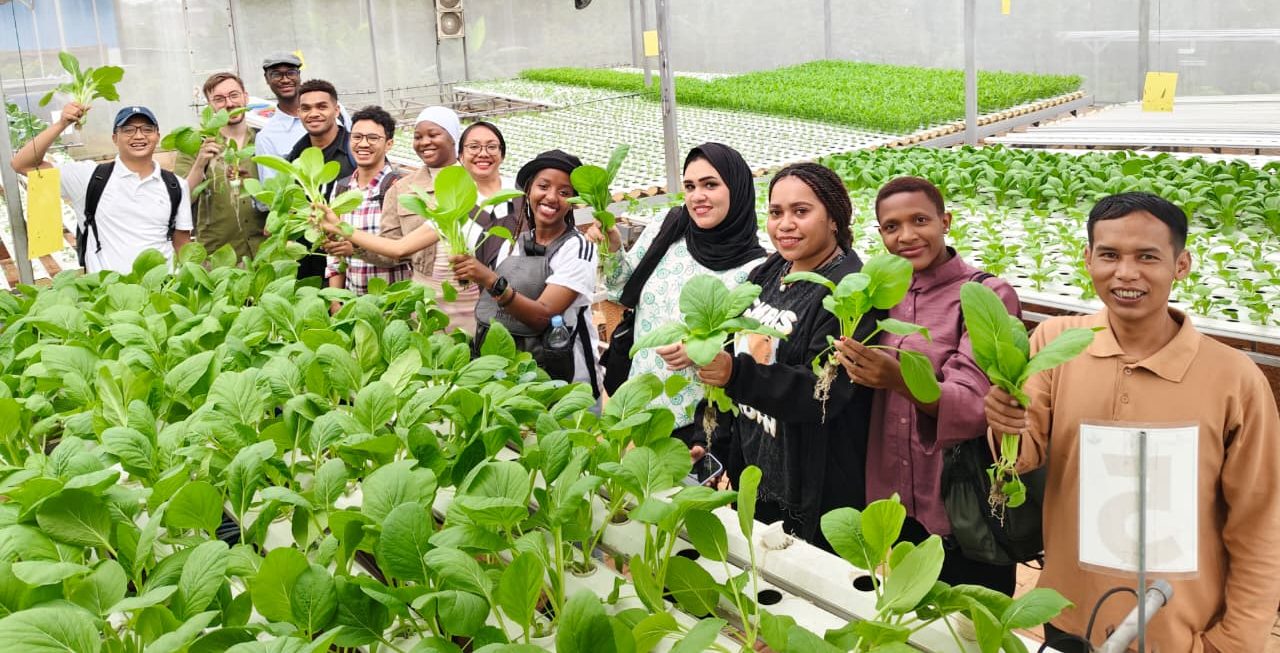
In addition to practicing their speaking skills, the students also participated in hands-on hydroponic farming activities. They had the opportunity to harvest hydroponically grown mustard greens and practice transplanting seedlings under the guidance of Rahmanudin, S.Si., the manager of UNNES Ecofarm. These activities allowed students not only to improve their spoken Indonesian but also to acquire thematic vocabulary and technical terms related to agriculture and sustainability through direct experience.
The use of the UNNES Ecofarm Educational Tourism Garden as a learning medium reflects UNNES’s strong commitment as a conservation-oriented university in delivering innovative and sustainable education. This initiative also aligns with the achievement of several Sustainable Development Goals (SDGs).
Specifically, the program supports SDG 4 (Quality Education) through the implementation of active and experiential learning, SDG 11 (Sustainable Cities and Communities) by utilizing green campus spaces as educational environments, and SDG 12 (Responsible Consumption and Production) through the introduction of hydroponic farming practices and sustainable food systems.
Through programs like this, international students are expected not only to improve their Indonesian language skills but also to gain broader insights into sustainability values, local culture, and the important role of environmental awareness in everyday life.