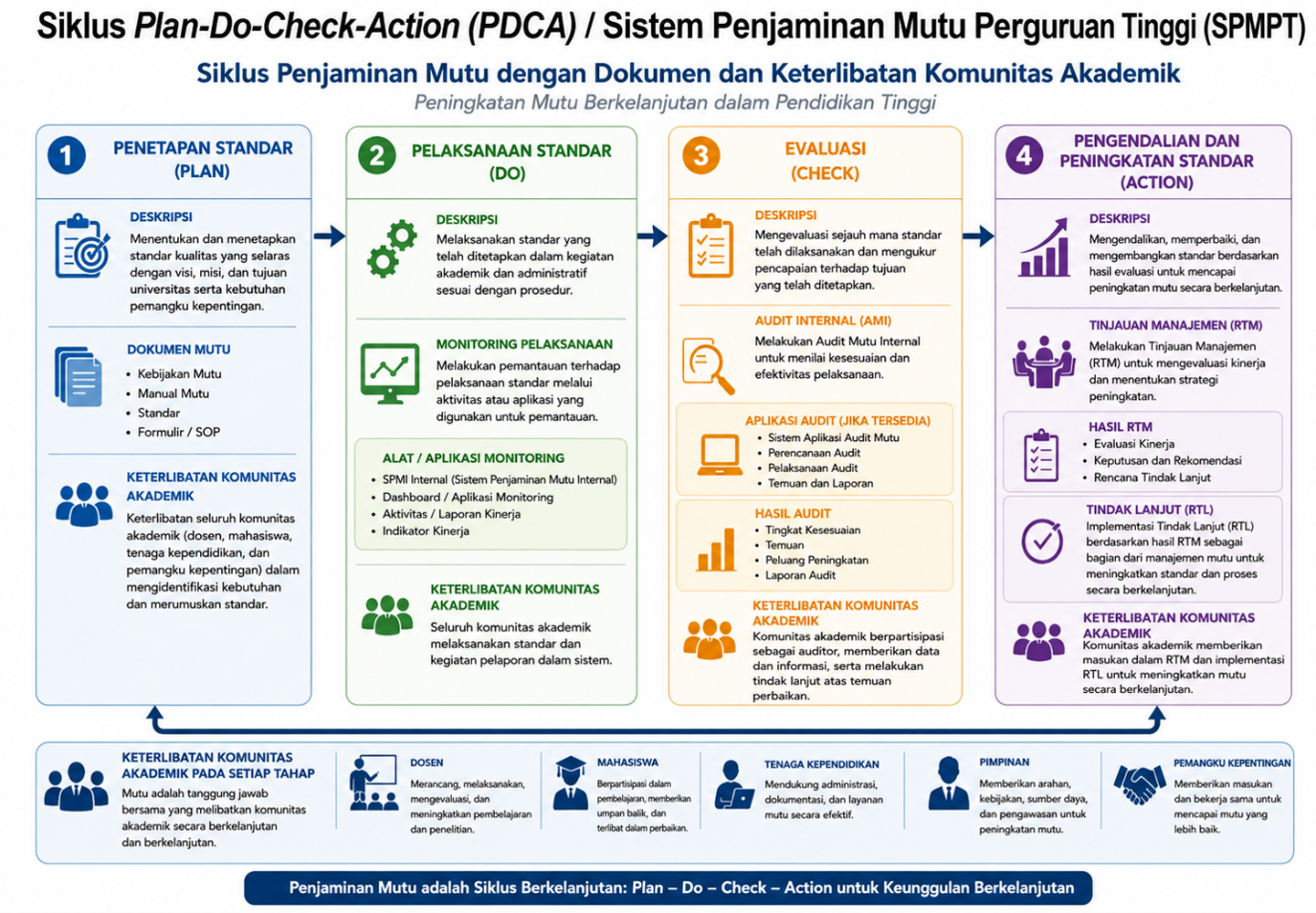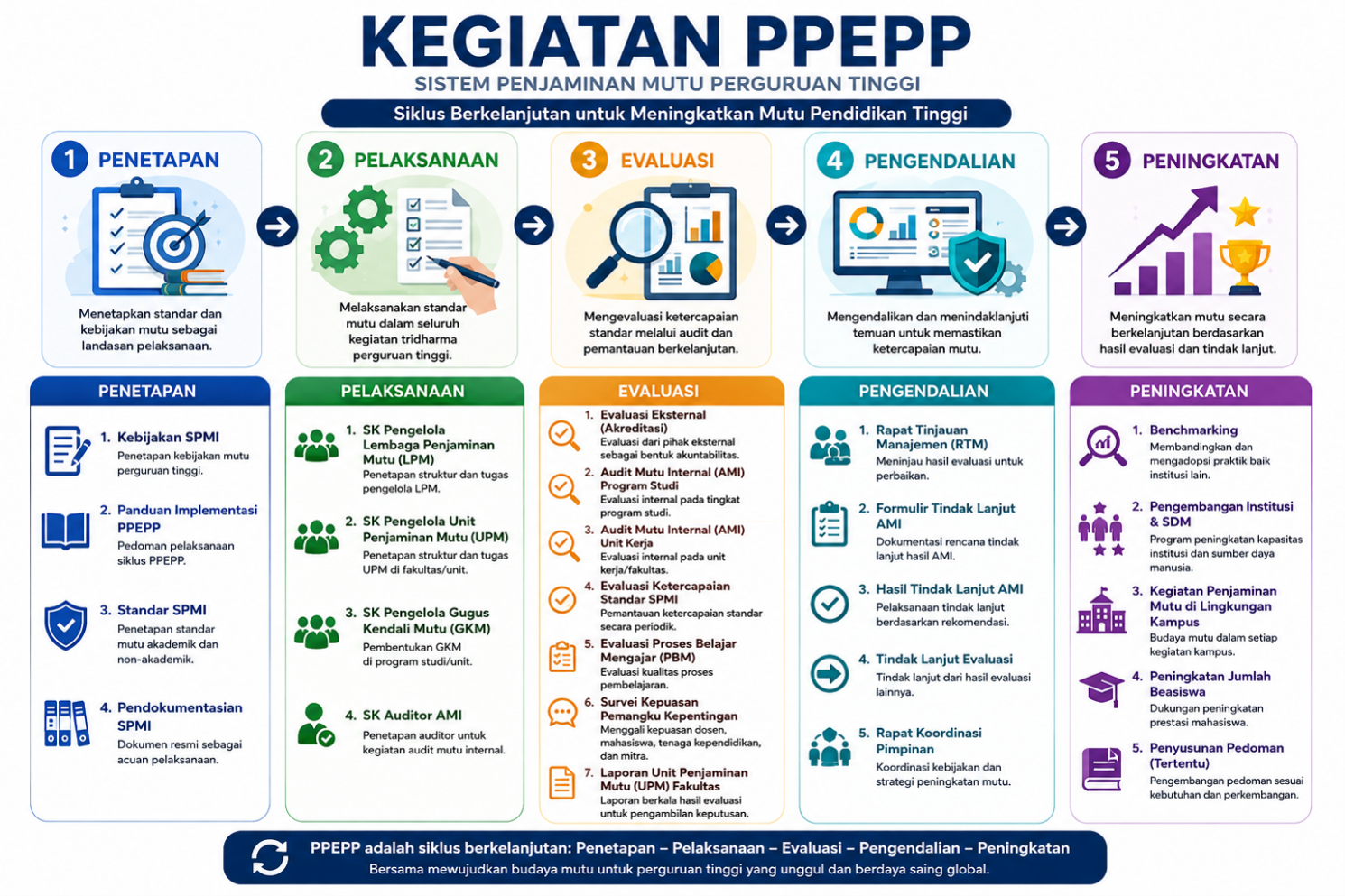
Involvement of the Academic Community in the PPEPP Cycle (Determination-Implementation-Evaluation-Control-Improvement) as the Comprehensive Implementation of UNNES’s Internal Quality Assurance System (SPMI) – PDCA/PPEPP Cycle
Universitas Negeri Semarang (UNNES) implements a continuous improvement cycle known as PPEPP—aligned with the widely accepted Plan-Do-Check-Action (PDCA) model—to develop its Internal Quality Assurance System (SPMI). Please also refer to the four UNNES quality assurance manuals at the provided link. (https://unnes.ac.id/kpm/en/homepage/).
This cycle is applied to all academic and non-academic units, ranging from the institutional level down to the study program level..
During the Establishment (Plan/Standard-Setting) stage, UNNES formulates quality standards that meet or exceed the National Standards for Higher Education (SN-Dikti). This process also entails the development of a quality document hierarchy—comprising the Quality Policy, Quality Manual, Quality Standards, and Standard Operating Procedures—crafted collaboratively with lecturers, students, university management, and external stakeholders.
During the Implementation (Do) stage, all levels of the university—including faculties and study programs—are required to carry out activities in accordance with established standards. To ensure evidence-based and accountable implementation, UNNES utilizes digital platforms such as SISTER and SIAKAD, as well as the national PDDikti database, to monitor performance indicators in real-time.
The Evaluation (Check) stage is underpinned by the Internal Quality Audit (AMI), conducted periodically by competent internal auditors in accordance with quality procedure PM-BPM-03. This audit encompasses document reviews, on-site interviews, and the classification of findings into categories of compliance, minor non-conformity, or major non-conformity. The entire audit process is managed via a dedicated digital platform that also automates reporting.
In the Control and Improvement (Action) stage, audit findings are discussed during Management Review Meetings (RTM) at the study program, faculty, and university levels. Each RTM results in a Follow-Up Plan (RTL) specifying the responsible parties, deadlines, and performance indicators. To ensure the system remains dynamic rather than merely compliance-oriented, the RTM also recommends formally raising standards whenever a specific standard is consistently exceeded.
Through this structured and interactive PPEPP/PDCA cycle, UNNES has cultivated a genuine culture of quality across all organizational levels, consistently advancing toward higher standards of academic excellence and public accountability.