
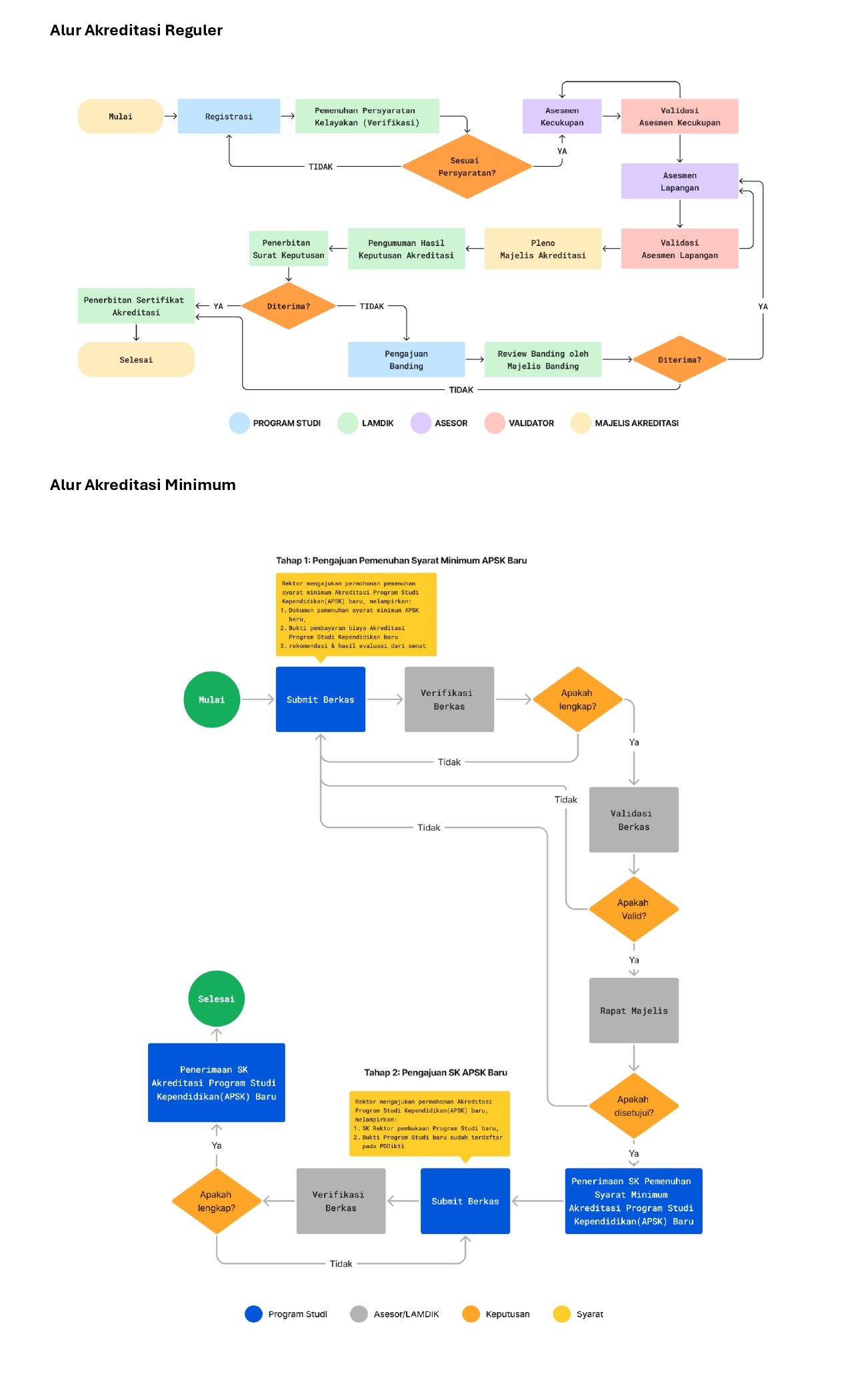
In general, the regular accreditation process consists of six main stages, as listed below. Detailed information for each stage is provided under the Guidelines and Regulations tab.
The minimum accreditation process for new Study Programs consists of the following stages:
Twelve months (one year) before the issuance of the reaccreditation decree (i.e., before the accreditation decision expires), the Study Program should begin preparing the Self-Evaluation Report (SER) and other required documents. These documents include:
Online registration is conducted through the Study Program’s Virtual Account under the Higher Education Institution account. If the Higher Education Institution has not yet obtained an account, please contact us via email at [email protected]. After the payment has been successfully completed, the Study Program may upload the accreditation documents, including the Self-Evaluation Report (SER) and other required documents, through the SIMA LAMDIK to proceed with the accreditation process.
Once the proposed accreditation documents have been verified, the Study Program proceeds with the payment for the Adequacy Assessment (AA). Upon receipt of the proof of payment, Independent Accreditation Agency for the Fields of Education conducts the assessment over a period of one week.
Independent Accreditation Agency for the Fields of Education appoints two assessors to evaluate the Self-Evaluation Report (SER) submitted by the Study Program. If the report does not meet the required criteria, the accreditation process will be postponed. However, the Study Program may reapply for accreditation after one year..
Study Programs that pass the Adequacy Assessment proceed with the payment for the Site Assessment (SA), which is conducted at the Study Program’s premises. The Site Assessment process, including score validation, takes approximately two weeks. The Site Assessment focuses on the following aspects:
Before the Site Assessment, several preparations must be agreed upon and communicated by the Study Program to ensure that the assessment proceeds smoothly. What needs to be prepared?
Administration
Access to Facilities and Infrastructure
Facilities include the management office, classrooms, laboratories, practice rooms, laboratory schools, student health service facilities, guidance and counseling rooms, academic staff offices, and other relevant facilities.
Curriculum-Related Documents
These include curriculum maps, modules, teaching materials, syllabi, course lesson plans, samples of student work, sample examination questions and test blueprints, as well as documents related to academic advising, internships, and final projects.
Internal Quality Assurance Documents
These include academic quality policies, quality standards, quality manuals, and quality forms.
Information Systems
These include the library, internet connection, IT infrastructure, applications supporting academic and non-academic activities, and the Learning Management System.
Assessors’ Working Room equipped with an LCD projector and screen, internet connection, printer, markers, whiteboard, and other necessary facilities.
The Study Program also provides an interpreter if English is not the native language, and most of the documents are not available in English.
The Site Assessment (SA) consists of the following activities:
Independent Accreditation Agency for the Fields of Education determines the accreditation rating through a plenary meeting of the council. The meeting results are announced through an official decree issued one week later. The accreditation rating is also publicly announced on the Accreditation Rating Results webpage. Study Programs that object to the accreditation result may file an appeal by repeating the process starting from the Site Assessment stage.
A Study Program may file an appeal against the accreditation decision within a maximum of four weeks after receiving the initial online decision. The appeal mechanism requires the Study Program to submit an appeal request accompanied by supporting evidence or related documents. The appeal letter and supporting documents must be uploaded to SIMA LAMDIK and sent via email to [email protected]. Independent Accreditation Agency for the Fields of Education reviews the appeal through the Accreditation Council and communicates the Council’s decision via email.
If the appeal submitted by the Study Program is approved, the Independent Accreditation Agency for the Fields of Education appoints a coordinator and assessors to conduct a reassessment, focusing on the criteria that form the basis of the appeal. The reassessment is carried out within two weeks.
If further verification of evidence is required, the Independent Accreditation Agency for the Fields of Education appoints a team of three assessors (one coordinator and two assessors) to conduct a visit to the SPMU/Study Program. The visit is carried out within a maximum period of eight weeks.
The final appeal decision is determined by the Accreditation Council within one week. The meeting decision is issued through an official decree and the accreditation certificate for the Study Program.
Note: The cost of the appeal process is borne by the Study Program Management Unit (SPMU) or the Study Program.
After the approval for the establishment of a new teacher education Study Program has been granted, the Rector of a Legal Entity Higher Education Institution may submit an application for the Minimum Accreditation Requirements for Educational Study Programs to the Independent Accreditation Agency for the Fields of Education through SIMALAMDIK, accompanied by:
The Independent Accreditation Agency for the Fields of Education examines the completeness of the administrative requirements and supporting documents. If the documents are incomplete, they will be returned to the proposing higher education institution for completion. If the documents are declared complete, the application proceeds to the assessment stage.
The submitted documents are then assessed by the validators of the Independent Accreditation Agency for the Fields of Education. If the documents do not meet the requirements, they will be returned to the proposing higher education institution for revision. If the requirements are met, the validators submit their recommendation to the Accreditation Council (MA) of the Independent Accreditation Agency for the Fields of Education for consideration./p>
The Accreditation Council (MA) then holds a plenary meeting to discuss and determine the fulfillment of the Minimum Accreditation Requirements for Educational Study Programs for applicants who have passed the document validation. The plenary meeting results in a decision, which is submitted to the Chairperson of the Independent Accreditation Agency for the Fields of Education.
The Chairperson of the Independent Accreditation Agency for the Fields of Education issues the Decree on the Fulfillment of the Minimum Accreditation Requirements for Educational Study Programs for the establishment of a new Educational Study Program. If the Chairperson of the Independent Accreditation Agency for the Fields of Education does not issue the decree, the applicant must make the necessary improvements to meet the eligibility requirements for establishing a new Educational Study Program.
After receiving the decree from the Chairperson of the Independent Accreditation Agency for the Fields of Education, the Rector issues the Decree on the Establishment of the new Educational Study Program. Subsequently, the Rector registers the Study Program in the Higher Education Database (PD Dikti). The Rector may then submit an application for the Minimum Accreditation Requirements for Educational Study Programs to the Independent Accreditation Agency for the Fields of Education through SIMALAMDIK, accompanied by:
After the application has been received, the Independent Accreditation Agency for the Fields of Education examines the completeness of the administrative documents. The proposing higher education institution must complete the required documents if any documents are still missing./p>
If the documents are declared complete, the Chairperson of the Independent Accreditation Agency for the Fields of Education issues the Decree on the Minimum Accreditation Requirements for Educational Study Programs with the accreditation rating of “Good”, which is valid for two (2) years from the date the Study Program admits new students.
The decree cannot be extended and must be renewed through a proposal for the Minimum Accreditation Requirements for Educational Study Programs to the Independent Accreditation Agency for the Fields of Education no later than six (6) months before the accreditation validity period expires.
The complete accreditation instruments for Study Programs under the scope of the Independent Accreditation Agency for the Fields of Education can be accessed through the link below.