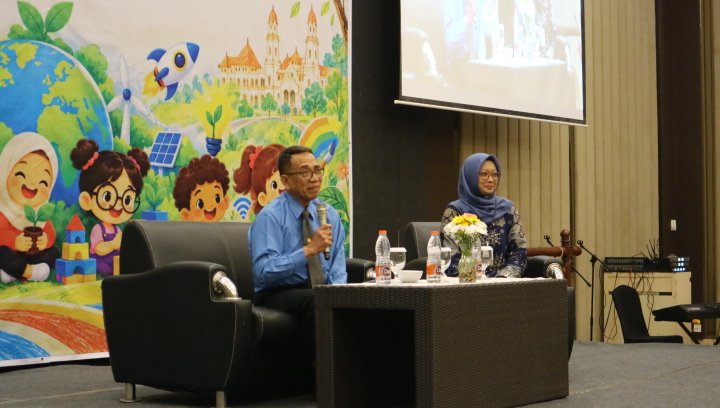




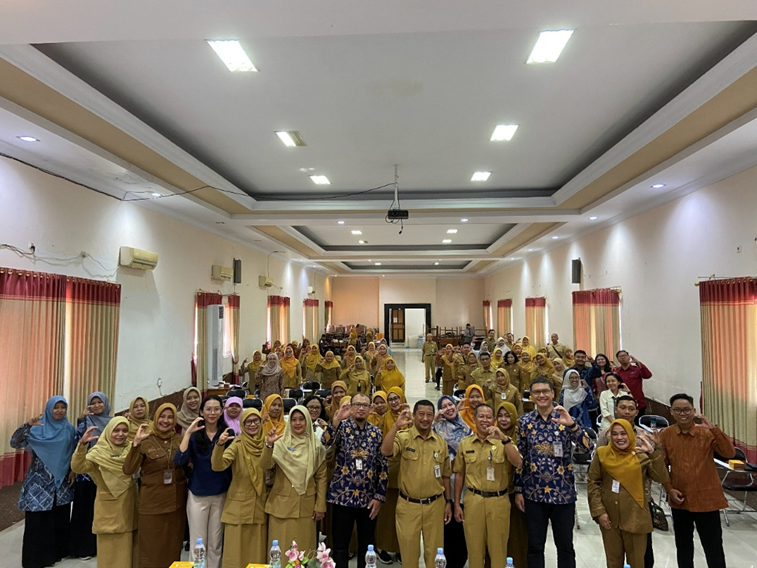
Tegal, September 1, 2026 – The Tegal City Branch of the Indonesian Guidance and Counseling Association (ABKIN) in collaboration with Semarang State University (UNNES) held a Visiting Lecture themed “Empowering School Counselors with Artificial Intelligence: Strengthening Guidance and Counseling Teacher Competence through Effective, Efficient, and Responsible Utilization of AI.” The activity, held at SMKN 3 Tegal City, was attended by 88 Guidance and Counseling Teachers from all over Tegal City.
The series of opening activities were guided by Widya Ayu Marlina, M.Pd.Kons., as the host, then began with an activity report by the Chairperson of ABKIN Tegal City, Lina Kusumaningrum, S.Pd. This activity also received remarks from the Head of the Education Office Branch of Region XI represented by Mr. Purwanto, M.Pd., as well as remarks from the Principal of SMK Negeri 3 Tegal represented by Mr. Heri Pramono, M.Pd., MT
This activity provides a platform for guidance and counseling teachers to strengthen their understanding of the development of Artificial Intelligence (AI), explore its practical applications, and assess the ethical boundaries of its use in school guidance and counseling (BK) services. Through this activity, guidance and counseling teachers are encouraged to view AI as a professional tool that can improve work efficiency, but must remain under human control, verification, and accountability.
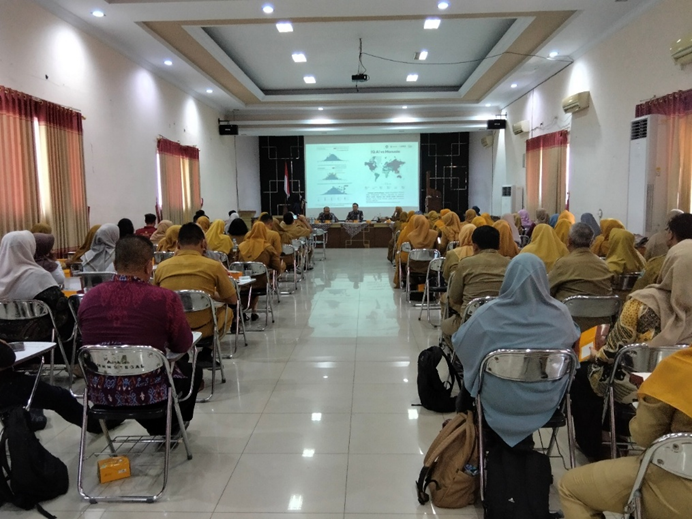
Mulawarman, S.Pd., M.Pd., Ph.D., delivered a presentation on the transformation of the role of guidance counselors in the AI era. In his presentation, Mulawarman explained that today’s students live in a fast-paced, personalized, and socially connected digital environment. This situation brings both opportunities and challenges, ranging from widespread access to information, digital distractions, cyberbullying, and increasingly complex social pressures.
Mulawarman emphasized that 21st-century guidance and counseling services require guidance and counseling teachers to possess digital and AI literacy, data literacy, ethical competence, and humanistic communication skills. AI is positioned as a co-pilot or augmentative tool that can assist with material development, administration, initial assessment, screening, monitoring, and follow-up. However, guidance and counseling teachers remain the decision-makers, guardians of confidentiality, and the professional responsibilities of the service.
The practical use of AI in guidance and counseling services was presented by Cristin Mutiara Damanik, S.Pd., M.Pd. In this session, participants were introduced to various realistic uses of AI to support guidance and counseling teachers’ duties, such as assisting with service administration, compiling psychoeducational materials, designing classical services, developing reflection questions, organizing documentation, and providing a brainstorming platform.
Cristin also introduced the PROMPT formula—Role, Scope, Objective, Material/Context, Procedure, and Output Display—to enable guidance counselors to provide clearer instructions to AI. With structured prompts, AI results are expected to be more relevant, easily reviewed, and consistent with service objectives. At the same time, participants were reminded that AI results remain drafts that need to be verified by guidance counselors before use.
In practice, Cristin emphasized the importance of vigilance against hallucinations, bias, privacy breaches, diagnostic overreach, and the risk of displacing human relationships. Therefore, every AI output needs to be reviewed through the human-in-the-loop principle, considering accuracy, relevance, compliance with BK principles, ethical security, and data integrity.
Sigit Hariyadi, S.Pd., M.Pd., presented material on the ethics of using AI in guidance and counseling services. He emphasized that the use of AI in guidance and counseling must be based on the principles of personal data protection, client confidentiality, safety, accountability, and respect for student autonomy.
In his presentation, Sigit outlined risks to be aware of, such as excessive data collection, misuse, third-party access, security breaches, sensitive data inference, unlimited storage, re-identification, and cross-purpose use. He also highlighted the potential for data bias, labeling bias, measurement bias, algorithmic bias, implementation bias, automation bias, interaction bias, and digital access bias.
Sigit emphasized that transparency, informed consent, fairness, inclusivity, professional integrity, and regular evaluation are the foundations of AI governance in schools. The crucial question is not just how intelligent AI is, but how responsibly it is used in guidance and counseling services.
In addition to strengthening understanding of AI transformation, practice, and ethics, this activity also introduced the AIAC (Artificial Intelligence-Assisted Counseling) Model to the guidance counselors. The AIAC Model was developed as an artificial intelligence-assisted counseling model that still places the guidance counselor as the primary decision-maker. This introduction also served as a forum for soliciting support and participation from Tegal City guidance counselors in developing media that can assist guidance counselors’ performance, particularly in individual counseling services.
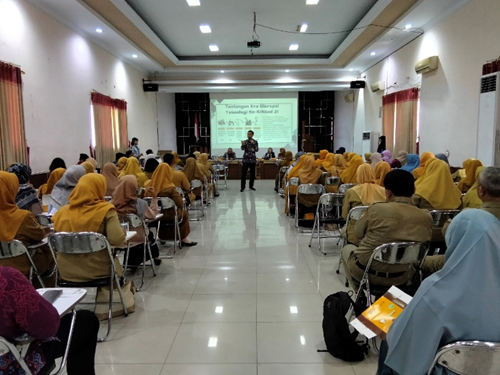
Through this activity, BK teachers are expected to be increasingly prepared to become educators and school counselors who are AI-capable and AI-critical: able to utilize AI to increase work effectiveness, but remain critical in limiting, verifying, or rejecting AI output when it does not comply with the client’s context, professional principles, or service ethics.
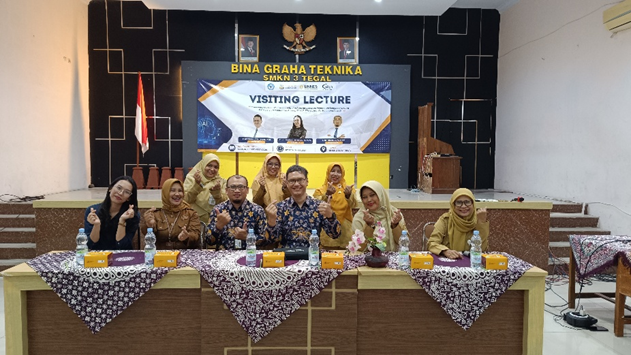
This Visiting Lecture activity emphasized that the use of AI in guidance and counseling services is not simply a matter of keeping up with technological developments, but rather part of an effort to build more responsive, efficient, safe, and responsible services for students. With the collaboration between ABKIN Tegal City and UNNES, it is hoped that the strengthening of guidance and counseling teacher competencies will continue so that technological innovation truly supports the quality of counseling services in schools without diminishing the core values of the guidance and counseling profession: empathy, confidentiality, presence, and professional responsibility.