

Semarang, UNNES — Semarang State University (UNNES), through its Institute for Research and Community Service (LPPM), has once again achieved success in its research partnership program with the World’s Top 100 Universities. This time, the UNNES research team conducted a visiting researcher program at Monash University, Australia, from August 10–12, 2026, marking a new chapter in international research collaboration between the two institutions.
The series of activities began with a class visit for the EDF5778 Qualitative Research Methodology course, taught by Assoc. Prof. Pearl Subban, Ph.D., accompanied by Fatona Suraya, Ph.D. Through this session, the UNNES team gained firsthand insight into the qualitative learning approach at Monash University, known for its world-class academic standards.
Entering the second day, August 11, 2026, the agenda continued with a session interpreting the results of exploratory research with the Indonesian diaspora community. In this session, the UNNES research team invited practitioner respondents, namely Indonesian citizens (WNI) working as migrant caregivers in Australia with four years of work experience. Through this session, the research team gained direct perspectives from field practitioners regarding the challenges of work readiness, cultural adaptation, and life skills education needs faced by Indonesian migrant workers, while also enriching and sharpening the initial research findings before further discussion in the FGD.
Highlight: Focus Group Discussion on Inclusion and Work Readiness
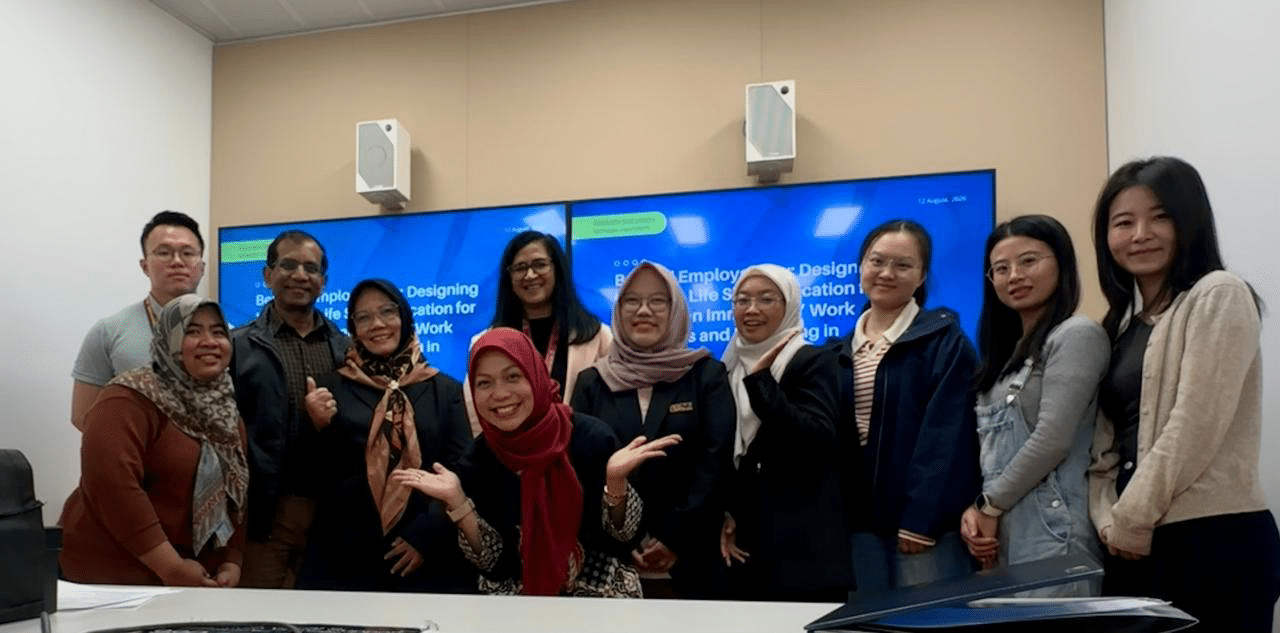
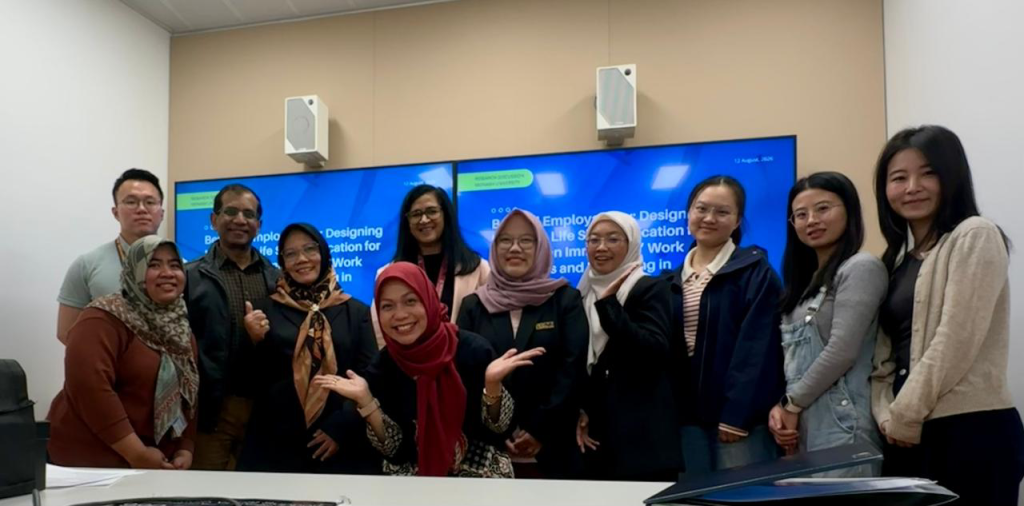
The peak of the activity took place on August 12, 2026, at 08.00–12.00 local time, at 19 Ancora Imparo Way, Clayton, Meeting Room Edu, Monash University. This Forum Group Discussion (FGD) raised the theme “Beyond Employability: Designing Inclusive Life Skills Education for Indonesian Immigrants’ Work Readiness and Belonging in Australia” . A topic that highlights the importance of inclusive life skills education for Indonesian immigrants to be able to compete in the world of work while feeling socially accepted in their new country.
The FGD was officially opened by Assoc. Prof. Pearl Subban, Ph.D., followed by remarks from the Head of Research at UNNES, Dr. Tri Suminar, M.Pd. The academic material was then presented by members of the research team, Indri Ajeng Setyoningrum, S.Pd., M.Pd., along with Dr. Arini Dwi Cahyani, S.Pd., M.Pd., who presented the results of a preliminary study related to work readiness and belonging in the Indonesian immigrant community in Australia.
The discussion was also attended by several senior academics from the Faculty of Education, Monash University, including Assoc. Prof. Pearl Subban, Ph.D., and Assoc. Prof. Raqib Chowdhury, as well as several Ph.D. students pursuing research in the field of inclusive learning. The presence of these interdisciplinary experts enriched the discussion with diverse academic perspectives, ranging from inclusive education and social psychology to migrant employment policies.
Closed with the signing of the Implementation Arrangement (IA)
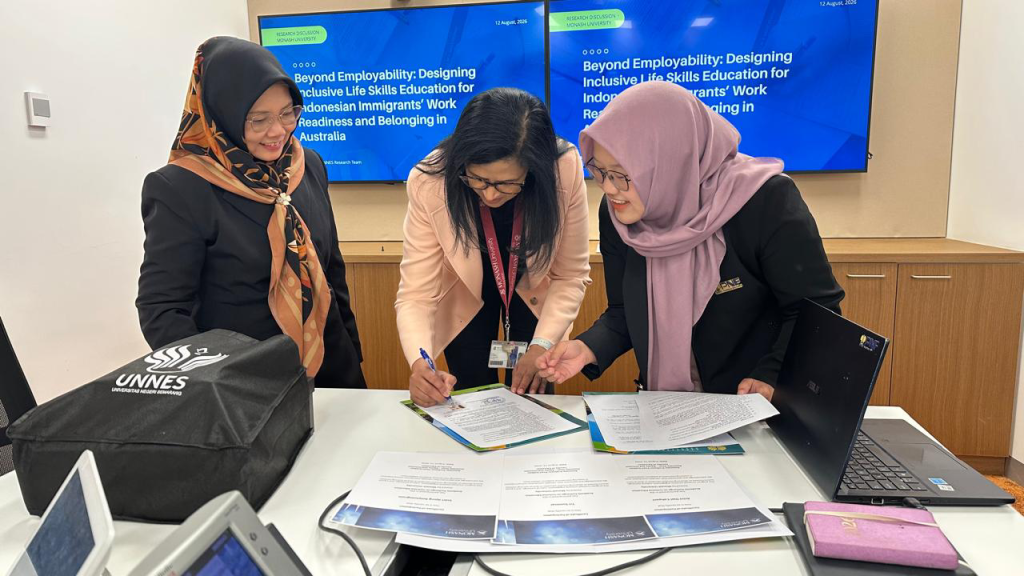
As a commitment to the continued partnership, the series of activities concluded with the signing of an Implementation Arrangement (IA) between UNNES and Monash University. This document serves as a formal foundation for both institutions to continue developing research collaborations, academic exchanges, and joint publications in the future.
Following the event, Assoc. Prof. Raqib Chowdhury expressed his deep appreciation for the discussion via email:
“Thank you very much for the wonderful seminar yesterday. The topic resonated with me – not only is the topic important in itself, but you’re conducting it very thoughtfully and efficiently. I wish we had more time discussing it, but hopefully this is just a start. Thank you also for the gifts and the warmth of your company. It was lovely to have to visit my office room. Please enjoy the rest of your visit in Melbourne and hopefully our paths will cross again at Monash, or UNNES, or who knows – somewhere else. Best wishes.”
These warm greetings are a sign that the collaboration between UNNES and Monash University will not stop at just one activity, but will become the starting point for long-term research collaboration.
UNNES’s concrete support for the SDGs
This research partnership activity is a concrete manifestation of UNNES’ commitment as a World Class University in supporting the achievement of the Sustainable Development Goals (SDGs), in particular:
- SDG 4 – Quality Education , through the development of a life skills education model that is inclusive and relevant to the real needs of immigrant communities.
- SDG 8 – Decent Work and Economic Growth , by encouraging work readiness for Indonesian immigrants so they can contribute productively in their destination countries.
- SDG 10 – Reduced Inequality , because this research specifically targets vulnerable groups, namely immigrants, so that they can obtain equal access to education and employment as well as a sense of belonging in the new society.
- SDG 17 – Partnerships to Achieve the Goals , is reflected in the cross-country collaboration between UNNES and Monash University that strengthens the global research network for shared sustainable development goals.
Through this activity, UNNES further affirms its position as a university that excels not only academically but also cares about global humanitarian issues, including the sustainability and well-being of Indonesian diaspora communities around the world. This collaboration is expected to continue with further collaborative research, joint scientific publications, and academic exchange programs between the two universities.