

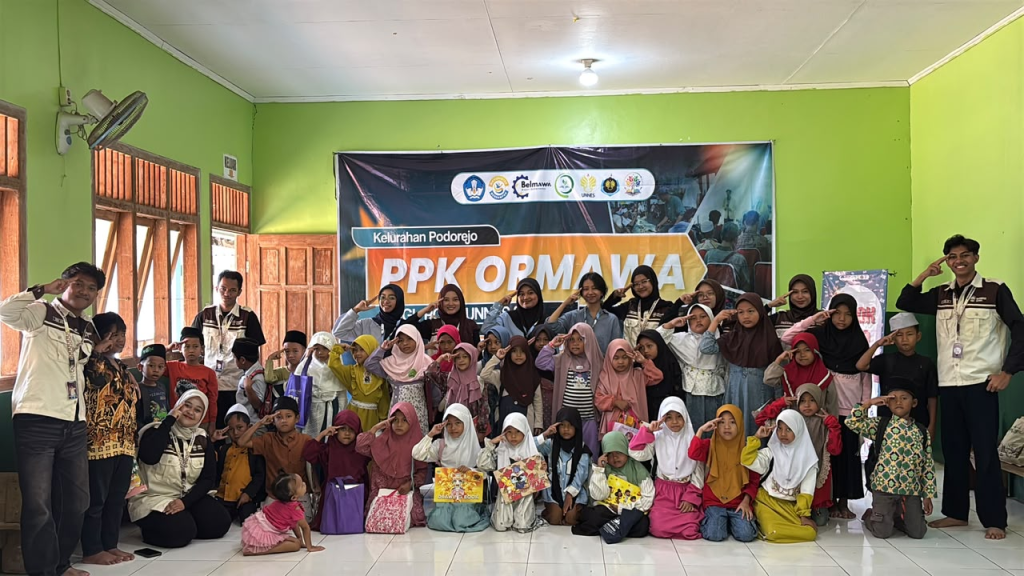
Semarang – After the previous meeting focused on strengthening multilingual literacy skills, the PPK Ormawa SGL PGSD Universitas Negeri Semarang Implementation Team once again presented new material in the series of Tunas Ngrembaka Literacy Corner activities. On Friday, 10 July 2026, the team held the Third Meeting (Pertemuan III) of the Tunas Ngrembaka Literacy Corner at the Madrasah Diniyah (Madin) in RW 6, Kelurahan Podorejo, an area designated as Target Point II (village settlement) within the NGREMBAKA AKSARA program. The activity, attended by 35 elementary-school-age participants, ran with great enthusiasm and eagerness to learn. Unlike the two previous meetings, this Third Meeting carried the theme of Financial Literacy, as one of the implementations of the NGREMBAKA AKSARA program in building literacy skills integrated with edupreneur skills from an early age. This choice of theme is in line with the results of the community needs mapping the team had carried out since the beginning of the program, which showed the need to strengthen the economic capacity of the Podorejo community, including through instilling entrepreneurial values from an early age. This effort is a concrete contribution to SDG 4 – Quality Education, particularly in ensuring that all children gain relevant knowledge and skills to support future economic independence, as well as SDG 8 – Decent Work and Economic Growth, which emphasizes the importance of instilling entrepreneurship and financial management skills from an early age as a foundation for inclusive economic growth.
Getting to Know Money and Basic Financial Concepts Contextually
The Financial Literacy material focused on introducing basic financial concepts, such as recognizing various denominations of Indonesian rupiah, understanding the value of money, the importance of saving, and introducing simple buying and selling activities close to children’s daily lives. Through this material, participants were expected to begin developing a basic understanding of wise financial management as a foundation for building independent, responsible character with an entrepreneurial spirit for the future.
The activity began with an opening by the implementation team, followed by an apperception aimed at exploring participants’ prior experiences with using money in everyday life. Next, the facilitators introduced the material interactively by inviting participants to discuss the function of money, the benefits of saving, and examples of buying and selling activities they commonly encounter at home and at school. This approach aimed to build a connection between the material and participants’ real experiences so that the learning process would be more meaningful and easier for the children to internalize.
Transaction Simulation as a Concrete Learning Medium
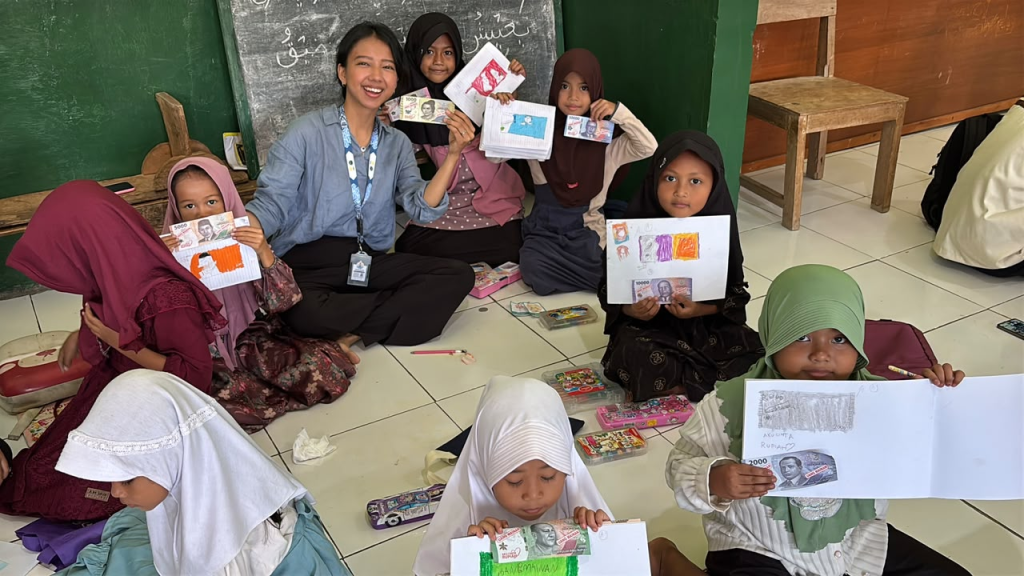
To increase the effectiveness of learning, participants were divided into several small groups accompanied by the implementation team and Ormawa members as facilitators. In each group, the material was delivered using a variety of engaging learning media, including play money, real rupiah currency, illustrated cards, illustrations of economic activities, and visual media on the buying and selling process. The use of these concrete media helped participants recognize the shapes, denominations, colors, and value of Indonesian currency more easily, while also providing an enjoyable learning experience through simple buying-and-selling transaction simulations.
Throughout the learning process, participants took part in various hands-on activities, including:
- Recognizing currency denominations, to train visual sensitivity to the shape and value of currency;
- Counting amounts of money, to sharpen practical, applicable arithmetic skills;
- Determining the value of goods according to a given price, as practice in simple economic decision-making; and
- Simulating transactions between seller and buyer, which trained communication skills, cooperation, and honest conduct in transactions.
These activities not only trained counting skills, but also gradually fostered children’s understanding of honesty, responsibility, and decision-making basic values that form an important foundation for building an entrepreneurial character from an early age.
Learning While Playing: Ice Breaking and Educational Games
To keep the learning atmosphere enjoyable and participants focused throughout the lesson, the activity was interspersed with ice breaking sessions and educational games themed around financial literacy. The various games carried out succeeded in boosting participants’ enthusiasm, strengthening cooperation among peers, and creating an active, interactive, and joyful learning atmosphere, even though the weather around the location was rainy at times.
Learning Evaluation and Appreciation for Participants
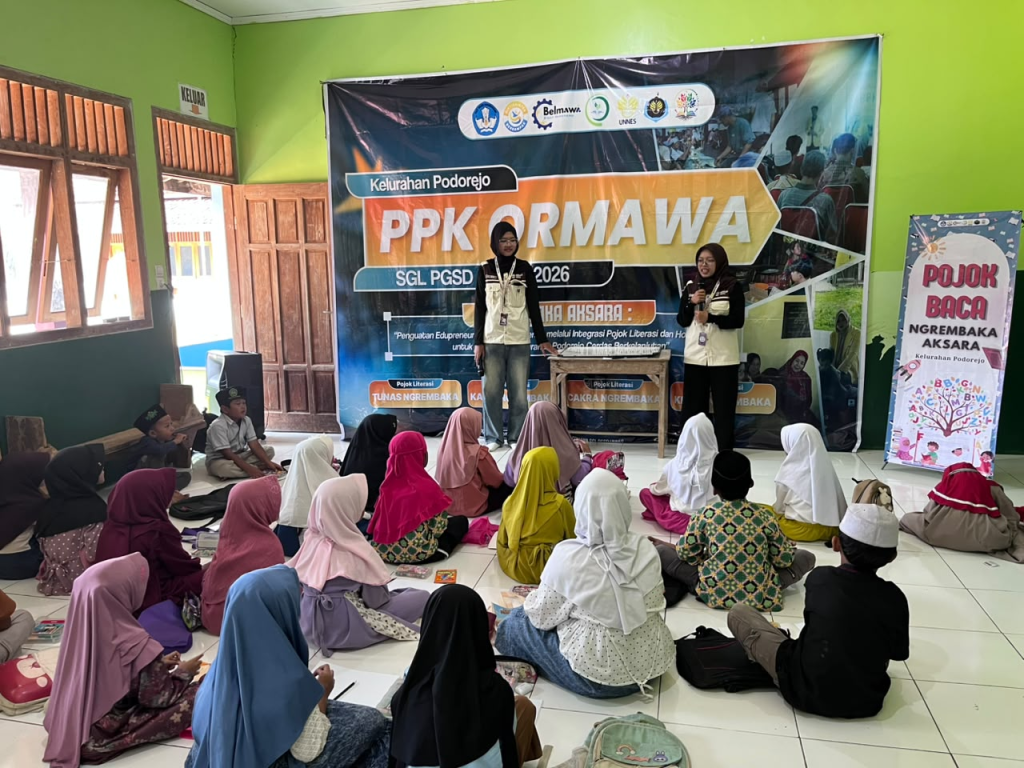
After the material was delivered, participants completed a Student Worksheet (Lembar Kerja Murid/LKM) prepared by the implementation team as a learning evaluation tool. Through this worksheet, the team was able to gauge participants’ level of understanding of the material presented, ranging from the ability to recognize currency and understand the concept of saving, to solving simple problems related to buying and selling activities. The evaluation results showed that most participants were able to understand the material well and demonstrated improvement compared to their initial understanding before the activity took place.
The next stage was a joint evaluation session packaged as an interactive discussion. Participants were given the opportunity to share their answers, recount their experiences with saving and shopping, and answer various questions posed by the facilitators. Children who bravely came forward to answer questions or practice the transaction simulation were given rewards as a form of appreciation for their courage, active participation, and involvement throughout the activity. This reward-giving was one of the strategies used to boost learning motivation while also building participants’ self-confidence.
Toward the end of the activity, the implementation team reinforced the material by emphasizing the importance of making a habit of saving, using money wisely, distinguishing between needs and wants, and being honest in every economic activity. These values serve as an important initial foundation for children in understanding responsible resource management, while also supporting the spirit of SDG 1 – No Poverty, in which strengthening financial capacity from an early age is one long-term preventive step in building the economic resilience of families and communities. The entire series of lessons was then closed with a summary of the material as a shared reflection on the learning that had taken place.
As a form of appreciation for all participants, the implementation team distributed snacks to all the children who had taken part in the activity in an orderly and enthusiastic manner. The use of the Madin in RW 6 as the activity location also demonstrated how existing social-religious facilities within the community can be optimized as additional inclusive learning spaces, in line with the spirit of SDG 11 – Sustainable Cities and Communities. The activity’s smooth continuity and the support of the Madin management and the RW 6 community reflect SDG 17 – Partnerships for the Goals through close collaboration between students, universities, and the community.
Shaping a Smart, Independent, and Entrepreneurial-Spirited Generation
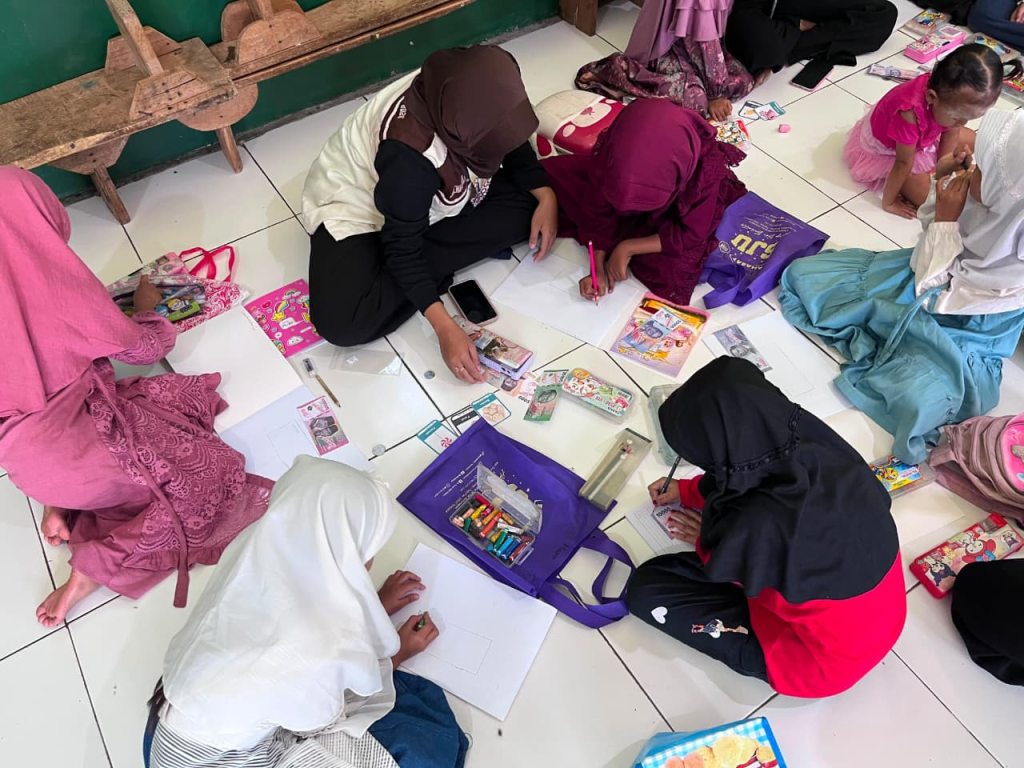
Overall, the third meeting of the Tunas Ngrembaka Literacy Corner went very well. Participants demonstrated active engagement throughout the learning process, grasped the basic concepts of financial literacy, and enjoyed a fun learning experience through an interactive and contextual approach. This activity demonstrated the commitment of the PPK Ormawa SGL PGSD Universitas Negeri Semarang to supporting the strengthening of basic literacy while instilling the values of edupreneurship from an early age to prepare a generation that is intelligent, independent, and creative, ready to face future challenges.
Through a series of meetings that continue to develop, from strengthening multilingualism to financial literacy, the Tunas Ngrembaka Literacy Corner further emphasizes its role as a comprehensive non-formal learning ecosystem, targeting not only cognitive abilities but also developing the character and life skills of the children of Podorejo Village. This activity is an integral part of the major effort of
NGREMBAKA AKSARA to realize Podorejo Village as a Sustainable Smart Village, in line with the spirit of achieving the Sustainable Development Goals (SDGs) at the grassroots level.
PPK ORMAWA SGL PGSD Semarang State University Together Empowering, Educating the Nation. Nurturing Literacy, Growing and Inspiring.