



Semarang, July 3, 2026 – In an effort to strengthen the implementation of the Independent Curriculum and improve the quality of lesson planning, SMP Negeri 35 Semarang held an In-House Training (IHT) themed “Strengthening Co-curricular Activities and Optimizing Learning Outcomes through Review of Learning Outcomes (CP), Learning Objectives (TP), Learning Objective Flow (ATP), and Learning Objective Achievement Criteria (KKTP)” on Friday, July 3, 2026, from 7:30 AM to 3:00 PM WIB in the SMP Negeri 35 Semarang Hall. The training focused on strengthening the linkages between CP, TP, ATP, KKTP, assessment, follow-up, and the development of meaningful co-curricular activities for students.
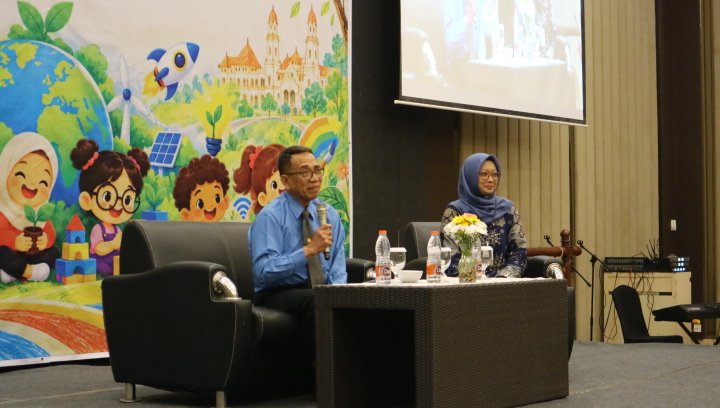
The event featured Muhammad Nazil Iqdami, M.Ed., a lecturer in the Educational Technology Study Program, Faculty of Education and Psychology (FIPP), Semarang State University (UNNES), as the main resource person. All teachers at SMP Negeri 35 Semarang attended the training as part of a program to strengthen their professional capacity in designing learning that aligns with the national curriculum policy.
In his presentation, Muhammad Nazil Iqdami emphasized that the quality of learning is not determined by the number of documents compiled, but rather by the extent to which these documents demonstrate a logical and consistent relationship between the competencies to be achieved, the designed learning experiences, evidence of achievement, and learning follow-up. He stated that teachers need to begin the planning process with a deep understanding of Learning Outcomes (CP), then translate these into operational Learning Objectives (TP), develop a systematic Learning Objective Flow (ATP), and develop Learning Objective Achievement Criteria (KKTP) that can be observed through authentic assessments.

The workshop was designed interactively, combining conceptual presentations, discussions, practice, peer review, and reflection. Teachers not only gained an understanding of the concepts of CP, TP, ATP, and KKTP, but also directly practiced developing learning materials based on their respective subjects. Through this practice-based approach, participants produced a product in the form of a lesson planning package consisting of CP review results, TP, ATP, KKTP formulations, assessment designs, and follow-up learning plans.
One important focus of this training was strengthening co-curricular activities as an integral part of the learning process. Co-curricular activities were no longer positioned as additional activities outside of class, but as authentic learning spaces that allowed students to apply learned competencies in real-life contexts. Thus, co-curricular activities became a vehicle for strengthening the achievement of learning objectives through cross-subject learning experiences, character building, contextual problem-solving, and collaboration among students. This approach aligns with the spirit of the Independent Curriculum, which encourages meaningful, contextual, and student-centered learning.
In the practical session, teachers were also encouraged to identify common mistakes in developing learning materials, such as equating learning objectives with learning activities, compiling ATP solely following the textbook sequence, or formulating KKTP solely in numerical form without describing the quality of achievement. Through discussion and peer review, participants collaboratively refined the design of the learning materials to make them more logical, operational, and aligned with the learning outcomes at each stage.
The principal of SMP Negeri 35 Semarang expressed his appreciation for this activity. He stated that the training provided new perspectives for teachers in developing higher-quality learning plans while strengthening the implementation of co-curricular activities in the school. The workshop’s results are expected to serve as a starting point for aligning learning materials among teachers, developing KKTP and assessment banks, and documenting good practices that can be sustainably developed within the school environment.
For Semarang State University, this activity is part of the university’s commitment to implementing the Tri Dharma Perguruan Tinggi (Three Pillars of Higher Education), particularly community service through strengthening educator capacity. Collaboration between universities and schools is a crucial strategy in bridging academic research findings with educational practices in the field, thereby significantly impacting the quality of learning.
This in-house training also contributes to the achievement of several Sustainable Development Goals (SDGs). This activity directly supports SDG 4 (Quality Education) by improving teachers’ professional competencies and strengthening the quality of the learning process. Furthermore, the collaboration between Semarang State University and SMP Negeri 35 Semarang reflects the implementation of SDG 17 (Partnerships for the Goals) through strategic partnerships between universities and educational institutions to develop human resource capacity. Furthermore, strengthening co-curricular activities that foster collaboration, creativity, environmental awareness, and contextual learning also supports the development of 21st-century competencies needed by students to face future challenges.
Through this activity, it is hoped that teachers at SMP Negeri 35 Semarang will be increasingly able to develop learning that is aligned, meaningful, and oriented towards student competency achievement. With more systematic lesson planning and integrated co-curricular activities, the school is expected to be able to provide a more relevant, adaptive learning experience that will impact the quality of education.