


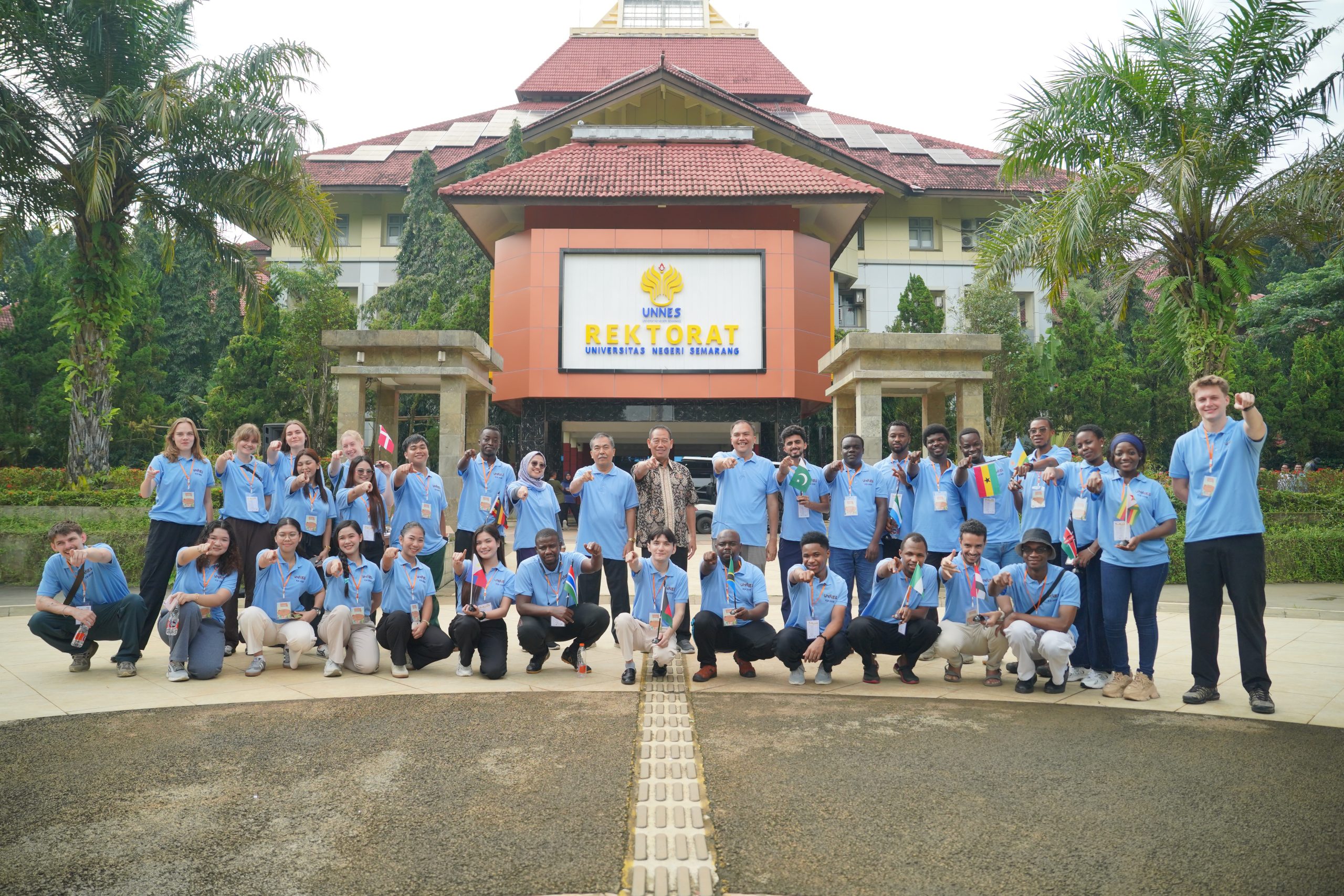
Universitas Negeri Semarang (UNNES) has once again demonstrated its commitment to sustainable development through the organization of the International Community Development (ICD) 2026 program. The initiative represents UNNES’ contribution to advancing the Sustainable Development Goals (SDGs).
ICD 2026 serves as a platform for cross-border collaboration, bringing together participants from 14 countries in a series of community-based service and learning activities. The program also promotes cultural preservation and environmental awareness.
Designed as a live-in program, ICD 2026 connects international participants with local communities through educational and social initiatives aimed at strengthening rural communities. Under the theme “Global Citizenship through Local Environmental Wisdom: A Sustainable Village Experience,” the program was held from 6–8 February 2026.
Head of the UNNES International Office and SDGs Center, Alfath Yanuarto, S.Kom., stated that ICD 2026 reflects UNNES’ tangible commitment to building global networks centered on sustainability and community empowerment.
“The diversity of participants’ backgrounds reflects the spirit of inclusivity and international partnership that UNNES continues to strengthen through collaborative programs. Participants not only engage in cultural activities but also take part directly in community-based learning that emphasizes sustainable practices and social responsibility,” Alfath remarked.
He further noted that ICD 2026 supports sustainable development through programs focused on quality education, community empowerment, strengthening local economies, and environmental stewardship.
Meanwhile, Chair of the UNNES EQUITY Program and Secretary of the University, Prof. Dr. Sugianto, M.Si., explained that ICD 2026 is supported by the Enhancing Quality Education for International University Impacts and Recognition (EQUITY) Program, a Government of Indonesia initiative aimed at improving the quality of higher education, strengthening global collaboration, and enhancing universities’ societal contributions.
“ICD 2026 provides a cross-cultural learning environment that strengthens international cooperation while generating positive impacts for local communities. I hope this program becomes a meaningful and memorable experience for all participants and further strengthens international friendship,” Prof. Sugianto stated.
Following the opening ceremony on campus, participants continued the program in Ngesrepbalong Village, Kendal Regency, the main site for ICD 2026. The village offers significant natural resources, cultural values, and local wisdom that support environmental and community-based learning.
Throughout the program, participants engaged in various activities, including an ecoprint workshop, tea blending class, janur (palm-leaf) weaving workshop, and a conservation-themed film screening. These activities enhanced participants’ awareness of environmentally friendly practices and sustainable living.
Participants also took part in forest and herbal plant learning sessions, nature activities in the Curug Lawe–Sicepit area, palm sugar production workshops, Javanese script classes, meditation sessions, and knowledge-sharing forums. These activities fostered contextual learning while supporting the preservation of local village potential.
On the final day, participants conducted community service by providing English language lessons for children and youth in nearby villages. This initiative was expected to foster an atmosphere of internationalization aligned with UNNES’ commitment to expanding global networks grounded in community empowerment.
Through this comprehensive series of activities, ICD 2026 is expected to strengthen UNNES’ contribution to sustainable development, particularly in advancing Quality Education (SDG 4), Decent Work and Economic Growth (SDG 8), Sustainable Cities and Communities (SDG 11), Responsible Consumption and Production (SDG 12), Climate Action (SDG 13), and Global Partnerships (SDG 17).
ICD 2026 brought together 35 participants from various countries, including Denmark, Belgium, the Philippines, Kenya, Zimbabwe, Afghanistan, Nigeria, Tanzania, Rwanda, Yemen, Uganda, Canada, Gambia, Sierra Leone, Pakistan, and Indonesia. The program also reflects the implementation of UNNES’ vision as a conservation-oriented university with a growing global reputation, realized through concrete action within communities.