
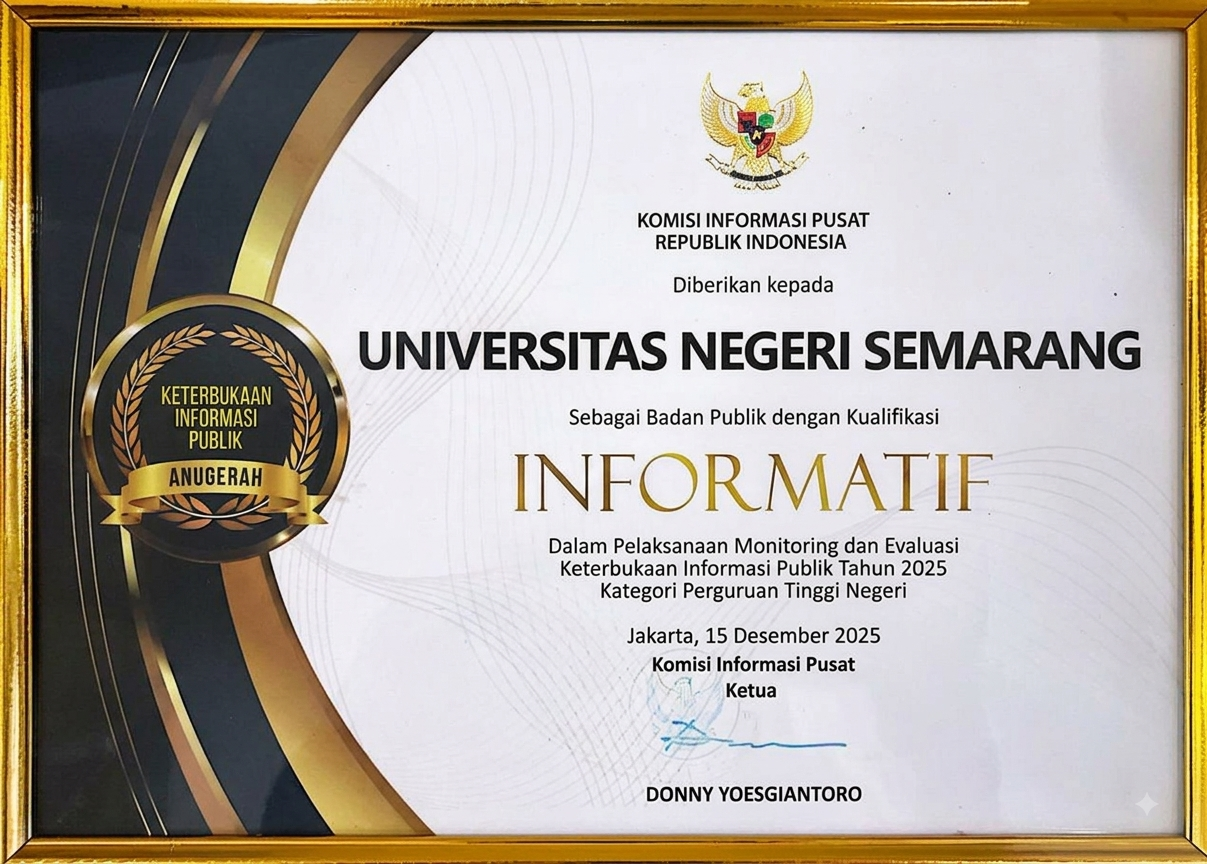
Universitas Negeri Semarang (UNNES) was ranked first in the Public University category in the 2025 Monitoring and Evaluation of Public Information Transparency. With a score of 98.87, UNNES achieved the highest level of public information transparency among state universities nationwide. This achievement reflects the University’s commitment to providing transparent, accountable, accessible, and responsive public information services.

Universitas Negeri Semarang (UNNES) was ranked third nationally in the University Category of the Jaringan Dokumentasi dan Informasi Hukum (JDIH) Awards. The recognition highlights the University’s commitment to maintaining a well-managed legal documentation and information system and to delivering professional, integrated legal information services that support transparent institutional governance.
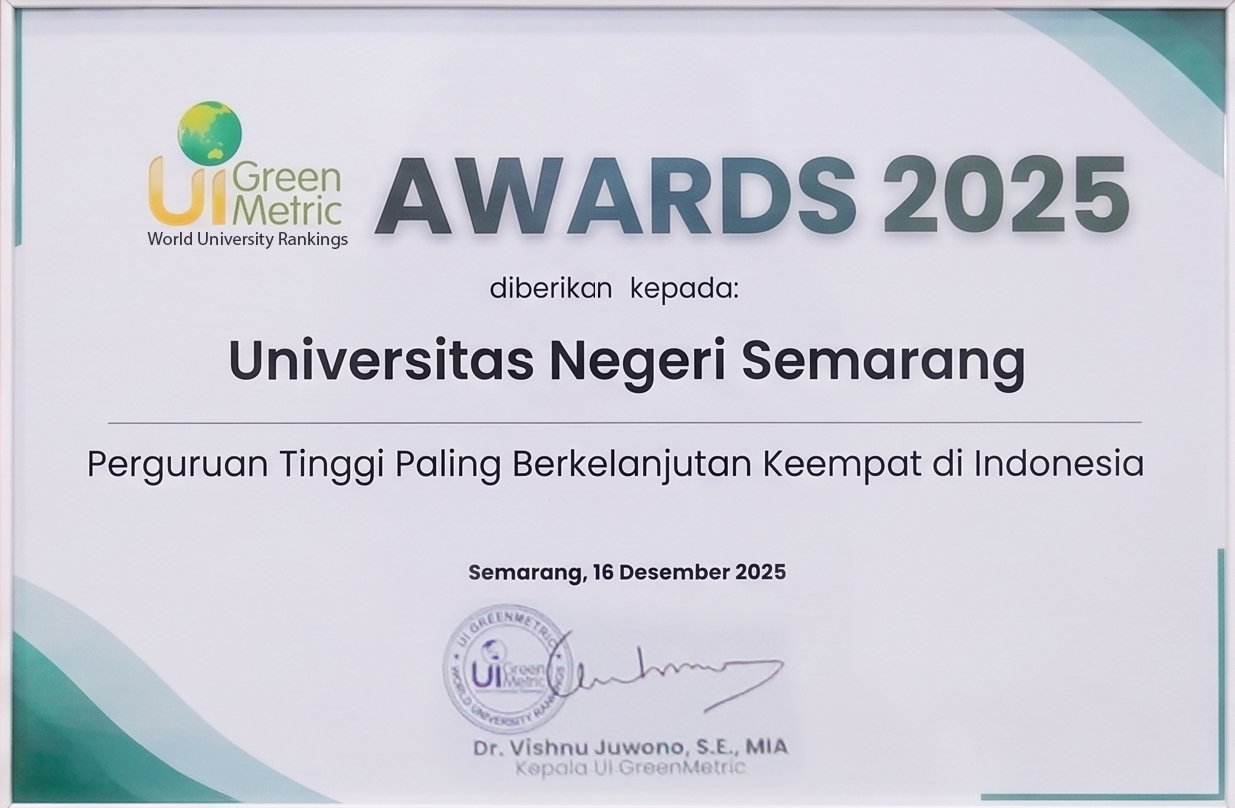
Universitas Negeri Semarang (UNNES) strengthened its position as a sustainability-focused university by ranking 4th nationally and 28th worldwide in the UI GreenMetric World University Rankings 2025. The achievement reflects the University’s consistent implementation of conservation and sustainability principles across campus infrastructure, energy, transportation, waste and water management, education, and research.
Strong public confidence in Universitas Negeri Semarang (UNNES) is reflected in the high number of applicants seeking admission to the University. In the 2026 National Selection Based on Achievement (SNBP), UNNES ranked fifth nationally among academic state universities with the highest number of applicants, attracting a total of 41,556 prospective students. The figure demonstrates the strong appeal of its academic programs and the University’s growing reputation as a leading higher education destination in Indonesia.

Student creativity and innovation placed Universitas Negeri Semarang (UNNES) among the top ten universities nationwide in the medal standings of the 2025 National Student Scientific Week (PIMNAS). UNNES teams secured two silver medals in the Presentation and Poster categories. The achievement reflects the University’s continued efforts to foster a strong student ecosystem for research, innovation, and community engagement.

The Faculty of Law at Universitas Negeri Semarang (UNNES) earned national recognition in the 2025 Top Indonesian Law Schools ranking by Hukumonline, securing sixth place nationwide. The achievement further strengthens the Faculty’s reputation as one of Indonesia’s leading law schools, supported by its academic performance, research, and growing alumni network.

The Psychology Program at the Faculty of Education and Psychology (FIPP), Universitas Negeri Semarang (UNNES), was ranked ninth nationally in the 2025 EduRank ranking for Psychology. The achievement reflects the program’s growing contribution to research and scholarly publications and its academic standing in the field of psychology in Indonesia.
Universitas Negeri Semarang (UNNES) received four awards at the 2025 Abdidaya Ormawa Awards, recognising the contributions of student organisations to community empowerment. The achievement highlights the effectiveness of the University’s student development initiatives in encouraging impactful, measurable, and sustainable community-based programmes, as well as fostering social innovation among students.

Universitas Negeri Semarang (UNNES) received recognition at the 2025 detikJateng-Jogja Awards as a Sustainable and Conservation-Oriented Campus. The award acknowledges the University’s consistent integration of conservation values into education, institutional governance, environmental management, and sustainability programmes.

Universitas Negeri Semarang (UNNES) received the Silver Award, placing second in the Halal Infrastructure Development category in 2026. The recognition highlights the University’s efforts to strengthen infrastructure and institutional support for the development of a sustainable halal ecosystem.
Universitas Negeri Semarang (UNNES) was placed in the 301–400 band worldwide in the Times Higher Education (THE) Impact Rankings 2026. The ranking reflects the University’s contribution to sustainable development and its efforts to generate positive social, economic, and environmental impact through education, research, institutional practices, and community engagement.
Universitas Negeri Semarang (UNNES) was placed in the 751–800 band in Asia in the QS Asia University Rankings 2026. This recognition reflects the University’s growing presence in the Asian higher education landscape and its continued efforts to strengthen academic reputation, institutional quality, and international engagement.
Universitas Negeri Semarang (UNNES) was included in the 1501+ band worldwide in the Times Higher Education (THE) World University Rankings 2025. Its inclusion reflects the University’s performance across key areas assessed by THE, including teaching, research, international outlook, and industry engagement.
Universitas Negeri Semarang (UNNES) was placed in the 601+ band in Asia in the Times Higher Education Asia University Rankings 2025. This recognition reflects the University’s continuing efforts to strengthen its academic and research performance and enhance its competitiveness within the Asian higher education landscape.
Universitas Negeri Semarang (UNNES) was placed in the 601+ band in the Times Higher Education Interdisciplinary Science Rankings. The ranking highlights the University’s efforts to foster interdisciplinary research and create an academic environment that encourages collaboration across different fields of study.
Universitas Negeri Semarang (UNNES) ranked 82nd in ASEAN in the AppliedHE Public University Ranking: ASEAN 2025. The ranking reflects the University’s presence among public universities in Southeast Asia, particularly in areas such as graduate employability, teaching and learning quality, and student experience.
Universitas Negeri Semarang (UNNES) was placed in the 1001–1020 band worldwide in the QS World University Rankings: Sustainability 2025. The recognition reinforces the University’s commitment to generating positive environmental and social impact through institutional governance, education, research, community engagement, and its longstanding conservation values.


