
UNNES Strengthens Waste Monitoring to Reduce Landfill Disposal

UNNES Strengthens Waste Monitoring to Reduce Landfill Disposal

SEMARANG – Universitas Negeri Semarang (UNNES) has established a campus-wide waste management policy that requires each university unit to sort, monitor, and report its waste. Through Circular Letter No. B/28401/UN37/RT.02/2024 on the Obligation of Waste Recycling within UNNES, the university sets out procedures for managing organic, inorganic, and hazardous and toxic waste (B3), with the aim of reducing waste sent to landfills.
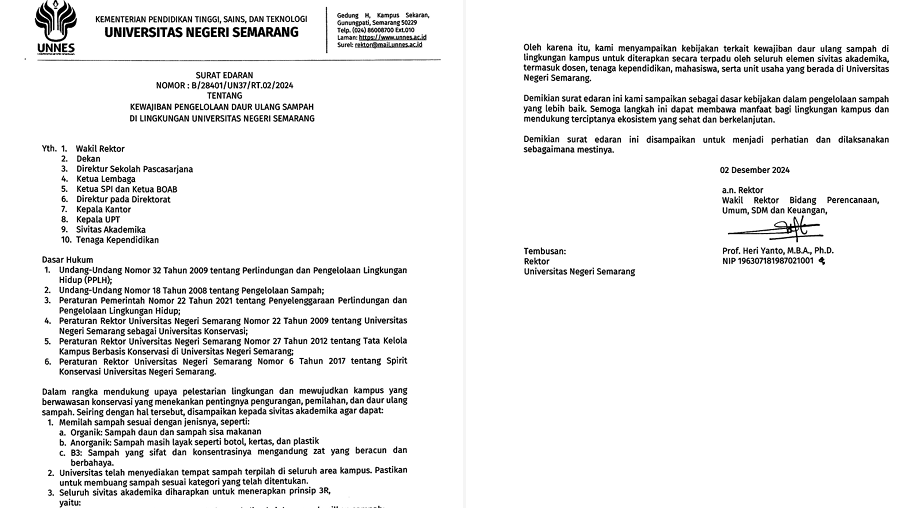
Rector’s Circular Letter B/28401/UN37/RT.02/2024. Source: https://jdih.unnes.ac.id/web/dokumen 

UNNES provide for each faculty and administrative unit is required to separate waste and report its management to the Conservation Development Unit. The policy also supports the measurement of recycling performance through waste weighing, data recording, and periodic reporting. These procedures provide a basis for tracking how much waste is generated, recycled, and diverted from landfill disposal.The policy requires every academic and administrative unit to classify waste into organic, inorganic, and B3 (hazardous and toxic materials) categories. 

Tracking Waste Generation and Processing
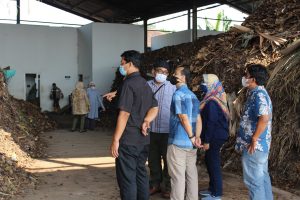
In 2025, UNNES recorded 4,275 tons of organic waste, comprising 4,217 tons of leaf waste, 36 tons of food scraps, and 22 tons of other organic materials. According to the reported figures, 4,211 tons of leaf waste were processed into compost, while food scraps were used as feed for black soldier fly (BSF) larvae, commonly known as maggots. The remaining 22 tons of other organic waste were reportedly processed through an incinerator.

The university also manages inorganic waste through recycling and material recovery. In 2025, 7.83 tons of hard plastic and 26.89 tons of soft plastic were shredded and sold as raw materials for recycling. Meanwhile, 7.83 tons of paper waste were sent to PT Pura Nusapersada in Kudus for recycling into paper products.

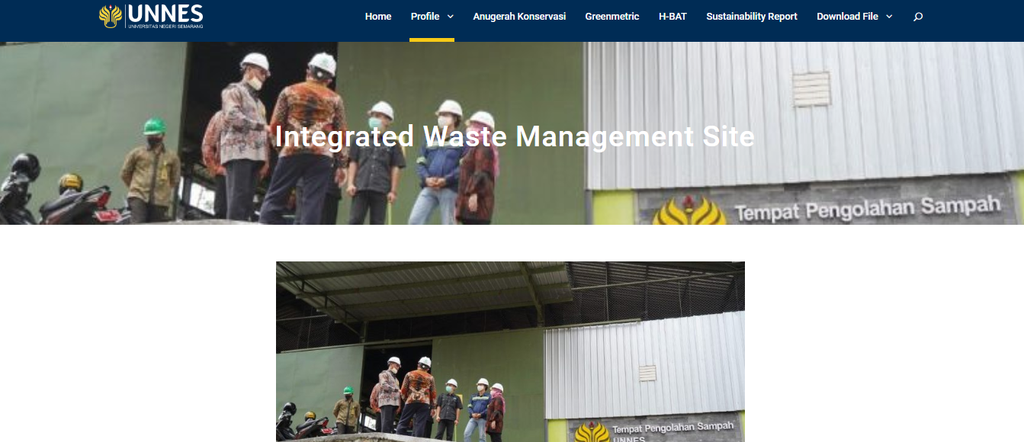
These activities form part of UNNES’s integrated waste management system, which processes organic materials into compost and maggot feed while directing recyclable materials to recycling partners. The university’s Integrated Waste Management Site (TPST), managed by the Conservation Development Unit, supports these activities and helps reduce the amount of waste requiring final disposal.
Measuring Waste Sent to Landfills

Measuring the amount of waste generated and processed is important for assessing how much waste is diverted from landfill disposal. UNNES’s published waste management policy describes a system of weighing recyclable materials, recording the results, and compiling periodic reports to evaluate changes in waste volume.

UNNES has also reported that it stopped sending campus waste to municipal landfills in 2020. This claim should be supported by current waste disposal records or confirmation from the university’s Conservation Development Unit, particularly to establish whether the practice has continued across all waste categories.

To strengthen the monitoring system, waste records should distinguish between the total waste generated, the amount recycled or processed on campus, the amount transferred to third-party recycling facilities, and any residual waste sent for final disposal. Such records would allow the university to report landfill diversion more clearly and assess progress over time.

Through its waste management policy and processing facilities, UNNES seeks to reduce waste disposal impacts and improve resource recovery. Regular measurement and reporting, supported by consistent records from each university unit, are essential to demonstrating the extent of this progress.

Related Posts

Leave a Reply

* Kode Akses Komentar:

* Tuliskan kode akses komentar diatas:

GDPR

  • Privacy Policy

Privacy Policy

At unnes.ac.id, the privacy of our visitors is of extreme importance to us. This privacy policy document outlines the types of personal information that is received and collected by unnes.ac.id and how it is used.

Log Files

Like many other Web sites, unnes.ac.id makes use of log files. The information inside the log files includes internet protocol (IP) addresses, type of browser, Internet Service Provider (ISP), date/time stamp, referring/exit pages, and number of clicks to analyze trends, administer the site, track user’s movement around the site, and gather demographic information. IP addresses and other such information are not linked to any information that is personally identifiable.

Cookies

unnes.ac.id uses cookies to store information about visitors’ preferences, to record user-specific information on which pages the site visitor accesses or visits, and to personalize or customize our web page content based upon visitors’ browser type or other information that the visitor sends via their browser.

Third-party ad servers or ad networks use technology in their respective advertisements and links that appear on unnes.ac.id and which are sent directly to your browser. They automatically receive your IP address when this occurs. Other technologies (such as cookies, JavaScript, or Web Beacons) may also be used by our site’s third-party ad networks to measure the effectiveness of their advertising campaigns and/or to personalize the advertising content that you see on the site.

unnes.ac.id has no access to or control over these cookies that are used by third-party advertisers.

You should consult the respective privacy policies of these third-party ad servers for more detailed information on their practices as well as for instructions about how to opt-out of certain practices. unnes.ac.id’s privacy policy does not apply to, and we cannot control the activities of, such other advertisers or web sites.

If you wish to disable cookies, you may do so through your individual browser options. More detailed information about cookie management with specific web browsers can be found at the browsers’ respective websites.

Consent

By using our website, you hereby consent to our privacy policy and agree to its terms.

Update

This Privacy Policy was last updated on: 2023-02-14. Should we update, amend or make any changes to our privacy policy, those changes will be posted here.

Contact Us

If you have any questions, comments, or concerns about our Privacy Policy or our practices with regards to your personal information, please feel free to contact us through the contact form on our website or by emailing us at humas[at]mail.unnes.ac.id.

This Privacy Policy is intended as a general guide to our practices in collecting and using information. If there is any inconsistency between this Privacy Policy and the terms of the Service Agreement or any other terms that may apply to specific services you use, then those specific service terms shall apply.

Terms of Use

By using our website, you agree to abide by this Privacy Policy. If you do not agree with this Privacy Policy, please do not use our website. We reserve the right to update this Privacy Policy from time to time without prior notice. Please review our Privacy Policy periodically to check for changes. Your continued use of our website following the posting of changes to this Privacy Policy means that you accept the changes.

Thank you for reading our Privacy Policy. We are committed to protecting the privacy of our website visitors and will continue to update our Privacy Policy to ensure optimal protection.